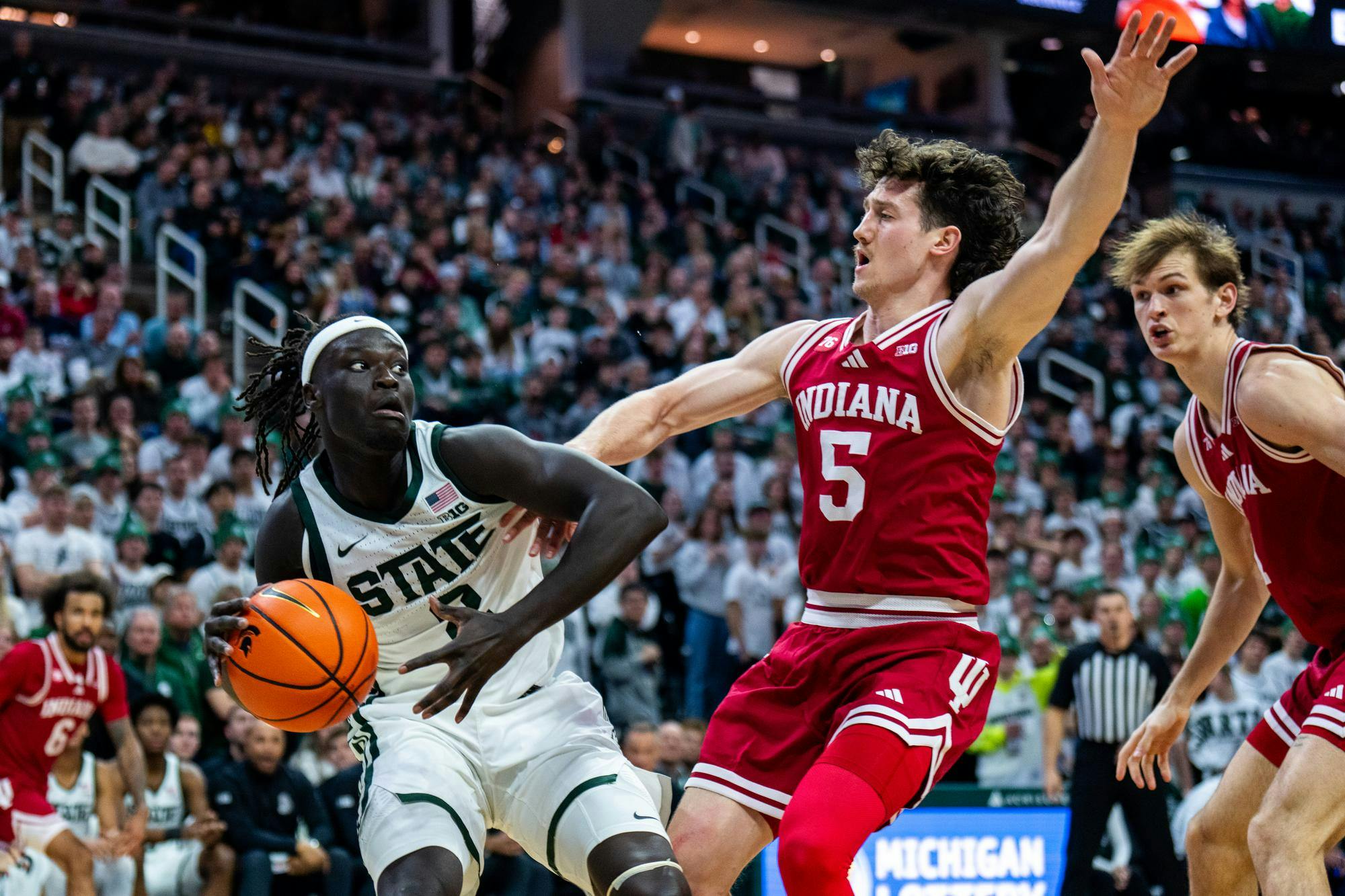
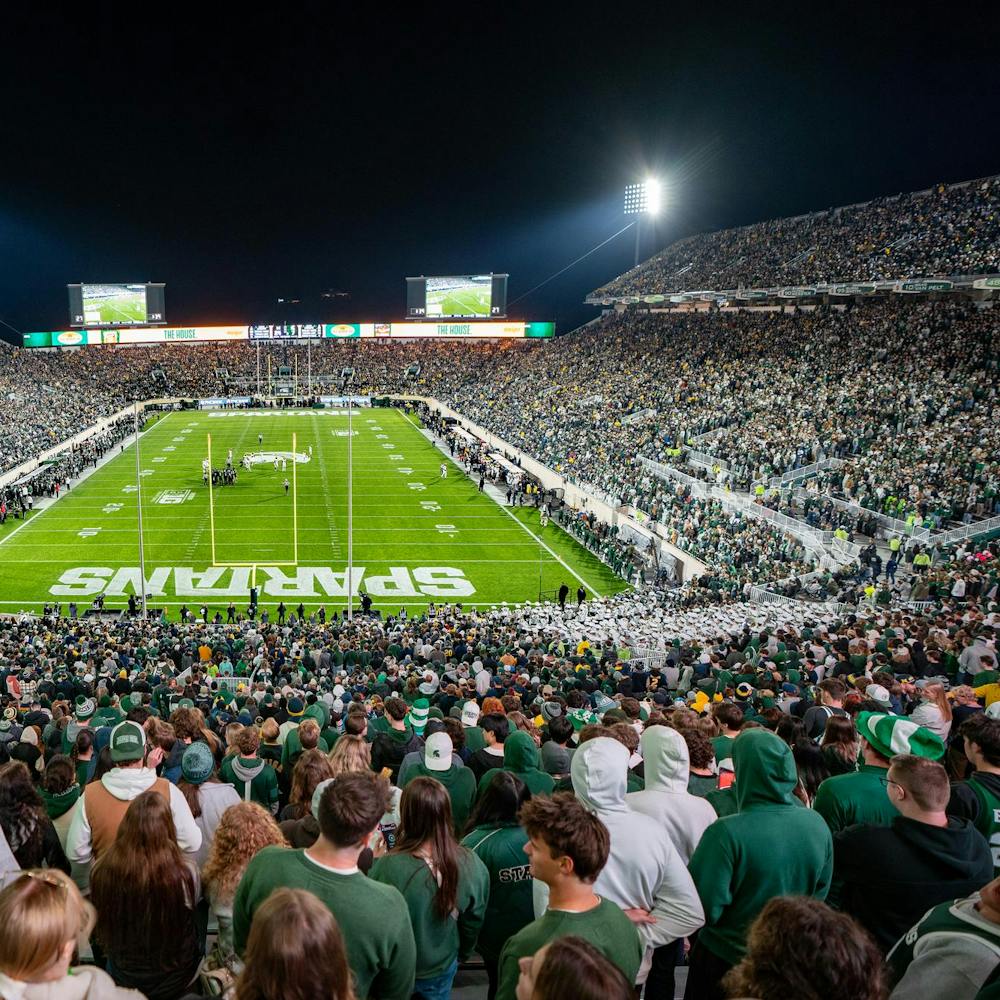
A typical East Lansing January is in full swing once again. North winds have turned campus into a frozen tundra of white snow and slick ice. Students trek to their new classes exposed to the elements, and Michigan State basketball is winning.
Now 17-2 (7-1 in the Big Ten) and coming off a demanding yet rewarding West Coast trip, the Spartans look to continue their reign of physical dominance against the Maryland Terrapins (8-11, 1-7), a team that has recently struggled with just about everything.
This season, the Terrapins have been an underwhelming team with an equally underwhelming style of play, a stark contrast from last year’s 27–9 Sweet Sixteen squad. The drop in success can be attributed to a coaching change and the loss of several players, leaving the program in a rebuilding stage—one that has placed Maryland in the lower half of many college basketball statistical categories.
Maryland is averaging 74.3 points per game (199th nationally) with a 50.4% rebound rate (162nd), while allowing opponents to score an average of 78.4 points per game (266th).
When playing ranked opponents, these stats drastically get worse. In six games against these ranked teams, Maryland’s front court has only scored 70 points per game while its back court has given up 93. It’s this statistic alone th at gives MSU a favorable shot at winning its 18th game of the year.
Despite its struggles, Maryland has still found ways to hurt teams with an aggressive, attack-the-basket offense and a quick, ball-pressure defense. Forward Pharrel Payne—the Terrapins’ leading scorer at 17.5 points per game while averaging 7.2 rebounds—will be a player Michigan State must limit, contesting his shots and matching his physicality in the post.
It’ll be a demanding matchup for the likes of MSU’s po st players, but a matchup they have not shied away from in the past.
Along with Payne, Terrapin guard David Coit has provided light to their overall dim season. The sharp-shooting talent is shooting 41% from beyond the arc this season, averaging 15.4 points per game. When left open, he’s a threat. When guarded, he’s a threat, too. For MSU to avoid having the headache of watching his three point attempts turn into three point conversions, the Spartan guards must latch onto Coit’s hip and play as physically as they did against Iowa’s Bennett Stirtz.
Much opposite of Maryland’s failure is MSU’s success. With the coming of the cold comes the consistent, physical and speedy Spartans who have shown no mercy for any team they’ve played this season. MSU has averaged 78.5 points per game (108th nationally) with a 59.6% rebound rate (2nd nationally), while allowing opponents to score an average of just 63.5 points per game (7th nationally).
Matching up against Maryland, it is clear the Spartans hold the advantage — they are more physical in the post, more aggressive at the top of the key, and more consistent overall. Ultimately, by the statistics, the record and everything in between, they are the better team.
But there’s one thing that has kept MSU from being a top-five team, and there’s one thing Maryland can exploit if it wants to give MSU a challenge: turnovers.
Like any sport, turnovers are part of the game. In baseball, there are errors. In football, there are interceptions and fumble recoveries. In basketball, there are turnovers. And as in any sport, the number of turnovers a team commits can make or break a game — or even a season.
Michigan State has learned this lesson. In its 58–56 loss to No. 7 Nebraska, the Spartans committed a season-high 21 turnovers, a statistic that ultimately cost them the game. That turnover rate against the Cornhuskers was no anomaly; it has been a recurring issue.
This season, MSU is averaging 12.3 turnovers per game, ranking 216th nationally.
It’s the Spartans fast pace and aggressive offensive tempo that triggers these turnovers, and it can be triggered at a higher level against Maryland, if they play aggressive and as fast as the green and white, limiting dribble drives, action in the post and fast break opportunities.
Maryland is forcing turnovers at the exact same rate MSU is committing turnovers. If it can’t put pressure on MSU, take the ball away at a high rate and turn defense into offense, then the Terrapins have a hard time upsetting the No. 10 team in the nation.
Maryland and MSU will tip off at noon on Saturday, Jan. 24 at the Breslin Center. This game will air on CBS.
Support student media!
Please consider donating to The State News and help fund the future of journalism.
Discussion
Share and discuss “Michigan State looks to clean up turnovers and hold off Maryland” on social media.