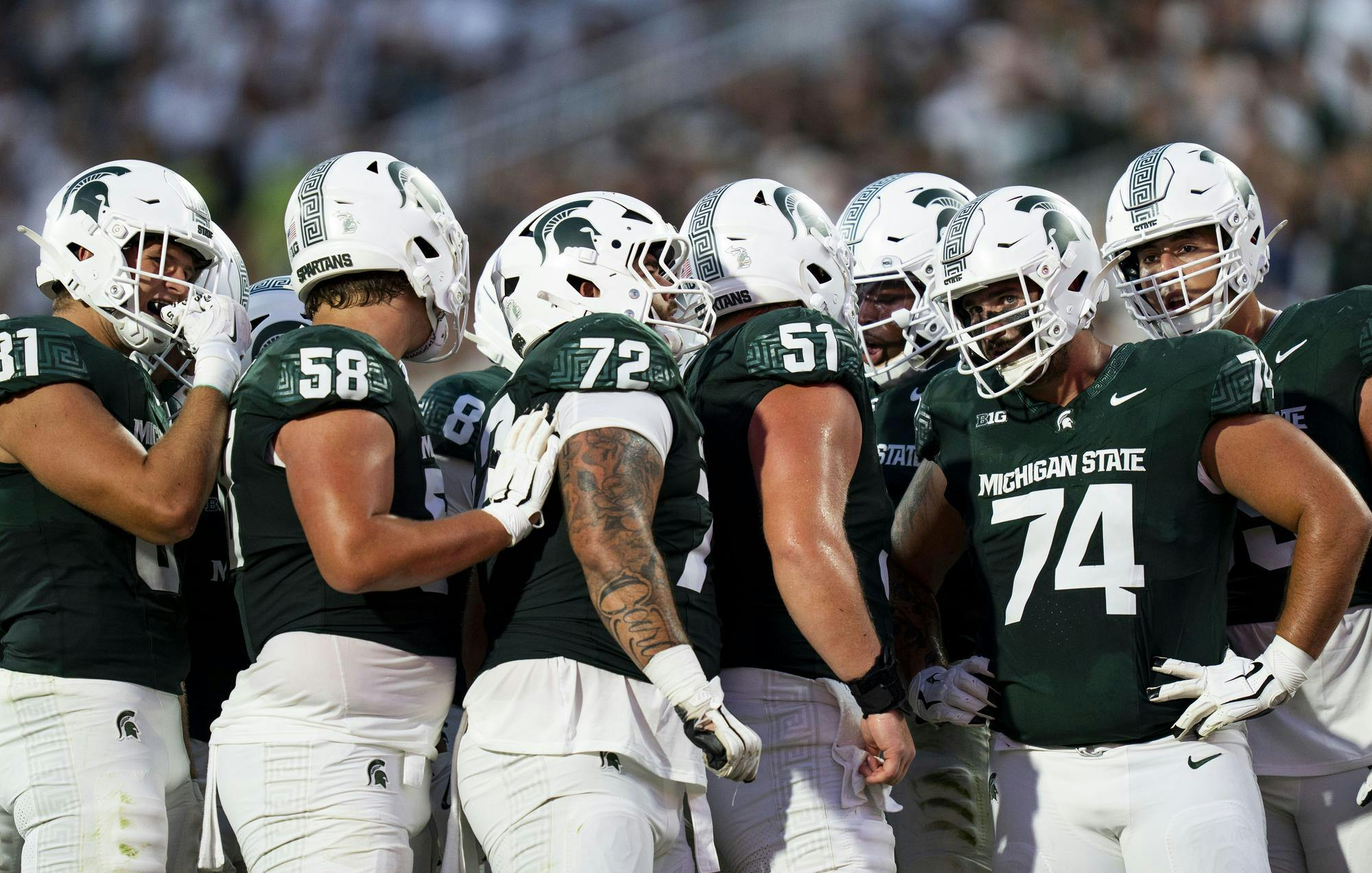
Trench warfare has been a losing battle for Michigan State football and its offensive line this season. Against Nebraska, the unit failed to generate any push. The same was true against USC. With UCLA and other future opponents looming, improvement up front is a must.
There are no holes to run through, no protection for the quarterback and none of the dominance expected from a Big Ten offensive line. Instead, opposing defenses are overwhelming the Spartans at every turn. To improve, something must change — and fast — because time is running out.
“We have to execute at a higher level, and that’s where we’re falling short,” Offensive Coordinator Brian Lindgren said. “We have to get our pass game going, and our run game as well.”
The first sign of struggle can be found when observing MSU’s rushing attack. On paper, the Spartans have not impressed, notching 182 carries worth 700 total yards (94th in the FBS) and 11 total touchdowns. Leading this impotent ground attack is Makhi Frazier, a sophomore running back, who has carried the ball 75 times for 325 yards, finding the endzone twice.
Averaging 3.8 yards per carry isn’t rock bottom, but it’s hardly a point of pride, either. In Michigan State’s case, it might be easy to blame the running back room for such underwhelming numbers. But by the eye test, the offensive line bears much of the responsibility — it simply hasn’t produced. The unit has struggled to correctly identify defensive personnel at the line of scrimmage, lost countless one-on-one battles, failed to reach the second level and hasn’t opened the space needed for running backs to succeed.
Not being able to block effectively – which leads to an inability to run the football – has taken away a key aspect of the MSU offense. The Spartans run the ball 36.4 times per game, making it clear that MSU wants to establish and control the ground game. Running effectively like the Spartans desires would help on first and second down efficiency, help open up the passing game and help blossom offensive success, but it’s something that’s impossible to do when minimal movement is displayed, when stalemates occur, when opposing colors are blowing up the Spartan backfield.
Such occurrences of substandard blocking have become something of a Spartan offensive tradition. This season, the MSU offensive line has allowed 8.4 tackles per loss per game. It’s the worst in all of college football.
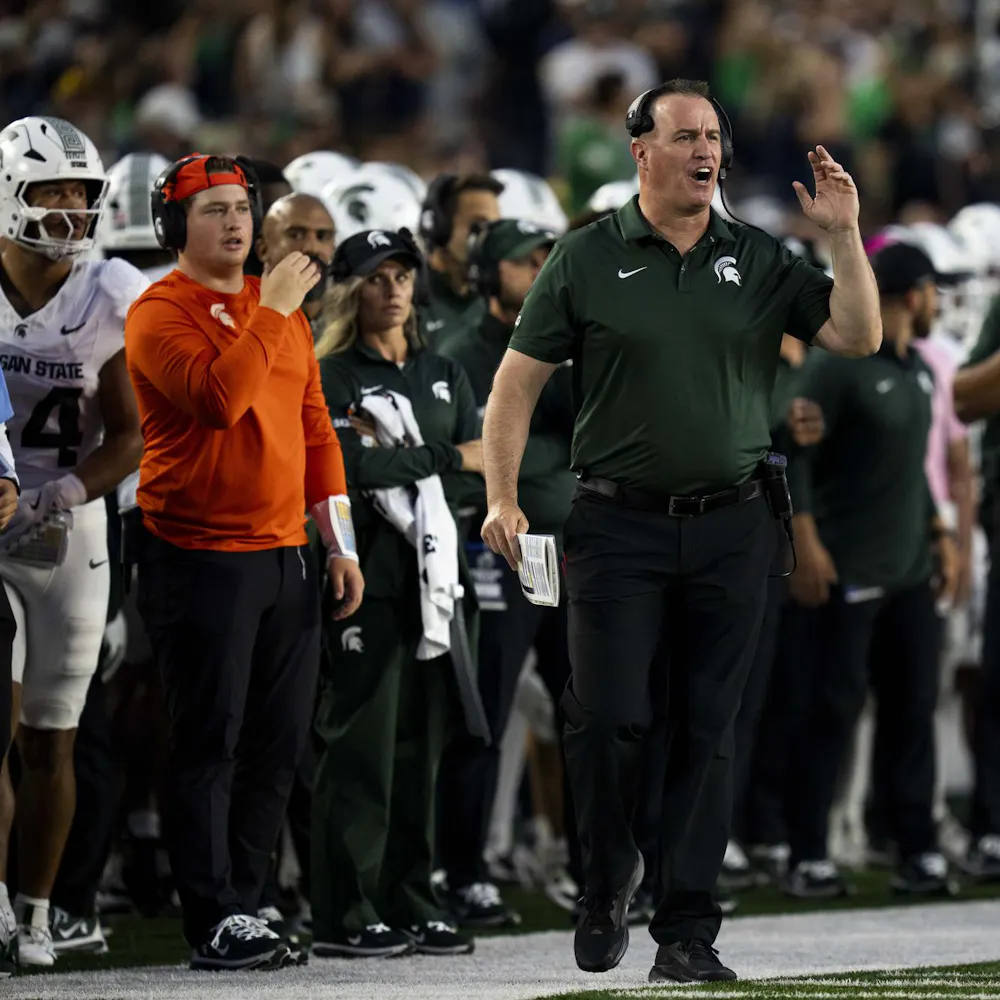
“It’s hard to go backwards,” Head Coach Jonathan Smith said. “We need to execute so we’re not fighting the sticks, because the sack problem has shown up along with some negative runs.”
From a pass protection standpoint, the offensive line efficiency has been no better. Junior Quarterback Aidan Chiles has faced constant pressure from every angle during every game, getting sacked 14 times (112th in the FBS) with 13 additional quarterback hurries.
If it weren’t for his swift legs and his ability to maneuver around defenders, those statistics may be higher.
The problem of insufficient pass protection is similar to the problems of run blocking: pre-snap identification issues and not enough one-on-one victories. The Spartans aren’t identifying who is set to bring pressure and who is dropping back into coverage, and when are identifying correctly, they’re either getting beat off the snap or being defeated in their one-on-ones.
All of this – the stats and the stalemates and the leakage in the backfield – has produced an inconsistent offense that's coming off of its worst game of the year. Against Nebraska, the Spartans and their offensive line couldn’t hold their own, allowing four sacks and 12 tackles for loss. All game, Chiles felt pressure, even when there wasn’t any to be felt.
What this Cornhusker pressure created was an uncomfortable, bumped and bruised quarterback that displayed visions of last year's unproductive season. To finish the game against Nebraska, Chiles went 9-for-23 with 85 yards and two interceptions, adding two rushing touchdowns on 23 yards.
“We need to continue to help [Chiles],” Smith said. “You think about the factors of protection, the lack of the run game, some of the down and distances we had. He did come back and have a couple of plays [against Nebraska] that reminded us of last year, in regard to him doing too much, movement within the pocket, moving his eyes a couple of times where he needed to trust the protection. And so again, he needs to go back to work, we need to play better around him.”
Trust between a quarterback and an offensive line is paramount to success. It’s something that’s built over countless hours of practice and work, and it’s something that’s enforced on Saturdays. As the season has rolled on for MSU and as its protection has broken down, this trust seems to be fading, and it’s something that Smith calls to reform.
“Whether [the offensive line] protects you or not on the previous play does not matter,” Smith said. “You go back to this trust idea. And this isn’t specific just to [Chiles], but to the whole group in regard to trusting each other to 'do their job so I can do my job’. All of us have to trust each other to do our jobs.”
What also plays into the offensive line's lack of execution is something that MSU can’t control: injuries. This season, the Spartan offensive line has already suffered long-term injuries to two starting linemen, one to sophomore Stanton Ramil who was injured against USC and the other to junior Luka Vincic who was injured against Youngstown State.
The loss of two starters on an offensive line that already had questions coming into the season is a blow MSU has yet to recover from.
Regardless of how this season has gone for the Spartan offensive line, MSU’s most consistent weakness still has time to grow and improve. It first starts this week against UCLA (1-4, 1-1), who’s coming off a stunning 42-37 upset against No. 7 Penn State.
Like MSU’s offense, the Bruins defense has not controlled the line of scrimmage. This season, UCLA ranks 126th in the FBS in sacks (five total), 130th in tackles for loss (3.6 per game) and 97th in total defense (392.8 yards per game). Against Penn State, it obtained one sack and six tackles for loss.
Support student media!
Please consider donating to The State News and help fund the future of journalism.
Regardless of these defensive stats, UCLA – coached by a new defensive coordinator and head coach – will still supply an aggressive matchup. To push back the blue and gold, the Spartans must play with trust, play effectively and play consistently.
“[UCLA] seems like they have new energy,” Lindgren said. “Those guys are flying around. It’s almost like looking at a different defense. They’ve changed their scheme, and their guys are playing with confidence. It’s going to be a challenge for us.”
The day Spartan lineman move bodies on a consistent basis is the day where MSU conquers victory upon victory. But for now, it just has to worry about beating 1-4 UCLA. On Saturday at Spartan Stadium, MSU and its offensive line will try to improve in a homecoming game against UCLA at noon. The game will air on Big Ten Network.
Discussion
Share and discuss “Spartan offensive line struggles has restricted MSU football from being its best” on social media.