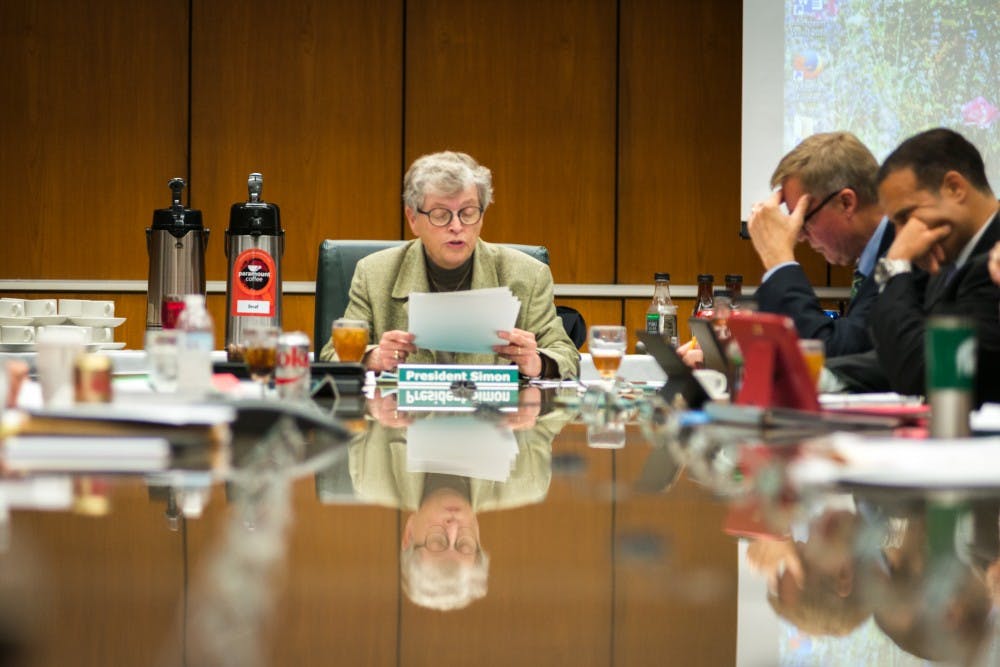
MSU’s Board of Trustees met Wednesday to set tuition and budget rates and unveiled new initiatives, including the proposed tuition freeze for the 2018-19 year and its new "Go Green, Go 15" program. Here are the top four takeaways from the meeting.
1. Tuition increase for the 2017-18 year
The MSU Board of Trustees raised tuition by an average of 3.3 percent for in-state students for the 2017-18 year. The increase in tuition marks the eighth consecutive tuition increase.
In-state lower division students, or freshmen and sophomores, will see a 2.8 percent increase in tuition for the upcoming year. Cost per credit hour will go up $13.25.
In-state upper division students, or juniors and seniors, will see a 3.8 percent increase and cost per credit hour will go up $19.75.
Out-of-state undergraduates will see a 4 percent tuition increase, which means out-of-state freshmen and sophomores will pay $50.50 more per credit hour and out-of-state juniors and seniors will pay $52 more per credit hour.
In-state and out-of state graduate students will both see a 4 percent increase in tuition. In-state graduate students will pay $28 more per credit hour and out-of-state graduate students will pay $55 more per credit hour.
2. New "Go Green, Go 15" initiative
Administration also announced a new initiative, titled "Go Green, Go 15." The new program, which will go into effect 2018-19, will freeze tuition at 2017-18 rates for incoming fall 2018 freshmen, so long as they take 15 credits for the semester.
The Go Green, Go 15 program, recently launched as part of MSU's Student Success Initiative, encourages MSU students to aim for an average of 15 credits per semester, completing 30 credits in their first year of study," according to a press release from MSU Media Communications.
Students are currently considered full-time students if they take a minimum of 12 credits per semester.
According to the Go Green, Go 15 website, a majority of students taking 15 credits per semester earn higher GPA's, taking 15 credits per semester will reduce college costs by up to $50,000 and taking 15 credits per semester will allow for more flexibility when it comes to studying abroad, dropping a class and taking internships.
The plan does not serve to rival the University of Michigan's recently announced "Go Blue Guarantee."
3. Other budget highlights
The 2017-18 budget shows a 2.5 percent general salary increase for faculty and non-unionized staff based on merit and a 0.5 percent increase for market adjustments.
$7.5 million will be allotted for academic competitiveness, student success analytics, campus Wi-Fi improvements, information technology and other initiatives.
With the move from coal to natural gas use at the T.B. Simon Power Plant, there was a 7 percent decrease in utility costs, which amounted to $4.2 million.
4. Coach contract extensions
Contracts were extended for Athletic Director Mark Hollis, men's basketball head coach Tom Izzo and women's basketball head coach Suzy Merchant.
Hollis' contract was extended to June 30, 2022. Izzo's contract was extended to June 30, 2024. Merchant's contract was extended to June 30, 2022.
Support student media!
Please consider donating to The State News and help fund the future of journalism.
Discussion
Share and discuss “4 takeaways from the June Board of Trustees meeting” on social media.