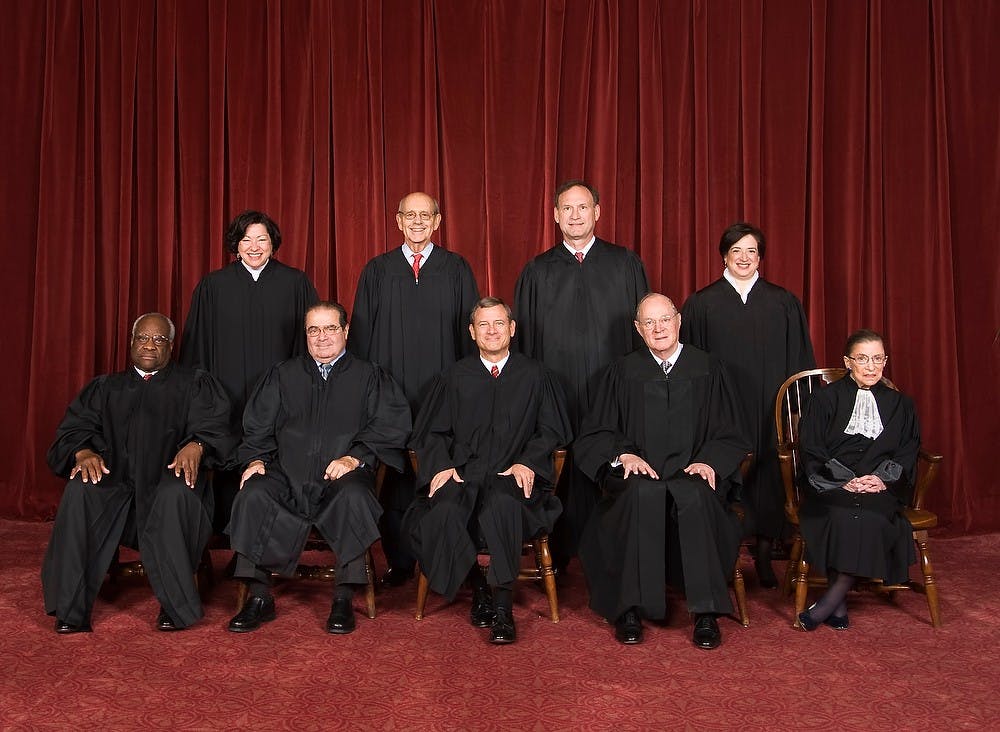
WASHINGTON — The U.S. Supreme Court heard arguments regarding Michigan’s ban on affirmative action policies in university admissions on Tuesday.
In the case, Michigan Attorney General Bill Schuette is challenging a lower court’s decision to overturn a statewide ban on affirmative action, which was approved by voters in 2006. Affirmative action advocates argued race-inclusive policies effectively achieve a diverse student body.
Both MSU and the University of Michigan have been named in the case because of their proximity. MSU officials previously acknowledged a drop in minority enrollment since the ban took effect, although they have hesitated to publicly favor of race-inclusive policies.
Supreme Court justices spoke today and questioned both sides of the argument. Here is some of their commentary on the case:
Justice Sonia Sotomayor

“Minorities finally get in, they finally have children and now their children are unable to get in,” Sotomayor said. “I don’t see how the argument is any different than segregation.”
Justice Antonin Scalia

“We want to take race off the table and treat cases without racial preference,” Scalia said. “Every classification of every proposal of racial classification is a racial classification. The 14th amendment itself is a racial classification.”
Justice Ruth Bader Ginsburg

“We can’t put hurdles in front a disadvantaged minority.”
Support student media!
Please consider donating to The State News and help fund the future of journalism.
Discussion
Share and discuss “Supreme Court justices speak on controversial affirmative action case” on social media.