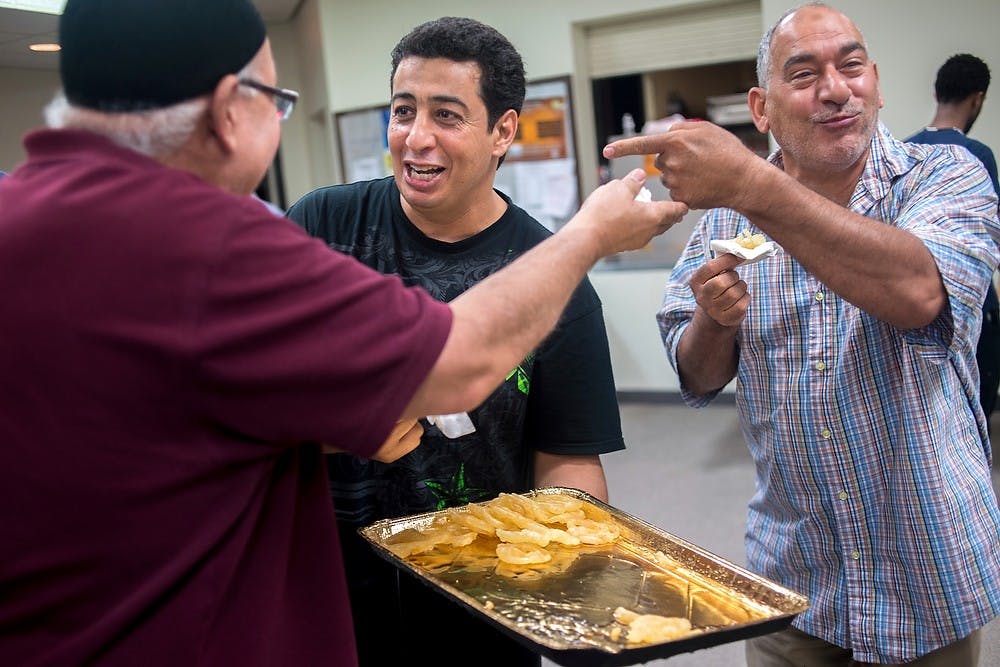
Amina Bahloul considers the Islamic Center of East Lansing, 940 S. Harrison Road, to be her second home. Islam is not just a religion for her. It is the essence of her community, a guide for whom she strives to be.
During Ramadan, an annual Islamic practice that lasts 29-30 days, nighttime is when Muslims truly revel in a shared community experience. Bahloul takes her faith to a whole new level in this month, often staying in the Islamic Center from dusk until dawn.
Bahloul and other Muslims have been working toward fulfilling deeds and accomplishments throughout the year, and the time has come to realize their full potential.
“(Ramadan is) kind of like game time for us,” Bahloul said.
Pillar of Islam
Mohammad Khalil, MSU associate professor of religious studies, said there are five pillars of Islam. The fourth of these pillars is fasting during Ramadan, which began this year on July 9.
“Fasting entails the following: abstaining from eating, drinking and sexual relations from dawn to sunset. Every day, those who are able have to fast,” Khalil said.
He added those who are elderly, sick or traveling are exempt from the fasting ritual.
The purpose of fasting is to attain taqwa, or God-consciousness, Khalil said.
“You’re conscious of God, you’re aware of God,” Khalil said. “Aware that God has given you food, given you drink.”
Each day, after the sun sets, fasting Muslims enjoy iftar, or breaking of the fast, which is traditionally broken with dates or milk. It is customary to take iftar with family and friends. Khalil added the fast becomes easier to handle with each progressive day.
Ramadan falls on the ninth month of the lunar Islamic calendar. Because of the contrast between lunar and solar calendars, Khalil said Ramadan falls at a different point each year with a 33-year cycle. This could potentially result in every Muslim having the opportunity to experience the Ramadans of both summer and winter in the course of their lifetimes.
Ramadan holds additional importance to all Muslims because it’s also the month the Quran, the Islamic religious text, was revealed, Khalil said.
“Fasting is just one aspect,” he said. “People will read more of the Quran than they normally read. Practicing Muslims are expected to pray (at least) five times a day. (During Ramadan), they’ll pray (more than) the five times a day.”
‘A month of cleansing’
Sawsan Mahmoud, a teacher at the Islamic Center of East Lansing and an Okemos resident, takes strong pride in her religion and finds that practicing Ramadan brings her spiritual peace.
“In Ramadan, all the evil, all the Shaytan, is locked,” Mahmoud said. “I’m a person who has (a) short temper. In Ramadan, I feel that I am more quiet. I feel that I am doing my prayer in a very special way.”
Mahmoud feels the serenity that is present during the month is proof they are genuinely doing what God wants them to do.
Bahloul, an MSU alumna, identifies Ramadan as a time to reinvent one’s self.
“It’s basically a month of cleansing — a month of physical cleansing, a month of spiritual cleansing,” Bahloul said. “It’s kind of like a rebirth, if you will. Going back to your original self, devoid of all your previous mistakes and starting anew. It means reconnecting with your creator, reinforcing that relationship.”
Support student media!
Please consider donating to The State News and help fund the future of journalism.
Doctoral student Zain Shamoon said he considers the hardest part of Ramadan to be maintaining that same God-conscious mindset throughout the year.
“I want it to be genuine, that we carry that throughout the year,” Shamoon said. “There is a distinction (in Ramadan), but not such that we’re not conscious of God throughout the year. That’s the hardest part: making sure that I’m not hypocritical.”
Shamoon added this Ramadan he has been thinking of holding his relationship with God higher than he holds other relationships, as a means of emotionally and spiritually nourishing himself.
“If I’m validated by God, all the relationships that come under God — I can celebrate as they come and go and come back,” Shamoon said. “Life is a process.”
A united community
The Islamic Center of East Lansing offers a large community iftar every Friday night during Ramadan. The halls of the center burst with people from sunset until dawn, when the fast must begin again. Prayers and religious lectures are all offered until dawn.
“(Ramadan is about) fostering that sense of community,” Bahloul said. “At these dinners, we’re able to see people that don’t normally identify themselves as Muslim come out of the woodwork. That girl that doesn’t necessarily cover, that brother that doesn’t necessarily pray — they’re all steadfast in their obligations during Ramadan.”
Susan Tomes, a Williamston, Mich., resident, studied religion for 20 years before converting to Islam. The diversity in worshippers that is apparent during Ramadan is important to her, she said.
“You see 40 or 50 countries of everyone together,” Tomes said. “You know it’s a worldwide religion, and it just has such power.”
Shamoon said he believes the shared element of fasting has profound effects on the community as well.
“Other people are fasting, too — not just from eating or drinking, but fasting from objectifying each other or fasting from talking ill about each other,” Shamoon said.” It’s a communal experience; we’re all doing it together.”
Bahloul said during Ramadan a youth group associated with the Islamic Center performs 10 Days of Service, during which they conduct community service at various locations in East Lansing and Lansing.
“I think giving back to the community … is what exemplifies Ramadan,” Bahloul said. “It’s the epitome of Ramadan. You’re benefiting somebody else.”
Ramadan will come to an end on Aug. 7 this year and Eid Al-Fitr, a major Islamic holiday, will occur the next day, Khalil said.
“Ramadan is more than just fasting,” Khalil said. “The whole point is to attain God-consciousness. The fasting is more of a tool. It’s not the end, it’s the means to the end.”
Discussion
Share and discuss “Praying the Price” on social media.