With Michele Bachmann down, they marched on to New Hampshire, where Romney landed a far more decisive victory with nearly 40 percent of the vote.
Now it’s on to the bigger states with more electoral votes and more weight: South Carolina, Florida and Michigan at the end of February. The most telling primaries likely will end up being midsized swing states, particularly North Carolina, Ohio, Indiana, Virginia and Florida, said Doug Roberts, president of MSU’s institute for Public Policy and Social Research. While Michigan went solidly for Obama in 2008, any of these states could go either way.
So far, Michigan-born Romney has gained momentum and now is the front runner the other candidates are looking to tear down.
Still, the youth vote might have not fallen one way or the other.
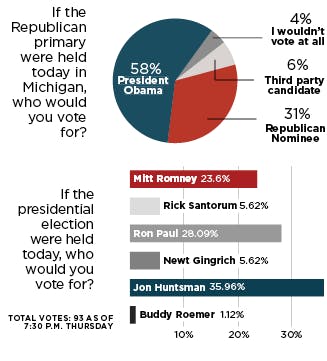
In a State News reader poll conducted this week, 58 percent of the 93 respondents said they would vote for President Barack Obama over the Republican nominee no matter which candidate is chosen.
Within the Republican field, the poll showed favor for Jon Huntsman, with 35 percent of voters supporting him. These results diverge from the primaries, where Huntsman came in dead last in Iowa and third in New Hampshire.
The Republican candidates now have slightly more than six weeks to make their case for Michiganians before the Feb. 28 vote.
Ron Paul
As the New Hampshire primary results began to roll in Tuesday evening, the East Lansing campaign to elect Ron Paul hunkered down at Reno’s East on Abbot Road to talk strategy. The primary, in which Paul ended up solidly taking second place, proved to many his viability as serious candidate.
Similar to a libertarian platform, Paul has campaigned on cutting $1 trillion in federal spending the first year of his presidency and an audit of the Federal Reserve in an attempt to stabilize inflation. Part of his platform includes cuts to federal assistance in education. At a debate at Oakland University in Rochester, Mich., in November 2011, Paul said he would completely eliminate the Federal Student Loans program.
“The policy of student loans is a total failure,” Paul said, adding he would put an end to the entire Department of Education. “They cause higher prices, lower quality.”
The Youth for Ron Paul movement at MSU appears to be the only campaign for a Republican candidate on campus. The East Lansing group plans to begin canvassing neighborhoods Sunday.
For economics junior Ethan Davis, leader of the Youth for Ron Paul, Paul is the one candidate who will preserve the country for the current college generation to thrive in. Most notably, Davis said he is attracted to Paul’s “noninterventionist” policies.
“A lot of other Republican candidates are pushing for a war with Iran right now,” Davis said. “It would absolutely wreak havoc on the economy.”
Not surprisingly, Davis isn’t alone in his economic concerns. In the State News reader poll, about 46 percent of respondents said jobs and the economy were the most important issue for them in the upcoming elections, and 32 percent cited fiscal policy.
“I’d definitely say I’m not in the Republican mainstream,” Davis said, adding he knows quite a few libertarians who have become Ron Paul supporters.
Paul is anything but a mainstream Republican. Although he has been a Republican congressman in Texas for more than 30 years, he ran in 1988 as a libertarian candidate for president and held his own convention separate from the Republican party in 2008.
Mitt Romney
On a whim, Nick Kowalski boarded a greyhound bus near his home in Oakland County, Mich. Twenty-two hours later, including a night spent in the Chicago bus station, he was in Des Moines, Iowa, making calls for the Mitt Romney campaign.
Kowalski hoped wins in each of the tiny caucuses would be a catalyst, eventually leading to the first Michigan-born man in the White House in nearly 40 years.
“They were really after a top-three victory, and with an official victory as it stands, it was icing on the cake,” said Kowalski, who also is the founder of the MSU Campus Conservatives, an offshoot group who feel the Republican mainstay has strayed from its traditional conservative message. “The momentum is really on our side.”
Support student media!
Please consider donating to The State News and help fund the future of journalism.
Romney was born near Detroit. His father George Romney was a popular moderate governor during the 1960’s — the building that houses the governor’s office in downtown Lansing is named after him — and he made an attempt for president in 1968, which never materialized. Richard Nixon ended up getting the nomination that year.
“I care about this state, I guess like no one else on this stage,” Romney said in November 2011 at a debate at Oakland University in Rochester, Mich. “I’ve seen this industry, and I’ve seen this state go through tough times.”
Romney went on to start his own political career, culminating when he served as the governor of Massachusetts from 2003-07.
Romney has been popular in Michigan throughout this election cycle. He won the Michigan straw poll with a 51 percent win in September 2011, while he was on Mackinac Island, Mich., for the Republican Leadership Conference.
But at MSU, Romney might not be as popular in the Republican field. In The State News reader poll, Romney placed second behind Jon Huntsman, with about 23 percent of the vote compared to Huntsman’s 35 percent and Ron Paul’s 28 percent.
Romney has been praised by supporters largely for his work in the private sector, where he started several companies including Staples, the now-mega office supply store. Romney campers say a president with such a business background will be more adept in putting the economy back on track.
At the same time, he’s been bashed by some far-right conservative for what they say are too-liberal policies, including a health care plan they say bears an uncanny resemblance to that of President Obama’s.
Rick Santorum
Former senator Rick Santorum wasn’t Brenton Craggs’ first choice for the Republican nomination.
In the beginning, Craggs, a medical technology and political science senior, was a Herman Cain supporter. That is, before Cain proved he wasn’t as Teflon as Clinton, crashing and burning after multiple accusations of sexual harassment poisoned his campaign (although Craggs said he didn’t agree with Cain’s decision to quit).
So, Santorum is the next best thing, as he embodies the values Craggs thinks a good conservative should.
“He seems to be one of the more pro-small government people,” Craggs said.
Santorum has been pegged as one of the most socially conservative candidates, championing the family structure as a unit of strength throughout his political career. As a Pennsylvania senator, he supported an education system that would leave open room to teach intelligent design.
When it comes to higher education, Santorum said the government shouldn’t be in the picture.
“There are higher and higher loan costs and more and more inefficiencies in a system that has become bureaucratic, costly and too heavily subsidized by the federal government,” Santorum told The State News in November 2011. “College is a place where you go to prepare for work, not extend your high school years.”
Santorum said he would support an end to federal student loans — not immediately but “certainly phasing it out for colleges and universities to get their act together,” he said.
Santorum also has said he supports strong national defense, including the possibility of taking action against Iran for their nuclear weapons program.
Jon Huntsman
Mathematics and physics freshman William Penn is tempted to vote for Jon Huntsman but said he wouldn’t dare do it.
He likes some of Huntsman’s core views, such as his foreign policy influenced by his time as an ambassador to China under President Barack Obama and his idea to put term limits on Congress in order to stop a “revolving door effect.”
Similar to 51 percent of respondents in the State News reader poll, Penn identifies as a liberal. And, reflecting most respondents as well, Penn said he thinks Huntsman is the best candidate in the 2012 Republican Presidential lineup.
But he’s afraid if Huntsman were elected, he would bend his views toward the mainstream Republican party, cutting education funding and passing pro-life legislation.
Therefore, Penn said he plans to support the president in November’s general election.
Huntsman carries a far more unique résumé than most of his Republican rivals. Descended from a long line of Mormon leaders, Huntsman dropped out of high school to play keyboard in a rock band. He eventually gave up on that plan to earn his G.E.D., later graduating from the University of Pennsylvania.
Fluent in Mandarin Chinese, Huntsman left his post as governor of Utah to serve as a Chinese Ambassador in 2009 after being appointed by Obama.
Repeatedly citing a “trust deficit” in the country, Huntsman has been an advocate of repealing Obama’s health care package and also has criticized the president and Gov. Rick Snyder for bailing out the Detroit automakers in 2009.
“This country is never again going to bail out corporations,” Huntsman said at the November 2011 debate in Rochester, Mich. “What we have is Washington and an administration who doesn’t like business.”
Discussion
Share and discuss “Who's your Man?” on social media.