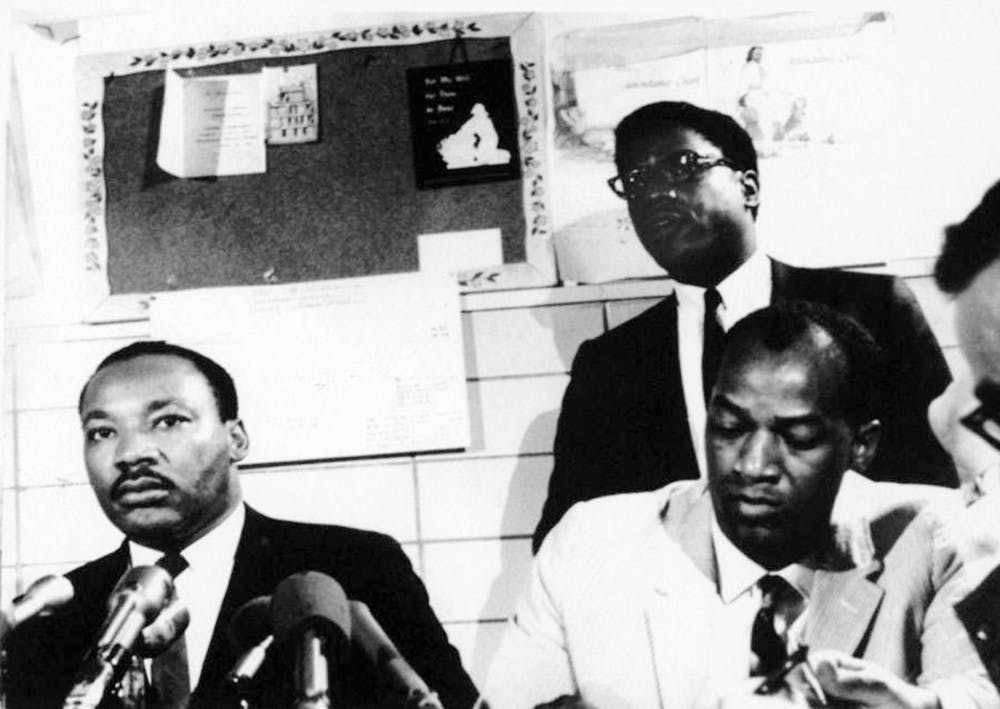
Robert L. Green remembers the day vividly — he got hot tea and a lemon for Martin Luther King Jr. before the civil rights leader spoke to a standing audience in the Auditorium’s Fairchild Theatre.
“It was a very positive moment for MSU and a very positive moment for the nation,” said Green, who became the first dean of MSU’s College of Urban Development in 1973.
King visited campus Feb. 11, 1965, to speak about the MSU-initiated Student Educational Project, or STEP, which was the first all student-run educational outreach program of its kind in the U.S.
The program sent student and faculty volunteers to assist elementary and secondary students in Holly Springs, Miss., in developing their skills in drama, art and music.
A friend and co-worker of King’s, Green had invited the civil rights leader to speak at MSU about the program. Green said King was accepted by the MSU community in a very strong way.
“He spoke at the old auditorium, and it was packed,” Green said. “The social and political climate at MSU was at an all-time high. Students were very active in the civil rights movement.”
After meeting King in San Francisco during the bus boycotts of 1955, Green worked alongside him from 1965-67 as the education director of the Southern Christian Leadership Conference, or SCLC.
While with the SCLC, Green worked out of Atlanta, Ga., and fought to educate children in the South, primarily through literacy programs.
“Part of our focus was teaching kids how to read and write,” Green said. “But it was also about fairness — fighting for fairness for all, including poor people.”
Green said King fought for those who lived in poverty, regardless of their skin color, and pointed to King’s Poor People Campaign, which aimed to help low-income people with jobs and housing.
Green said King, who was assassinated about three years after his visit to MSU, spoke to people about challenging racism and not backing down.
“He was a very honest, very committed person,” Green said. “He was committed to human rights and not afraid — not afraid to challenge racism and racial segregation, no matter where it existed in America.”
Green, who now lives in Las Vegas, said the recent assassination attempt of U.S. Rep. Gabrielle Giffords, D-Ariz. has reminded him of King’s message and the violence minorities faced during the civil rights movement.
“The kind of violence we saw in Arizona — that’s a horrible thing, but what it calls me to reflect on is that blacks were faced with that type of violence on a day-to-day basis,” Green said. “We avoided (the violence) by walking a straight and strict line in segregation with rules that restricted us.”
Communication junior Rodney James said the straight and strict line that Green spoke of has been blurred because of people such as King.
“Back in the ‘30s, ‘40s and ‘50s, people would risk their lives just to walk to the polls and if they voted, they might have gotten beaten or possibly killed,” James said. “(King) helped people to
be brave and stand against that.”
James said having such an iconic figure on campus would be a unique occasion he’d speak of for years.
“I feel like it’d be a very momentous occasion for me, and for MSU as a whole,” James said. “That opportunity would be such a privilege — something I’d share with my children and grandchildren.”
Murray Edwards, director of the Office of Cultural and Academic Transition, said King would be pleased in some ways about the progress society has made, but said there still is work to be done.
“There’s been progress made — the president of the U.S. is African American and that’s progress in a sense,” Edwards said. “But there’s a gap with the haves and have-nots.”
Support student media!
Please consider donating to The State News and help fund the future of journalism.
Edwards said an indication of that gap is seen by looking at certain ways our society functions today.
“Look at our social services and our school systems — they are not served properly,” Edwards said.
Edwards said he believes King would look to students to help fight the injustice.
“I think (King would) want students to have a responsibility to contribute to the development and success of society,” Edwards said. “We have students that are coming to the campus to not only gain an education, but to take those skills back to benefit their own communities.”
Green said he believes King would appreciate some aspects of where we are today, but would not agree with the presence of the American military in different parts of the world.
“(King) would say, ‘Your health care bill is a good thing, your anti-discrimination bill that passed is a good thing,” Green said. “‘But we’ve got to bring peace to the world and we can’t do that by keeping troops in Iraq and Afghanistan.’”
Green said King’s message went beyond just promoting peace.
“He was not peaceful to the extent that he would just talk about peace,” Green said. “He was a peace activist. He did something about it in a continuing way.”
Discussion
Share and discuss “King’s visit to MSU remembered 46 years later” on social media.