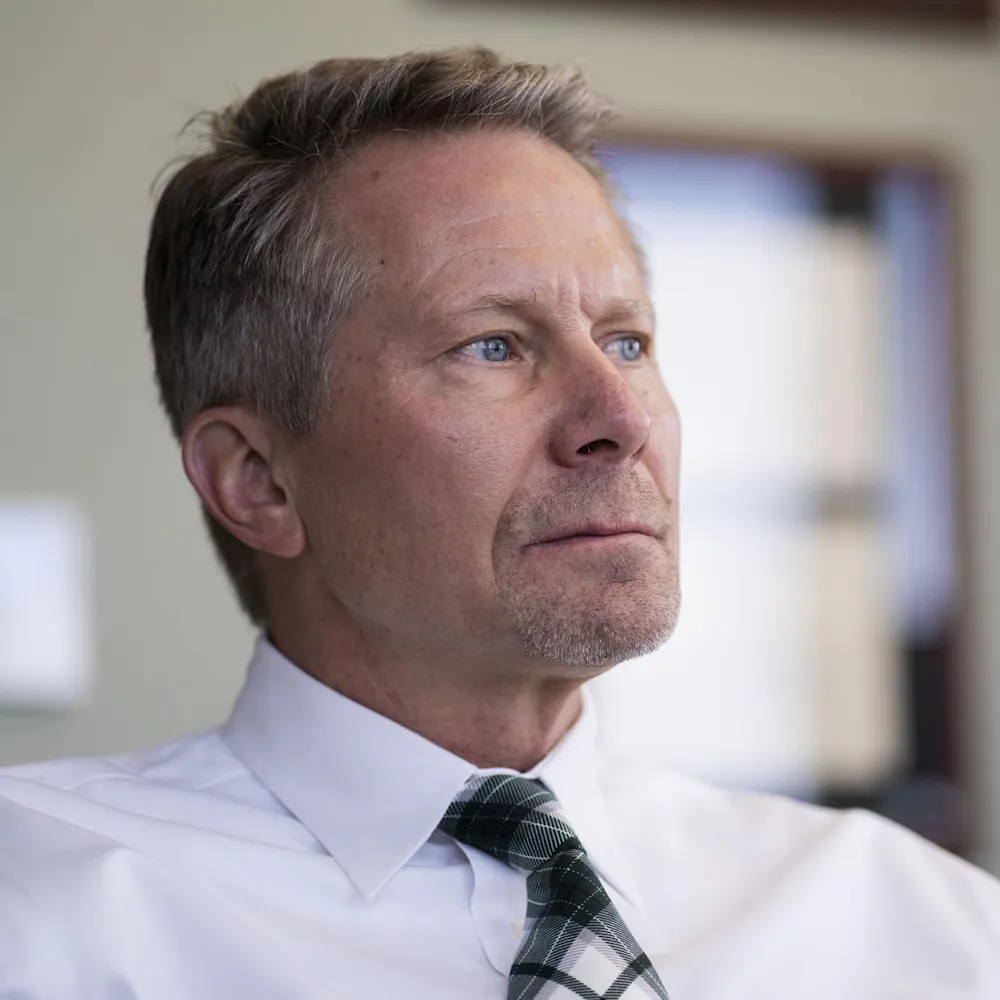
The reality of Hurricane Katrina hit Tom Wolff last week when he was in New Orleans.
"Being in the city of New Orleans is overwhelming to the senses right now," said Wolff, MSU's associate dean for engineering undergraduate studies. "You have 50,000 to 60,000 homes that are going to need to be bulldozed."
Wolff was in New Orleans from Oct. 8 until Friday as part of an assessment team looking at the six major breaches in the city's levees and what caused them.
Driving through the streets, Wolff said the feeling was surreal.
"Every main street and every single building or store had 3 to 6 feet of water in it," he said. "Some of the contents are piled up at street corners, at the curbs. You make a turn down the residential areas and every single house is water damaged.
"Many of them are absolutely gone," he said.
Pink teddy bears stuck in a tree and children's bicycles laying in the streets are evidence of the destroyed lives. Images of red Xs marking each house with a date and the number found dead inside still linger in his mind, Wolff said.
"As we go back and look at pictures, it will be more emotional than it was at the time," he said.
But while Wolff was there, he had a technical job to do — assessing the levees' failures. The American Society of Civil Engineers, a group from the University of California, Berkeley and the U.S. Army Corps of Engineers composed the assessment team that gathered evidence, made observations and took measurements in New Orleans.
"It is truly wonderful to have a faculty member who can contribute his expertise to addressing some of the problems the people are facing there," College of Engineering Acting Dean Satish Udpa said. "We want to rebuild New Orleans the right way. Not all people have the skills and talents that Tom has in the area of levees and dams."
Wolff was part of the American Society of Civil Engineers, which always sends an assessment team as part of its disaster response. Created in 1852, this professional society sends a team to look at the performance of critical infrastructures, like the levees, said Jill Dixon, the society's senior manager of external relations.
"We made pretty good conclusions on modes of failure," Wolff said. "Why they failed remains to be analyzed as more data comes in."
According to a report on their work, released by assessment team leader Peter Nicholson of the University of Hawaii, three levees overflowed because of floodwaters and were destroyed. However, three others had no evidence that they overflowed, but had still been breached, suggesting a structural failure.
The report also mentions that the assessment team will continue to gather data from New Orleans and use that data to draw more conclusions.
"This will be in public mind, whether it is a good idea to live below sea level," Wolff said. "Engineers can design to a very low risk, but you can never have a zero risk. You can have a failure with something else you didn't anticipate."
Wolff said the levees were designed to keep water out of the city and protect against a Category 3 hurricane, but with Katrina — a Category 4 hurricane at the time it hit — the levees were exposed to more risk.
"This will raise a lot of public debate how New Orleans in particular and society deals with structures that are exposed to risk and who pays," he said.
Walking the streets, Wolff and the team were surrounded not by locals, but by officials from the Federal Emergency Management Agency and the Environmental Protection Agency, working to rebuild the location.
"New Orleans is much bigger than Lansing," Wolff said. "It is hard to imagine if everything in Lansing was damaged. A few people are coming back to look at their homes and to find out what to do with them."
Wolff said he remembers finding a woman in the Ninth Ward and asking her what agency she was with. She replied that she was not with an agency, but was taking pictures of her sister's house, which had landed on top of a truck.
"I am looking face to face with a person whose sister lost everything," he said. "It is surreal. You are just in another world."
Currently, the U.S. Army Corps of Engineers is rebuilding the levees to their previous heights and strengths. Any structural changes would call for a congressional decision before they are made.
"There was some professional excitement in being able to contribute," Wolff said. "There was a sense of duty. The best way for me to be helpful is to put some engineering eyes on the situation."