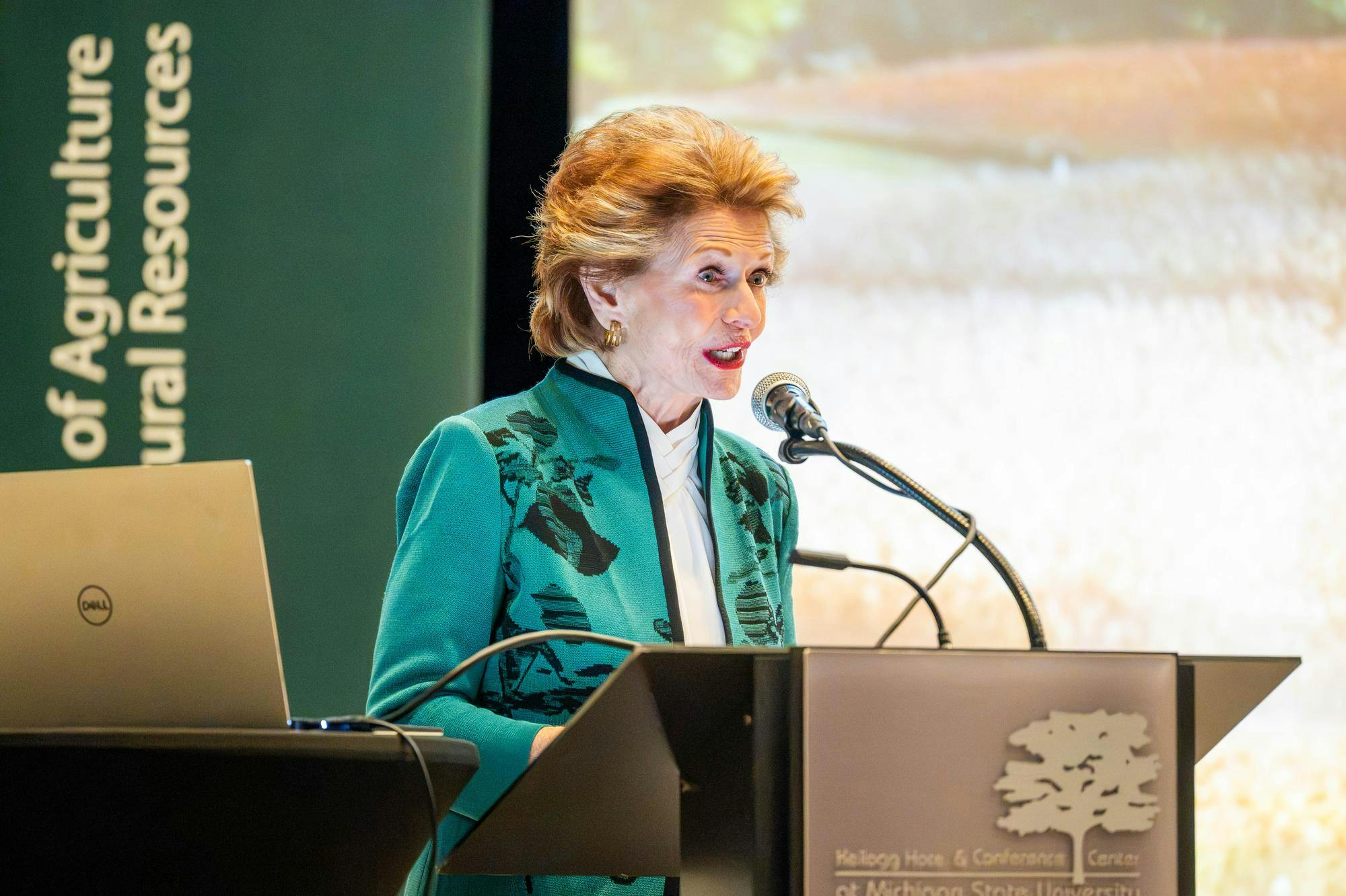
Former U.S. Sen. Debbie Stabenow pushed for improved agricultural legislation and restoring SNAP funding at the Kellogg Center on Wednesday.
The Stuckman Lecture Series is a College of Agriculture and Natural Resources initiative dedicated to fostering discussions on food systems with experts in agricultural policy and economics.
Stabenow retired from the U.S. Senate in 2025 and was succeeded by Elissa Slotkins, serving on the Agriculture, Nutrition and Forestry Committee from 2011 to her retirement. The former senator chaired the committee from 2011 to 2015 and from 2021 to 2025. She graduated with her bachelor's degree from Michigan State University in 1972 and a master's in social work in 1975.
At the event on Wednesday, Stabenow said everyone in the United States is involved within the food system, yet only a few understand it.
"Everybody eats. Nobody in this room or in this country is outside of the food system — nobody," Stabenow said. "And more than 40 million Americans cannot afford the food they need on a regular basis for their family."
That connection is the Farm Bill, legislation that contains a multitude of policies concerning agriculture, including rural development, crop insurance, commodity support and conservation programs among others.
The first Farm Bill was passed in 1933. An adjusted version of the bill passed every five years until 2018, when it was extended for eight years.
The 2014 Farm Bill was signed on MSU's campus by former President Barack Obama.
The 2018 Farm Bill is set to expire on Sept. 30, although legislators have struggled to approve its next iteration after Congress rejected the proposed adjusted Farm Bill last year.
That wasn’t a "true Farm Bill," Stabenow said, due to features, such as SNAP, being removed or remodeled as a result of the One Big Beautiful Bill.
Stabenow said that if Congress wishes to pass an adjusted bill, they should find common ground in valuing the needs of the people.
"In my farm bills, I kept three goals," she said. "Keep farmers farming, keep families fed and keep rural communities strong."
As senator, Stabenow pushed for the continuation of the bio-economy, such as research pertaining to crop diseases, food health and quality, engineering drought-resistant crops, biofuel research and creating new markets. Stabenow lauded the agriculture research being done at MSU.
Now, Stabenow said legislators need to restore investments in SNAP education programs, enabling people to access to local produce and keep families fed.
"The farmer and the consumer are the same economy," Stabenow said. "The same system."
To keep rural communities strong, she also encouraged legislators to invest in rural hospitals, schools and small businesses. Stabenow linked increasing the living quality in rural America as an incentive for more young people to become farmers.
In her closing remarks, the former senator admitted that Farm Bills take lots of time and effort to complete, but the time that farmers work outlasts several cycles of these bills.
That's where universities like MSU come into play.
"Universities built to focus on big, long term challenges, and Michigan State has been leading that charge since becoming that first land grant (university)," Stabenow said.
Support student media!
Please consider donating to The State News and help fund the future of journalism.
Discussion
Share and discuss “Former U.S. Sen. Debbie Stabenow pushes restoring SNAP programs at MSU event” on social media.