Near the bridge by the main library, past Beal Gardens, a group of giddy students and instructors splash against the Red Cedar River current with their waders, buckets, nets and electrofishing gear at the end of a clear and warm day.
Onlookers come and go from nearby buildings to sit by the river, some reacting with confusion or disgust, others with curiosity or pride. Some individuals pass by without a second thought, while others go out of their way to question the river's health and the safety of the group walking in it.
Phoebe Bosch, an applied conservation biology junior and president of the Fisheries and Wildlife club, said that each time they’re out on the water, at least one person comes up to them asking, “Is that safe? I thought the river was dirty,” to which they try to politely explain otherwise.
The Fisheries and Wildlife club’s activities mirror those of some ecology courses at MSU, providing a living laboratory for students, but its membership reaches far beyond the field, drawing students from majors like psychology and engineering. For Bosch, even a strong background in river ecology hasn’t exhausted the river’s surprises, and they deeply value helping students from across campus encounter it in new ways.
Professor of fisheries and wildlife Dr. Daniel Hayes said that although some students might have a negative perception of the river, once they get in and start to see how its ecosystem functions up close, their previous misconceptions are replaced by a newfound understanding of it.
“In their reflective essays, in their interactions after seeing the diversity of fish in the river, they’re just blown away,” Hayes said. “Their classmates might joke about the ‘dead cedar,’ or the ‘red sewer,’ but once they see the fish, they’re like, my gosh, this is much more vibrant.”
Not many universities can boast a river that stretches across campus. The Red Cedar River is a symbol of Michigan State University, contributing to its campus life and culture since the university was established. Some academic programs rely on it, student organizations revolve around it, and the school’s fight song opens with it: “On the banks of the Red Cedar— Is a school that’s known to all.”
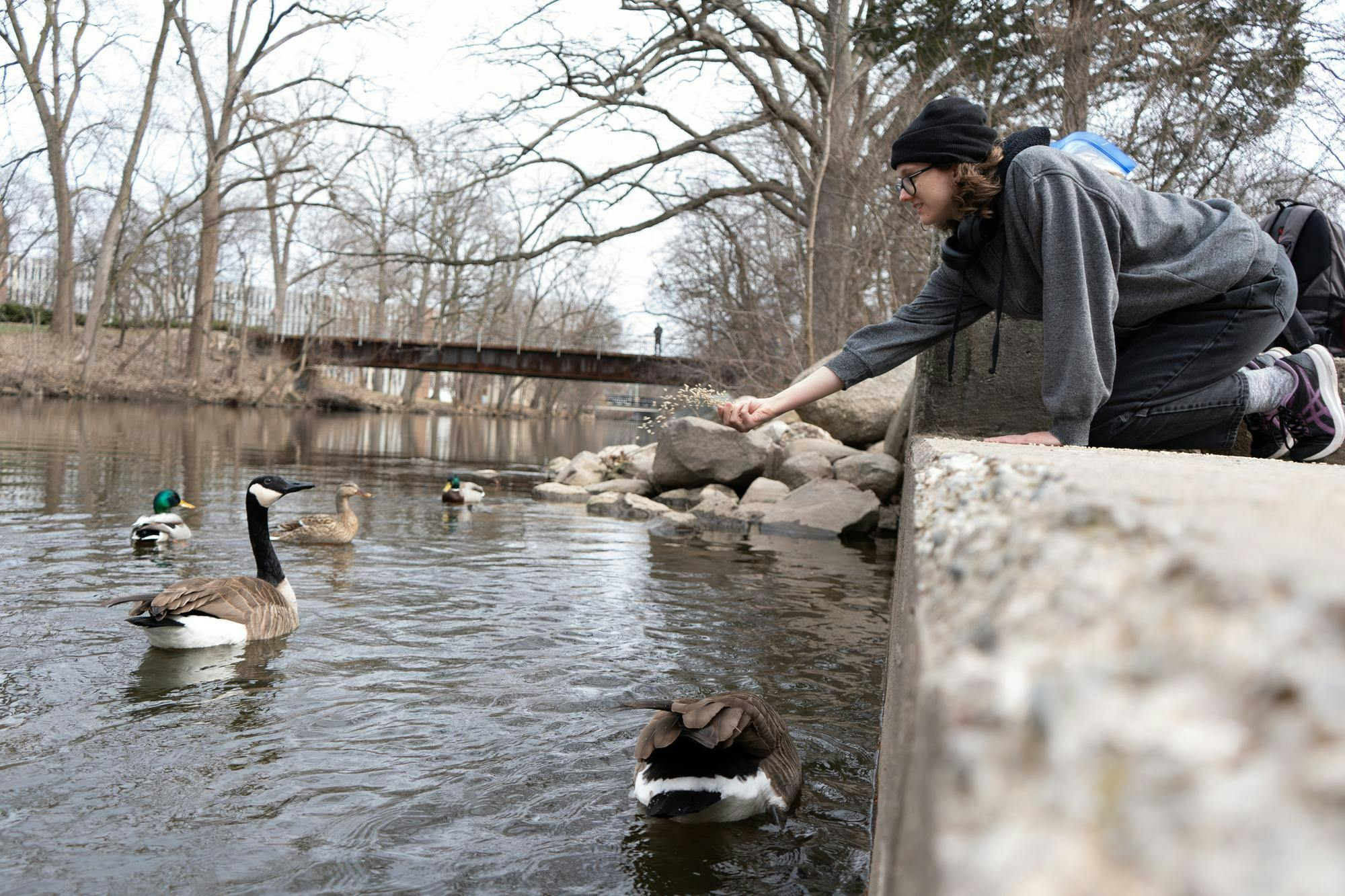
Across from the main library, near Wells Hall, students take breaks in their busy days to relax near the sound of the weir running nearby. Alexina Nelson, a sixth-year microbiology major, sat on the edge of the concrete terrace, throwing pellets to the ducks and geese in the river below as she spoke about her admiration for the river. When she was applying to schools, she said that having the ability to interact with wildlife as a bird lover really drew her to MSU.
“This campus stood out to me because of the surprising amount of nature. Having a central third space on campus that’s not only accessible for everybody, but is also nature oriented, I think, is really beneficial for the mental health of everybody, even if they don’t realize it,” Nelson said. “Seeing everybody out here, just watching everything, feeding all the squirrels and the animals, is really nice to see the community bonding in that way.”
Yet, for all its symbolic weight, the Red Cedar doesn’t always get the reverence it deserves. Some treat the river as an afterthought, leaving behind trash, dumping items into it, and overlooking the reality of its role as a living ecosystem. The river’s natural characteristics work against it— its murky reddish-brown color and seasonal flooding often fuel misconceptions and frame the river as a nuisance rather than a campus gem.
Many aquatic insects, which are sensitive to pollution, are found in abundance in the Red Cedar. The river runs dark, not due to pollution, but partly due to soil and partly due to organic material that gets dissolved from upstream. Yearly flooding is a result of building infrastructure too close to the river, Hayes explained.
“We think rivers should stay in their banks. But that is not how rivers work at all as an ecologist,” Hayes said. “I think humans can be arrogant. We think we run the world."
These misconceptions reinforce our view of the river as humans, Hayes observed, noting how oftentimes individuals look at the water, and initially, don’t see it the same way the organisms living in it do. Generally, no one is taught to, Hayes said, but she urged that it is something worth rethinking.
The condition and public perception of the river were much worse before the 1970s, though. After the Clean Water Act was passed in 1972, the green hue of the river faded, and the health of the river improved significantly; however, it wasn’t until recently that certain campus recreational amenities were approved, and long-needed restoration efforts began, which have fostered a new sense of shared responsibility and the cleanest rivers the area has seen in decades.
Michael Stout, president of the Michigan Waterways Stewards and a MSU 1983 alumnus, said that he never really thought about the river as a student here. The Red Cedar was something he passed over every day and didn’t care much about, but now, his life is filled with it. He recalls coming back to campus throughout the years for various parties and standing on the bridge by the library, leaning over the railings and marveling at the natural beauty he once overlooked.
He grew up in West Michigan, developing an affinity for Lake Michigan and a passion for the outdoors. Once his kids were grown, he decided to rediscover himself through long-distance paddling. After a sweep of fate led him back to the Lansing area with his college sweetheart in 2022, his training grounds for paddling became the capital city region, and he was quickly appalled by the state of the local rivers.
Lined with trash, unnatural debris, and even electric scooters and refrigerators, some passages of the river were completely unusable for recreation. Not to mention, chemicals from debris, such as electric scooter batteries, can be extremely harmful to river wildlife.
Support student media!
Please consider donating to The State News and help fund the future of journalism.
Having paddled thousands of miles of rivers over the past decade or so, he never imagined water could be so polluted. It was time to help the community rediscover the natural amenity that helped him rediscover himself. By 2023, his advocacy organization, Michigan Waterways Stewards, was born.
At first, Stout’s efforts to rally people on the issue were futile, and he received no responses for months, including none from MSU.
“Without a doubt, the health of a waterway is a direct reflection on a community, or a residence, a business, a neighborhood, or in this case, a university. If a university is neglectful, it’s like having a messy backyard. It reflects poorly on the university,” Stout said. “We’re a land grant university, and we boast about best practices and how to take care of our land, so we should be demonstrating best practices.”
MSU finally responded after he decided to directly reach out to the president and Board of Trustees. Since then, Stout said, they’ve seen a transformative shift in stewardship and responsibility for the river.
Michigan Waterways Stewards has brought the MSU community together in various restoration and advocacy efforts. They began retrieving electric scooters from the river in Dec. 2022, continuing for three years and leading to the City of East Lansing revoking Spin’s license to operate there.
In 2023, when the City of East Lansing asked Stout to help out with littering responsibility near the properties of some riverfront fraternity houses, a twice-yearly river cleanup event was conceived and has since turned into Michigan's largest student-led community-wide waterways stewardship event. MSU Crew Club, MSU Rotaract, Delta Sigma Phi and Delta Kappa Epsilon are just some of the student organizations that the stewards have partnered with.
“We can cast stones and whine about the past, but we should celebrate the recent changes in their attitudes, behavior, and practices,” Stout said. “All that’s been done in the last year and a half is the very beginning of a whole new journey.”
In March of 2024, MSU created the Red Cedar River Stewardship and Recreation Committee, which ensures the community's engagement with the long-term health of the river, while providing a variety of educational, research and recreational opportunities on and near campus.
Hayes, a member of the committee, said its work helped influence the MSU Board of Trustees’ April 2025 decision to lift a decades-old ban on fishing, allowing catch and release on some parts of the banks for the first time since the 1960s.
Other expanded amenities, including a kayak and canoe launch behind Jenison Field House and updated public spaces along the river, have signaled MSU’s continued efforts towards the stewardship of the Red Cedar.
“Culturally, seeing people use something puts it in a more favorable light. I think there are community norms that build up, and it's how people both protect the river, but then also use it,” Hayes said. “If you don't use something, you tend not to value it— it's just sitting there, and I think that changes a community's view. Starting to see people fishing, I think, changes the view of the river in a positive way.”
By taking a community-engaged approach, advocacy work that feels far too daunting to take on suddenly becomes an experience worth remembering for many. Stout said that the stewards’ primary source for Red Cedar cleanup volunteers is students, adding, “Many hands make light work.”
Max Sambucetti, the Crew Club treasurer and a computational data science senior, looks back fondly on his contributions to river cleanups over the years.
“In the short run, you may think, it’s not hugely impactful what I’m doing, but with all of the people there and each contribution, it actually is a massive positive impact,” Sambucetti said. “And that’s something that I can look at and be happy every single day while I’m going to class.”
Sambucetti’s experience reflects a broader shift on campus, where the river is no longer ignored but actively maintained and treasured by the people who live alongside it. As new community traditions, advocacy events and educational initiatives form around the river, the community culture around it will evolve, too.
Hayes, who has taught for 32 years and plans to retire this year, said that one of the greatest honors for him was being able to advocate for local waterways and foster strong communities that care about the river by teaching people about it hands-on, rain or shine.
“It’s rewarding, but it’s also a way we build relationships through shared experiences that are momentous,” Hayes said. “Sharing those really high moments builds relationships, but also facing adversity together builds relationships.”
Hayes hopes continuous education, maintenance and restoration of the river will inspire people to enjoy the river, in turn sparking greater respect for it and interest in its protection overall.
Near the bridge by the main library, past Beal Gardens by the concrete bench on the bank of the river, students drift between classes, some linger only for a few minutes, and others find a place of refuge and comfort. The Red Cedar moves at its usual steady pace, the current of the weir providing an enveloping but calming backdrop of sound for nearby ears.
A backpack drops to the grass by the bench. Exploratory business freshman Ava Myers takes her headphones off as she takes a seat. She comes here to hear the calming sound that helps keep her grounded through hectic campus life.
“It feels like I can just sit with my thoughts and I don’t have interruptions,” Myers said. “I’m not surrounded by the crazy life in the dorms. I’m not in a classroom stressing out. It feels meditative in a way.”
In a campus environment often defined by deadlines and expectations, the banks of the river offer a sense of simplicity and belonging. Students come not just for a pause in campus life, but to connect with something that mirrors places beyond MSU.
On the way to his 4 p.m. class, Jake Baciak, a civil engineering sophomore from the Upper Peninsula, finds a sense of familiarity on the banks of the Red Cedar.
“I miss home,” Baciak said. “That’s why I come here a lot. I just sit here and visualize my home; visualize the state parks that I normally go to that have flowing water like this, and it’s just really relaxing.”
Take it from an MSU grad who discovered the magic of the river years after leaving campus:
“The Red Cedar River is the most beautiful natural asset that we have,” Stout said. “I wish every student would just take a pause and go by the dam, sit by the atrium, just take it in and look at the animals and the birds, maybe go fishing or go canoeing, but make it part of their MSU experience, and really appreciate how beautiful the campus we have is.”
Discussion
Share and discuss “Rediscovering the Red Cedar River and its role as a staple of Michigan State University” on social media.