A Michigan State University academic governance body is caught in the middle of contract negotiations between a recently recognized faculty union and the university.
The University Committee on Faculty Affairs, which writes an annual memo recommending faculty merit raises to the administration, has been advised by the general counsel to pause its bylaw-mandated work pending contract negotiations between the Union of Tenure-System Faculty and the university.
The dispute between the three parties began last September, shortly after MSU officially recognized UTSF. In response, the university paused UCFA proceedings, including work on faculty raise memos that were scheduled to be sent at the end of the academic year. Last month, UTSF claimed that this action by the university, among others, violated labor laws on contract negotiations.
They alleged that MSU violated the “status quo”: the existing terms and conditions of employment at the time a union is officially recognized. On the other hand, MSU is claiming that UCFA proceedings, like the drafting of the annual faculty merit raise memo, serving as an advisory document to the administration, also constitute status quo violations. In the eyes of the general counsel, that memo acts as a form of direct dealing.
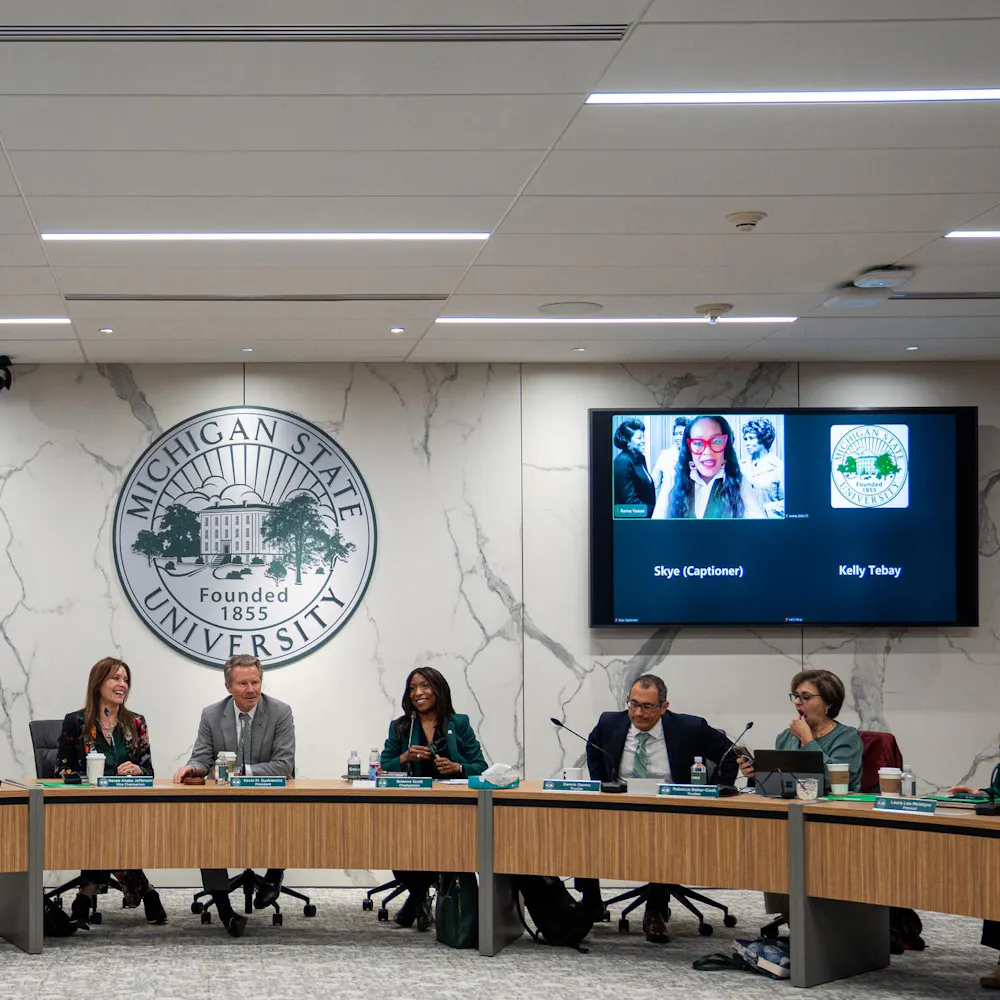
The UCFA brought these grievances to yesterday’s Faculty Senate meeting, where the raise memo was introduced and approved, but with a minor tweak. The memo will be sent to UTSF and the administration, with the expectation being that MSU will choose to ignore the recommendations presented.
UCFA Chair John McElroy said the committee has spent the past academic year working to define its role as an academic governing body amid claims that its work conflicts with negotiations between UTSF and MSU. As a result, McElroy said, UCFA has been “caught in the middle” of the dispute between the two parties.
Faculty Senate Chair John Aerni-Flessner said the issue began with a memo sent by the president and provost in September. The memo asserted that maintaining the status quo meant UCFA could not carry out certain mandated duties, including the raise memo, an interpretation UTSF disputed.
Faculty Senate vice chair Jack Lipton, who discussed this matter with the Board of Trustees last week, said getting Brian Quinn, the university general counsel, to define “status quo” has been a challenge.
There are differing perspectives as to what constitutes status quo, Lipton said, explaining that the conflict stems from the tension between ensuring no changes to the status quo are enacted and avoiding any form of direct dealing on employment matters.
“That's really the rub,” he said.
The faculty's raise memo, drafted by UCFA and approved by the Faculty Senate to be then sent to the administration as an advisory document, has been deemed a form of direct dealing by Quinn, Lipton added. He stressed that this has been confusing for everyone involved, since UCFA does not deal directly with the university on issues of salary benefits or working conditions.
This memo, and UCFA business as a whole, does not violate status quo due to the fact that this business occurs on an annual basis and is not a newly created process, Lipton said. As such, the memo should still be sent forward.
“The point of status quo, particularly dynamic status quo, which is one interpretation of what status quo should be, is that you are not supposed to change things that are happening all the time,” Lipton said. “You're not supposed to prevent them from occurring.”
Looking at data from recommended raises by UCFA and what was actually granted by MSU, Lipton said it's clear the memo is typically ignored every year. To academic governance, it is more of a “moral document,” he said. “And I think it should be moved forward, even though Brian Quinn is very firm that: ‘send it to the Faculty Senate, but don't send it to the administration’.”
Due to the unique circumstances present in the drafting of this year’s memo, other faculty senators found issues within the language that excluded important faculty groups. Human Medicine Senator Kelly Hodges said there are a large number of faculty not represented by either UTSF or UNTF, like fixed-term faculty, health programs faculty and academic specialists, which are not explicitly mentioned in the memo.
“There are a number of places in this memo where either those groups are rendered invisible by the fact that they were not mentioned in either the prose or in the statistics, or in which words used to describe those groups in this memo are in conflict with our bylaws,” Hodges said.
She pointed towards language in the memo that implied that academic specialists, like advisors, are not faculty members.
Aerni-Flessner acknowledged the exclusionary language in the memo brought up by Hodges, noting that it did not undergo full review due to concerns from general counsel regarding the status quo. He then entertained a motion to amend the document to better reflect and include all faculty perspectives.
Hodges introduced an amendment to strike the term “tenure-system” from the recommendation section of the document to ensure that other faculty groups were not excluded from the memo. Other proposed amendments, such as adding statistics on academic specialists, could not be introduced due to time constraints, as the meeting marked the final opportunity for the memo’s approval.
With the addition of the singular amendment, the memo was approved by the senate. To circumnavigate any claims of direct dealing, Aerni-Flessner said the memo will be sent to both UTSF and MSU administration “as recommendations of a body caught in the middle whose bylaws say they need to do this, but who has received conflicting advice from both sides.”
Support student media!
Please consider donating to The State News and help fund the future of journalism.
Speculating on how the memo will be received by administration, Aerni-Flessner said the memo, which is typically ignored, will be “ignored more than usual.”
“Usually it is read,” he said. “My guess is that it would not be read. That is just my interpretation of the conversation that happened at the board meeting last week with the general counsel and others.”
Discussion
Share and discuss “Faculty committee 'caught in the middle' of negotiations between UTSF and MSU” on social media.