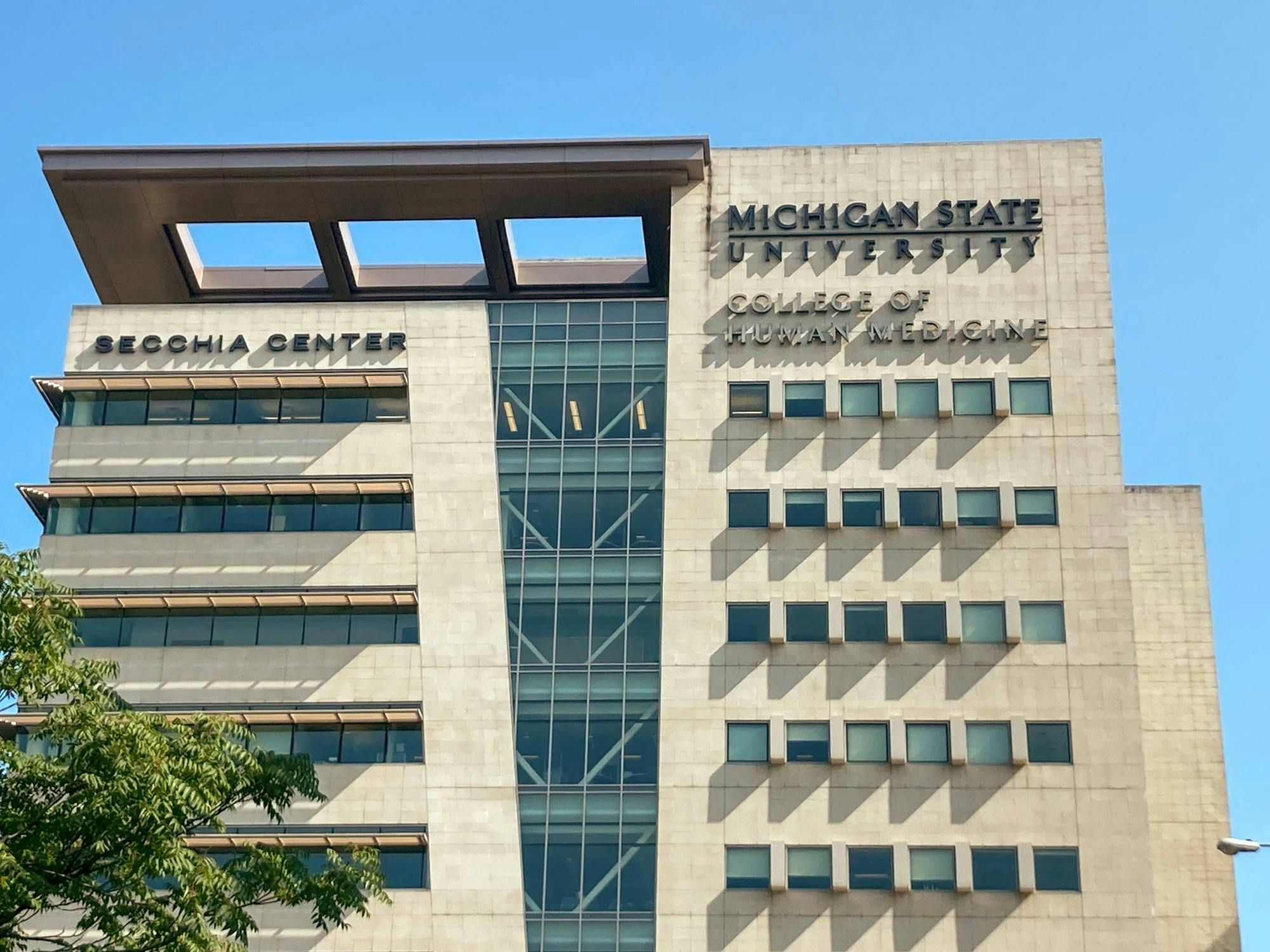
Michigan State University will combine its Colleges of Human Medicine and Osteopathic Medicine into a unified college of medicine, among other changes to its health education and research, the university announced Wednesday afternoon.
The announcement follows over a year of deliberation after the merger was first introduced by MSU President Kevin Guskiewicz as part of his “One Team, One Health” initiative in February 2025.
As part of the initiative, MSU will also create a new College of Health Sciences and “One Health Research Network” to assemble faculty and infrastructure “around shared thematic research priorities.”
The unified college of medicine will offer both Doctor of Medicine and Doctor of Osteopathic Medicine degrees, Guskiewicz wrote.
He wrote that a unified college would create a “larger, more visible presence” on campus and strengthen its ability to build partnerships, create opportunities for students, expand current programs and launch new initiatives.
The new College of Health Sciences, meanwhile, aims to “reflect the growing alignment of core competencies and the interdisciplinary collaboration that prepares our graduates for critical health science roles in today’s health care environment,” he added. Its creation would also better position MSU to meet workforce needs and offer “new educational pathways to students,” he wrote.
While celebrating the initiative for its potential positive impacts, Guskiewicz’s statement also referenced concerns some faculty had voiced about how merging the Colleges of Human Medicine and Osteopathic Medicine could impact each college's identity. In responses to a survey of College of Human Medicine faculty conducted in the fall of 2025, some faculty also warned that merging the colleges would be unproductive or destabilizing.
The statement released Wednesday sought to soothe some of those concerns, with Guskiewicz noting that “This unification is designed to preserve and celebrate the unique identities and rich histories of these two distinguished academic enterprises.”
He added the colleges would maintain their independent Liaison Committee on Medical Education accreditation and Commission on Osteopathic College Accreditation as a “non-negotiable priority.”
“I am deeply grateful for the professionalism shown throughout this process to date,” he wrote. “This work represents more than structural change. It reflects our belief that Michigan State University can and must lead in shaping the future of integrated health sciences. Continued support and engagement are vital as it is a true One Team effort.”
A campus-wide survey conducted in late 2025 demonstrated the wide array of opinions regarding the merger’s potential benefits and downsides. Respondents who identified with the Colleges of Human Medicine and Osteopathic Medicine, as well as campus as a whole, indicated that “budget implications” were the largest perceived potential challenge facing the consolidation and that “expanded research collaboration” would be the greatest potential benefit.
In an announcement that coincided with Guskiewicz’s, Interim Dean of the College of Human Medicine Supratik Rayamajhi wrote that the next phase of the One Team, One Health Initiative would “take place thoughtfully over time through additional review, engagement and approvals in coordination with appropriate accrediting and governance bodies, university protocols, and the Board of Trustees.”
Support student media!
Please consider donating to The State News and help fund the future of journalism.
Discussion
Share and discuss “Colleges of Human Medicine and Osteopathic Medicine will merge, president says” on social media.