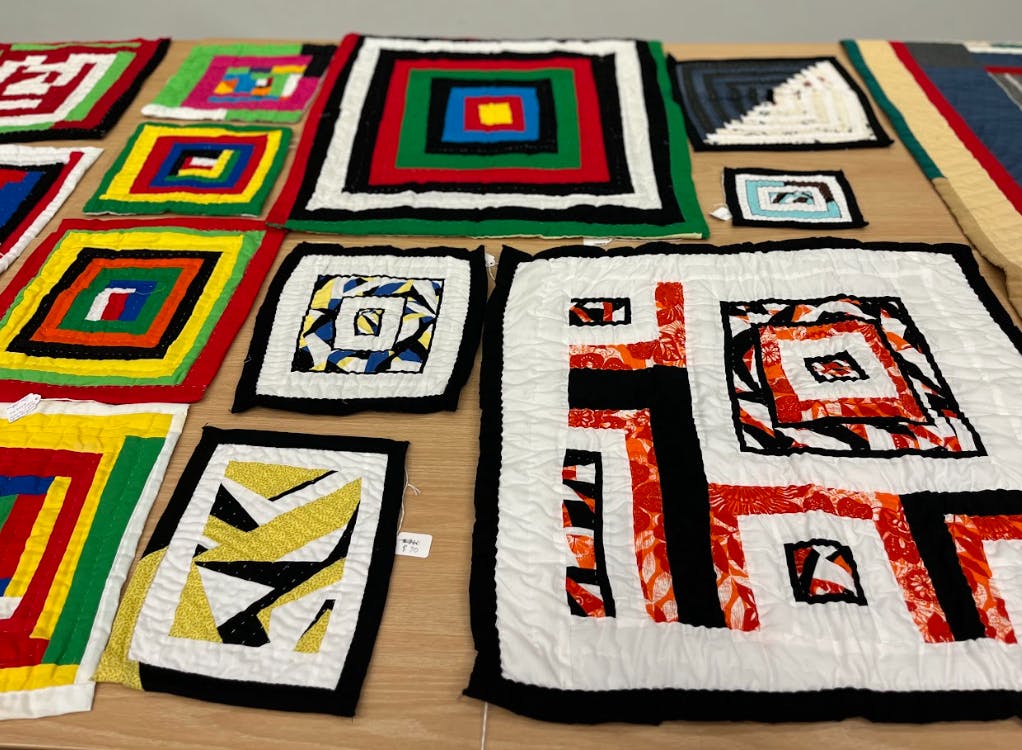
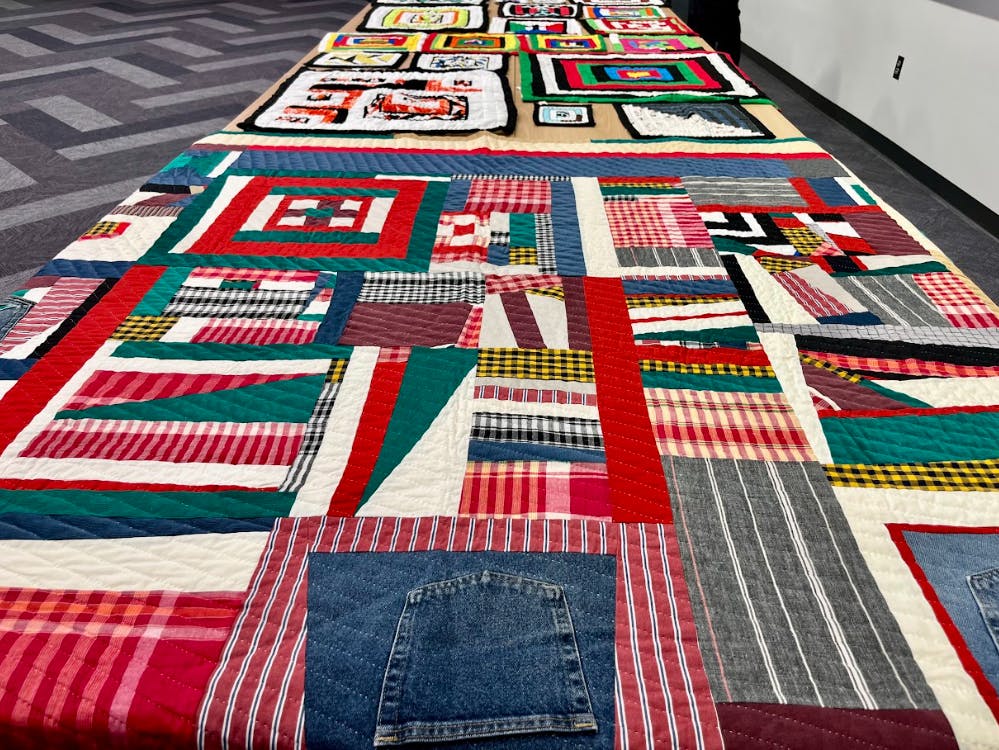
Gee Band quilts on display at the Multicultural Center in East Lansing, Mich. on Feb. 26, 2026.
Many may not think too much about quilts, how they’re made, or where the material comes from. But in a land in rural Alabama, with its only direct-route accessible exclusively by ferry boat, the quilts serve not just as bedding, but also to block the outside winds from inside the homes.
Manager of the Gee’s Bend Quilting Collective Mary Ann Pettway and China Pettway, one of the region’s leading gospel singers, spoke at the annual William G. Anderson Lecture Series which was put on by the College of Osteopathic Medicine on Feb. 26. Associate Dean of Osteopathic Engagement and Community Practice and Assistant Professor of Osteopathic Surgical Specialties Dr. Marita Gilbert organized the event.
“We have been doing this series for 26 years now,” Gilbert said. “And this is something that was really important to Dr. Anderson when he started the series. It started small and has become a hallmark of Black History celebrations at Michigan State University. And so, we have grown and grown… we’re continuing to grow.”
Gee's Bend, formally known as Boykin, is a census-designated place in rural Alabama. Though not nearby to Michigan State University, Mary Ann and China Pettway made the trip to East Lansing to share the history of quilting in their community.
For these two women, quilting isn't just about art: they're making functional, everyday items. Quilting is a skill that young women and girls learn in the Gee's Bend region, and it's passed down through generations.
“Quilting has been certainly an African American and African American women’s tradition, a way of bringing community together, telling stories about either our families or our communities, and then taking bits of pieces of things that, you know, may not have been as useful any longer and making something beautiful,” Gilbert said.
Mary Ann and China Pettway spoke about their upbringing, and how they sourced their fabric for the quilts. The scraps and shapes would come from old garments, things such as old skirts and pants. They also spoke of their mothers and their families in other ways, painting a picture for the audience of what growing up in Gee’s Bend was really like. The two credit God for their successes and say it’s easy for them to stay true to their faith because they know and remember where they came from.
The quilts can be commissioned. The two women as well as others have been able to make money by selling the quilts. They offer specific commission exchanges. Over time, China Pettway has developed a love for all aspects of quilting.
“Blue was my favorite color, but now every color I see is my favorite,” China Pettway said.
The tradition is still passed down with Mary Ann's grandson, DeShaun, taking up quilting. This later inspired him in his career as he took up graphic design in college.
“DeShuan – he is very talented. When you look at it (his work) it looks like one piece of fabric, but he sews a bunch of them all together. He loved doing it," Mary Ann Pettway said.
Outside of their quilting history, Gee's Bend is rich in history rooted in the Civil Rights movement of the 60s.
“Dr. King traveled to Gee’s Bend and really was working to mobilize voting rights in that area,” Gilbert said. “As people were starting to register to vote, you know, they had to take a ferry across from Gee’s Bend into Camden. And when folks got wind of this happening, then they restricted the ferry so that people wouldn’t be able to register to vote,” Gilbert said.
Mary Ann Pettway recalled her youth, saying that during the Civil Rights movement, she and others got arrested and had to spend the night in jail. Protesters had to lie on the concrete floor to sleep.
“The worst thing that could happen to you could end up being the best thing,” Mary Ann Pettway said.
The history of Gee's Bend was commemorated by the U.S. Postal Service. Dr. Gilbert recalls having an entire sheet of the limited-edition stamps featuring the Pettways' quilts in her possession and “not ever wanting to mail them” due to how rare they were, and because of the historical value they held.
The event held significance for many audience members with the Pettway quilts being relevant to their personal lives. One audience member reminisced about mini quilts Mary Ann Pettway had made – the woman presented a bright red and green strawberry pincushion. They’d met 15 years ago, and she’d come to the event to hear Mary Ann Pettway speak and to present her with the gift.
Another attendee also presented a quilting book they’d bought after seeing some of the quilts in an art museum in Cleveland. They spoke of the injustices of them not getting any royalties or benefits from contributing to the book.
Gilbert closed the event reflecting on the historical significance of the quilts.
Support student media!
Please consider donating to The State News and help fund the future of journalism.