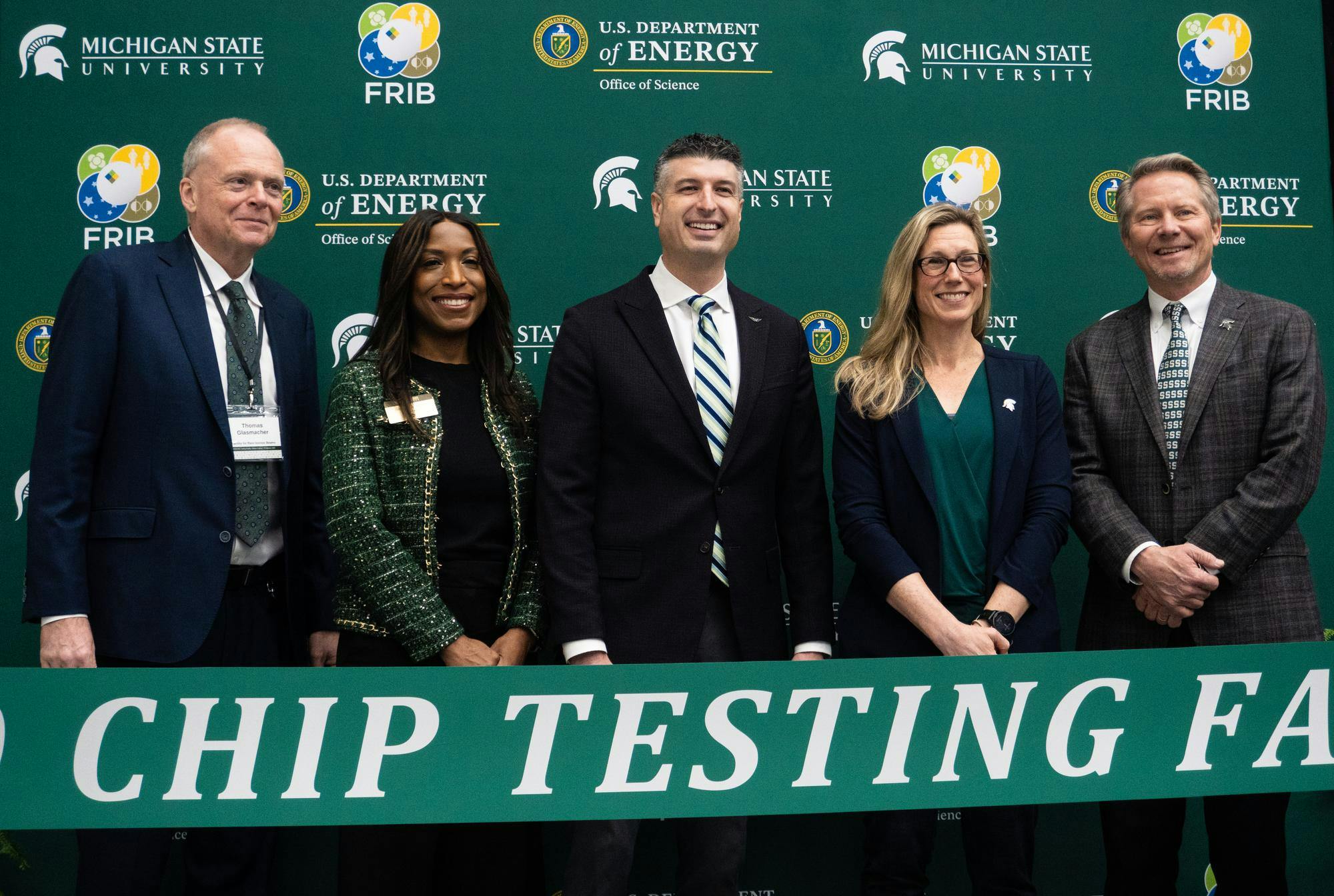
Facility of Rare Isotope Beams (FRIB) at Michigan State University inaugurated its K500 Chip Testing Facility during a ribbon-cutting ceremony Thursday morning.
The ceremony recognized the completion and operational launch of a refurbished superconducting cyclotron, originally built in the 1980s, and a new high-bay addition that increases FRIB’s ability to support testing for government, industry, and academic users across the country, while addressing a national shortage of testing capacity for advanced microelectronics.
FRIB Laboratory Director Thomas Glasmacher spoke at the ceremony about MSU's continued ability and efforts to address the need for technological innovation.
“The university has always been shaped by those who know it the best of us,” Glasmacher said. “We thus understood the vast amount of impact that comes from taking hold of the attractive and strong people and incorporating them into the ambitious business of the next generation.”
The new facility provides high-energy heavy-ion beams that allow testers to estimate within minutes the likelihood of malfunctions or failures caused by decades of cosmic ray exposure on electronic components, with the type of testing that ensures the reliability of microchips used in spaceflight, autonomous vehicles, wireless communications and other high-radiation environments.
FRIB will now provide up to 2,000 hours of annual availability through its FRIB Single Event Effects Facility (FSEE) and up to 6,000 user hours per year through the K500 Chip Testing Facility.
MSU President Kevin Guskiewicz commended the efforts FRIB has made to continue its work in making scientific breakthroughs and conducting research while generating economic activity.
“We know the research we pursue here creates direct economic benefits for communities and for the state of Michigan,” Guskiewicz said. “A recent report shows that Michigan's 15 public universities generate over $45 billion in annual impact for the state of Michigan, and it's one of the state's research contributions, one of our four research contributions. Michigan State University alone contributes nearly $10 billion in economic impact annually.”
Board of Trustees Chair Brianna Scott recognized the state and federal efforts put into the project.
“We have a K500 chip testing facility that illustrates how such investments appreciate over time,” Scott said. “Recent infrastructure that we developed decades ago is now creating the opportunity for our students of today in supporting the emergence of technology and contributing to the state and the nation's competitiveness.”
MSU Provost Laura Lee McIntyre said the refurbishment of the facility demonstrates how decades of nuclear science expertise are incorporated into national scale capability, giving students hands-on experience with the “responsible use” of artificial intelligence.
“Aimed at hands-on, peer-connected learning environments, where students work with schools, stakeholders, and challenges that are culturally familiar to them, efforts advances in virtual research structures by applying machine learning to nuclear theory experiments in cellular operations, enabling faster predictions, real-time detection of rare events, and more stable performance,” McIntyre said.
U.S. Representative Tom Barrett spoke on the bipartisan support for the KSEE facility, which was supported with $14 million in federal funding for its cyclotron refurbishment.
“MSU’s expanded K500 Chip Testing Facility will make mid-Michigan a hub for the next generation of durable semiconductor research, especially when it comes to military and medical technology,” Barrett said. “I’m confident that combining this new testing facility with the $125 million investment I recently secured for FRIB’s other nuclear physics research will help ensure scientists, staff and students at MSU continue leading the way in cutting-edge innovation for years to come.”
Audience members heard recorded remarks from U.S. Senators Gary Peters and Elissa Slotkin and U.S. Representatives Jack Bergman, Debbie Dingell, Hillary Scholten and Shri Thanedar.
After the ceremony, Guskiewicz commended Glasmacher’s leadership of the FRIB and continued bipartisan support of the facility.
“As we launch the K-500 testing facility, it is about building on the excellence that began here decades ago at FRIB,” Guskiewicz said. “It builds on the visionary leadership of Dr. Thomas Glasmacher and the belief in the federal government, state, and local legislators who have advocated hard to be sure that a facility such as this could be here in the state of Michigan, here on our campus in East Lansing.”
While speaking about how proud he is to represent MSU and his district, Barrett continued to emphasize the importance of U.S. dominance in driving innovation efforts to create more chip testing facilities.
“Countries are trying to innovate and get an advancement ahead of the United States. We've got to make sure that that doesn't happen,” Barrett said. “It's a paramount national security issue, it's also an issue of economic opportunity and economic development that we want to really do here in the United States.”
Glasmacher said his hopes and goals for the testing facility are for the continued development of semiconductor companies.
Support student media!
Please consider donating to The State News and help fund the future of journalism.
“This is a unique facility that will help semiconductor companies but also will help us develop the workforce that we need for the future,” Glasmacher said. “Through this, we will attract more students into the general microelectronics semiconductor area, which is a highly, it's a high priority area for the United States.”
Discussion
Share and discuss “Facility for Rare Isotope Beams inaugurates microchip testing facility” on social media.