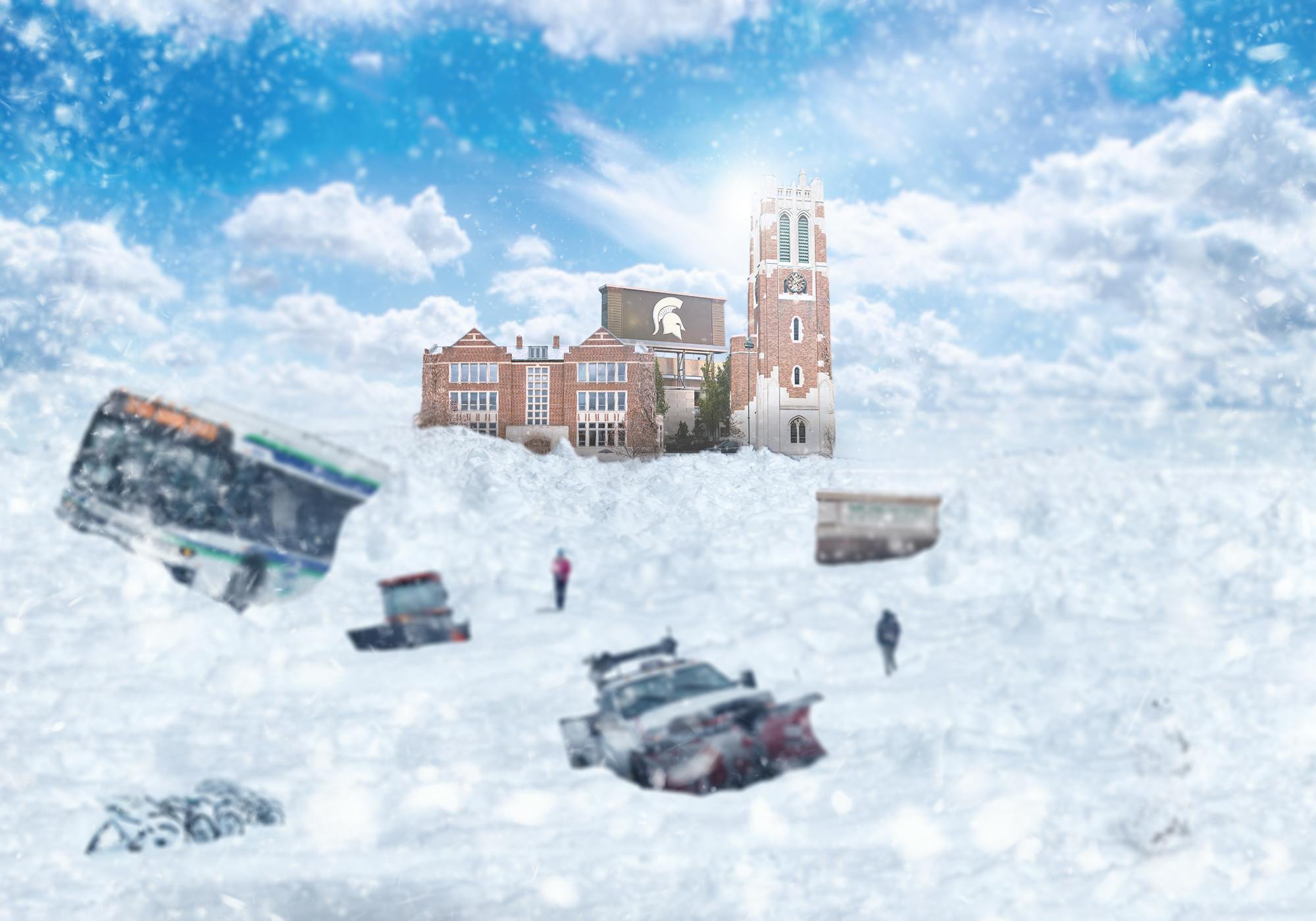
On Friday, January 23, Michigan State University students woke up to a barrage of snow, ice and wind. When they checked their phones, they saw a message from MSU, saying that “after a thorough review of local weather conditions … university leadership and the MSU Department of Police and Public Safety have made the decision to maintain the regular schedule of classes, scheduled events and campus operations through the weekend.”
This decision was made despite many complaints from students about the “awful” conditions of roads and sidewalks, and the long commutes in those frigid conditions.
If they then wondered what other colleges in the area were doing, they would have seen the announcements from Western Michigan University, Ferris State University and Grand Valley State University that their classes were either cancelled or switching to remote learning.
In the midst of their frustration, students probably wondered why MSU was refusing to alter campus operations, despite road and sidewalk conditions that seemed concerning. In their search for answers, the best thing they could have found is a website under MSU’s Office of the Executive Vice President for Administration.
Notably, despite claiming “changes to university operations are only made under defined criteria,” the website never explains what that criteria is. In fact, further reporting has uncovered that MSU has no specific criteria for class weather cancellations. The website mainly served to notify students and professors that “cold weather, by itself, does not warrant class cancellations or operational changes.”
They justify this position by saying “thousands of students on campus … require residential services as well as research projects and critical infrastructure that require constant monitoring,” so MSU maintains these services, even in cold weather, for community members’ safety.
However, upon further investigation, this “maintaining essential services” argument comes up short. A quick search of nearby colleges makes clear that altering class operations for students and faculty safety need not require a total university closure. When Eastern Michigan University cancelled classes on 1/23, their announcement made clear that essential services like heating, food services and public safety would remain open. Even MSU’s own record of their (just 7) past class cancellation notes that in 2014, despite cancelling classes for two days, “critical functions of operations were maintained.”
While MSU’s justification to students was somewhat unclear, their guidance to professors was even more confusing. After telling faculty that “MSU intends to remain open Friday, January 23,” they enter into vague prescriptions that offer no clear direction.
They tell faculty to “approach these situations with empathy and flexibility,” saying “instructors are encouraged to communicate expectations clearly while offering flexibility and understanding for students who may face extreme challenges due to winter weather.” However, ultimately “it is the instructor’s responsibility to determine if their course can be moved online or if learning can continue in alternative formats.”
MSU’s lack of guidance on winter weather issues burden professors with making a judgment call about whether to cancel class, move to remote learning or hold instruction as usual. Individual faculty members choose whether their students should be braving frozen sidewalks and snowy roads to reach them. They should not have to make this decision, and frankly, they are unqualified to do so.
MSU’s Infrastructure Planning and Facilities Department (IPF) is responsible for taking care of the university’s sidewalks and roads. So if anything, MSU themselves would obviously have the best information about whether or not campus is safe for students to travel. Granting this task to professors, while lacking any clear standards for class cancellation, seems like the university’s way of skirting responsibility for student safety. Instead of inviting backlash when they decide whether or not to alter operations based on established criteria, it is much easier for MSU to say nothing, and place the burden on their faculty.
However, simply cancelling class whenever the weather gets too bad would be irresponsible. While not to the same extent as in-person lectures, the pandemic taught us that some learning can still happen virtually, whether synchronously or asynchronously. In the interest of keeping students engaged while their syllabi stay on pace, either moving classes to virtual learning, or providing excused absences for students struggling with weather conditions would mean students can stay safe while instruction continues.
The solution is clear: MSU needs to provide actual criteria on when they will cancel classes or switch to remote learning during significant winter weather. Students and faculty need a standard to point to when conditions are poor. Even when class operations are not changed university-wide, clearly encouraging professors to offer remote learning or excused absences to students struggling to get to class would go a long way towards removing professors’ burden.
Michigan winters are predictable. They happen every year, and MSU should not be improvising its response each time. These solutions in tandem would produce a campus that is more safe and accommodating to student and faculty needs.
This editorial represents the view of The State News Editorial Board. It is made up of The Opinion Coordinator, two staff columnists, the Editor-In-Chief, the Multimedia Editor, Newsroom Development Manager and Design Editor.
Support student media!
Please consider donating to The State News and help fund the future of journalism.
Discussion
Share and discuss “EDITORIAL: MSU needs a policy for harsh winter weather” on social media.