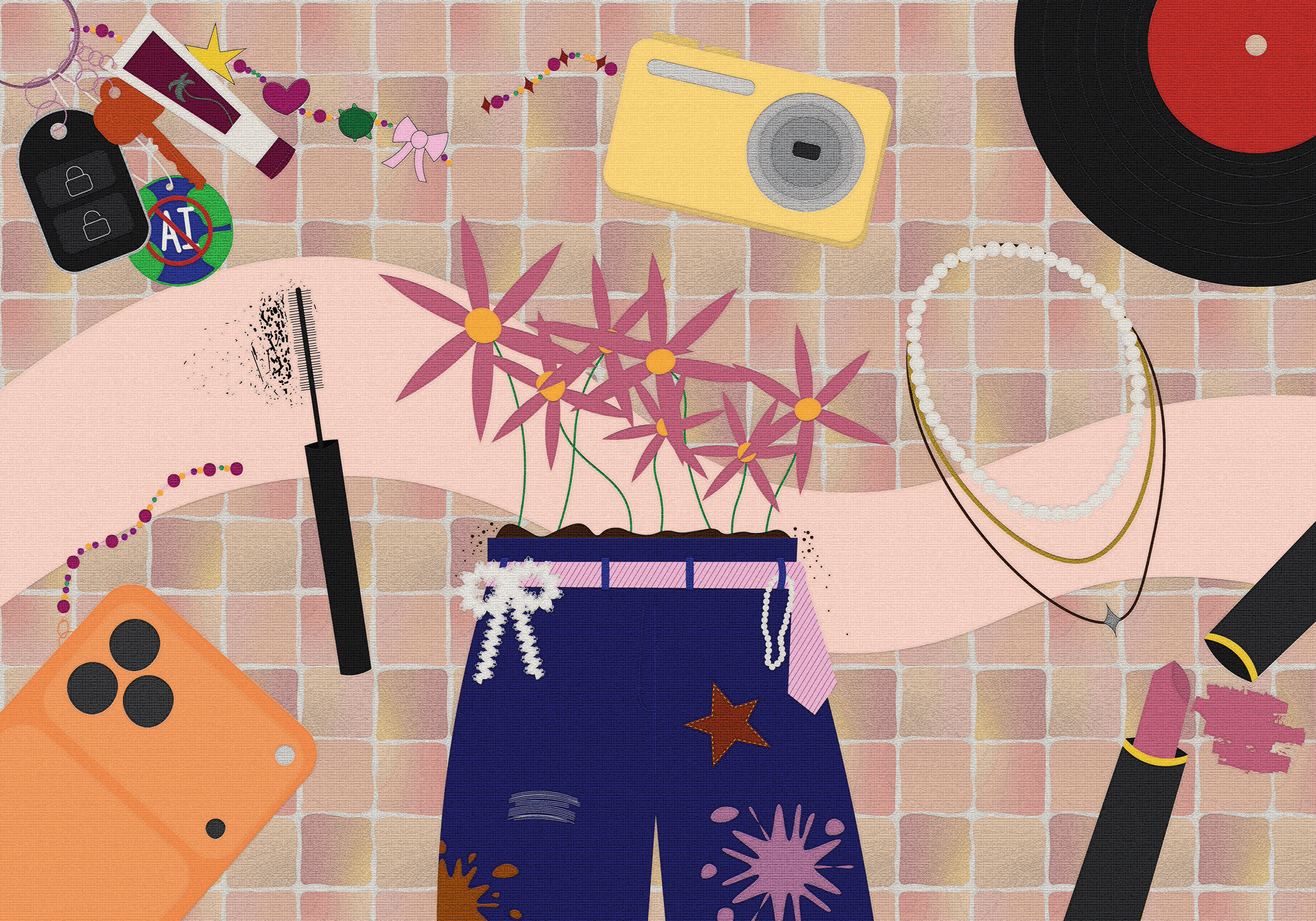
What do maximalism, the “messy girl” trend, the bright orange iPhone 17, and the 2025 Vanity Fair White House photos have in common? They are all reactions to the oversaturation of artificially-generated media on the internet. A new phenomenon called AI content fatigue is making us prefer increasingly imperfect, striking and bold elements in what we consume.
Take the “messy girl” trend. Popularized near the end of 2025, this style is the antithesis of the “clean girl” aesthetic. It’s rebelling against the beige, minimalistic and perfectly curated content that, with the help of AI, has dominated the internet the past few years. Such repetitive use has led AI to create tons of content that is best described as “visual elevator music”: generic, visually perfect and devoid of meaning and authenticity.
The “messy girl” trend is a rebellion against exactly that unrealistic standard. It centers around smudged, lived-in makeup and a disheveled yet authentic persona. The style glamorizes chaos and clutter as a signal of humanity; to be human is to be messy.
The ubiquity of AI and its uncanny, stock photo-esque flawlessness has actually made imperfection more appealing to us. As one user wrote in an Instagram Reel, “the more ai I see, the more I crave imperfection.” AI content fatigue has fostered this new inclination towards the organic and flawed, which is heavily influencing the development of our digital culture. This shift can be seen most explicitly in style trends but is evident in countless other places as well.
One of the most interesting examples of the desire for authenticity is the Vanity Fair white house photos taken by Christopher Anderson. These controversial photos are riddled with blemishes, exposed wiring and pores; they capture flawed individuals in an environment that is literally fraying around the edges. The photographer’s intention was not to humiliate the administration, but photograph it authentically. Anyone with access to a computer can generate a polished image of Karoline Leavitt with smooth skin and a picture-perfect smile. These photos provided the now rare opportunity to see this environment, blemishes and all, invigorating viewers’ desire to see the real and imperfect amidst the phony.
The “messy girl” aesthetic also centers around imperfection, but unlike the Vanity Fair White House photos, many are seeking to recreate the glamorously disheveled look of the “messy girl.” The fad has inspired countless other sub-trends, like what Pinterest Predict 2026 is calling “glitchy glam.” Pinterest pitches “glitchy glam” as a movement that embraces flaws more than anything else: “The perfect winged liner? She doesn’t go here. This year, beauty is missing the mark – on purpose.” This style, backed by skyrocketing search terms on the platform, is all about the asymmetrical and over-the-top.
But these trends go beyond just the taste for imperfection, they also signify another trend that is reacting to AI fatigue: maximalism. Many have grown tired of the minimalism that dominated social media for the past few years. However, the influx of AI content has only exacerbated this, as the bulk of corporate AI slop is not only inhumanely perfect, it's also soulless. Users are overwhelmed with the beige, uniform and generic. To stand out against the sea of sameness, individuals and brands are turning to maximalism.
In terms of fashion, bold, high-contrast colors are everywhere in 2026, from runways to retail. Patterns have been, and continue to be, surging in popularity. Think stripes, polka dots and all types of animal prints. The glamoratti trend, also mentioned in Pinterest Predict 2026, is an exemplary maximalist sub-trend: chunky gold jewelry, bold accessories, rich colors and pattern-on-pattern clashing. AI can not (or maybe just does not) replicate these extravagant styles, making them a much needed refuge from the excessively bland.
Fashion is not the only place we are seeing bright colors to combat the AI ”beige-pocalypse.” Look at Apple’s release of the iPhone 17 Pro in “cosmic orange.” This vivid shade is a deviation from the visual color palette of the brand, and it signifies a need to stand out that was never there before.
Bright orange became wildly popular in 2025, as the centerpiece for Taylor Swift’s October album, in the extravagant marketing for Marty Supreme and on the runways of global fashion brands like Saint Laurent. The color undoubtedly stands out, so it makes sense why brands would use it to differentiate themselves from the bland AI content that currently dominates the internet.
The oversaturation of sterile, soulless AI-generated content on social media might have made the experience of scrolling significantly more miserable. But on the bright side, it has forced us to garner a new gratitude for the irregularities that make us human, and pushed us to be more bold and expressive than we otherwise might have been.
Support student media!
Please consider donating to The State News and help fund the future of journalism.
Discussion
Share and discuss “OPINION: AI is making us more human — and more fun” on social media.