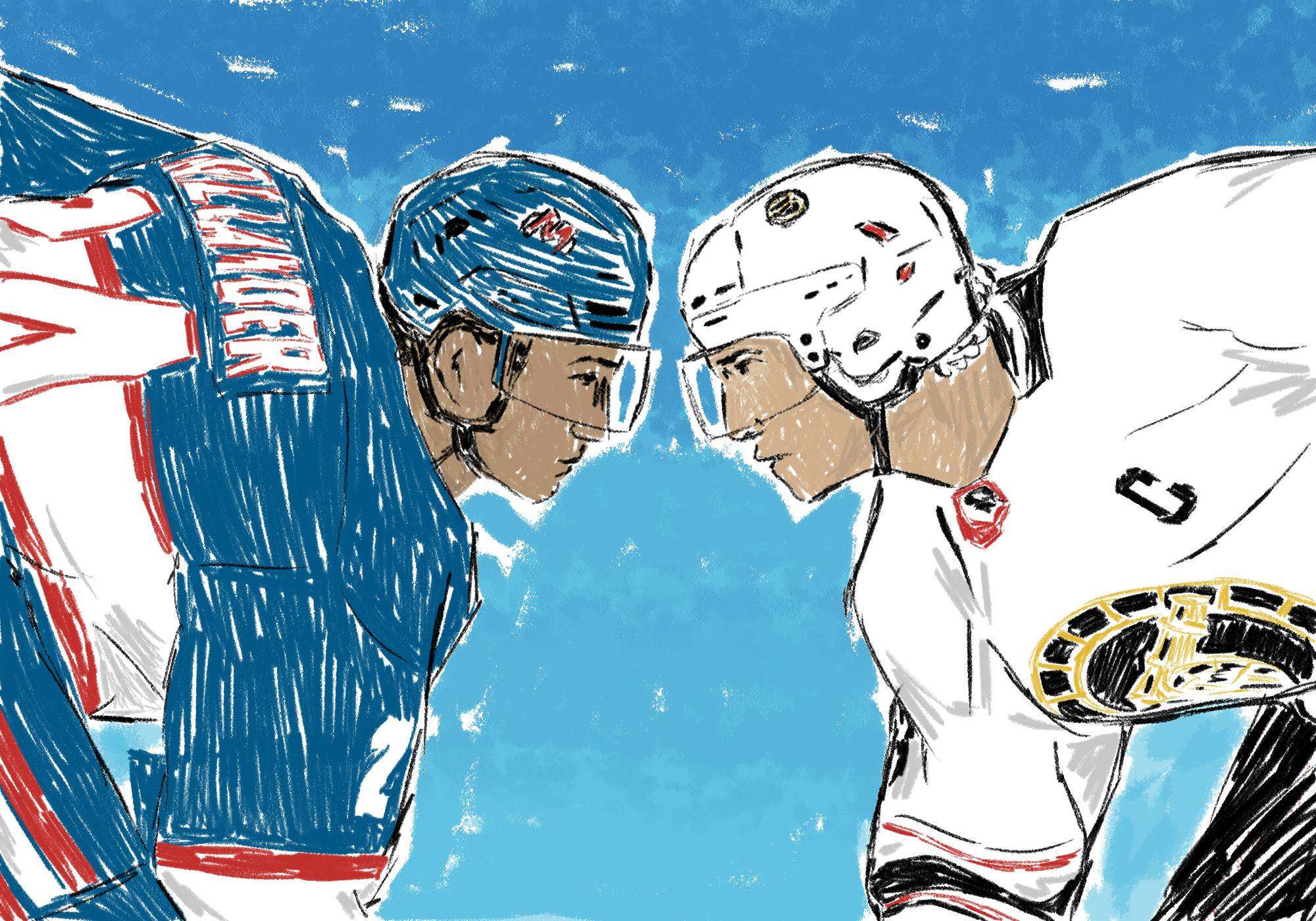
The show itself has accumulated a large number of viewers for many different reasons.
For arts and humanities and english secondary education sophomore Juno Bursch, LGBTQIA+ representation was a factor that pulled them in.
"I heard a lot of positive things about it from my friends, and I think that getting positive LGBTQ+ representation, especially in times like these, is really important, especially in a society where gay love, especially gay sexual love, is kind of treated as, like, disgusting or immoral or unnatural," Bursch said. "With those attitudes being exacerbated with the current administration, I feel like seeing that kind of representation in a popular media show is really important."
Additionally, Bursch said the show being centered around hockey may have attracted many other viewers.
"I think it might have something to do with the setting, being sports-related, because it's like sports tend to be more of, like, a mainstream activity where a lot of people enjoy it," Bursch said. "[Also,] I guess it's seeing characters who are not heteronormative in a heteronormative space that a lot of people know a lot about, that I think is contributing to the popularity and to the widespreadness of the show."
Kinesiology senior Daika Medrano said she was drawn to the romantic aspect of the show. However, Medrano said why others choose to watch the show depends on the person.
"I've heard, from my experience, I've heard different opinions on why people choose to watch the show. There are people within the LGBTQIA+ community that I have had conversations about the show with, and they've kind of said that they think it's a show that's made for straight women, or they won't watch the show because they think that it's sending the wrong message," Medrano said. "I think from different perspectives, it can be a show because someone loves romance, right, like they just love romance, they love what the show is about. Or it could be people watch the show because they think it's a great message that they're sending out, because it is important to have inclusivity and for professional sports in general, not just hockey…"
Heated Rivalry, being a show focusing on queer relationships, has impacted the LGBTQIA+ community in different ways.
Bursch said following the release and popularity of the show, they have noticed "open discussions" regarding topics explored in the show.
"I'm seeing a lot of open discussions around, like, gay presences in sports communities," Bursch said. "Like the actor for Shane Hollander (Hudson Willliams) said that he's been receiving emails from closeted hockey players and other professional athletes who feel like, maybe that the popularity of the show means that they can come out and live their authentic lives. I feel like it's showing that the LGBTQ community can thrive even when it's being, like, oppressed."
Similarly, English senior Micah Prince said the show has reached a broader audience due to its popularity.
"I think that it's made it so that we, as a community, have to, kind of, sit with how culture as a whole is interacting with media that includes us, and I think that we're really used to queer media being just for us and having kind of these insular circles of queer media and queer audiences," Pirnce said. "But getting used to that conversation becoming broader and including a wider audience is, I think, definitely a learning curve for a lot of people, but I think it's really important for progress overall."
Medrano said the show "did a great job" touching upon queer relationships both inside and outside of the sports world.
"I think representation is very important, and I think that the show did a great job in showing that these relationships are (not) only within sports, but also outside of sports and that everyone kind of deserves the space, and the environment, the support to kind of love who they want to love, you know, like it shouldn't be a set dynamic," Medrano said. "It should be whatever, or whoever you want to be with."
Throughout Heated Rivalry, queer relationships are represented, not only through the main characters of Hollander and Rosanov, but also through side characters, such as Scott Hunter and Kip Grady.
This representation, Bursch said, really matters.
"People being able to see themselves represented on screen, in art, inspires them to live their most authentic lives," Bursch said.
Similarly, Prince said representation of queer relationships in media is important.
Support student media!
Please consider donating to The State News and help fund the future of journalism.
"...You can see that even within the characters themselves, because, without getting too spoilery, two of the characters, their relationship is very heavily, not necessarily inspired, but like, encouraged, and like they see themselves in another set of characters and their relationship, and it gives them the courage to pursue the relationship that they want with each other," Prince said. "So the show, on, like, an insular level, shows how that's important as well."
Following the release of the show, some athletes, such as hockey player Jesse Kortuem, have come out as gay, crediting Heated Rivalry as the motivator.
Bursch said effects like this, specifically stemming from the show, are "beautiful."
"I definitely think that the sports world can be a little bit rigid when it comes to like traditional sex and gender hierarchies, so homosexuality or gayness can really challenge that sort of expectation, and so often it's suppressed, or, like, there's a lot of homophobia in the sports world," Bursch said. "….I think it's really beautiful, honestly, to see these people, even in these in this time of hardship, being able to share their authentic identities because of seeing themselves represented in a popular show."
Similarly, Medrano said being able to connect with the characters on a personal level is "really important."
"I think this is really important where they kind of see themselves in the character, and they see themselves," Medrano said. "Because they see themselves in the character, and they see how well people are taking it, how people love them, and they think that they're great and they love the show, it kind of gives them the confidence to be like, 'Maybe I can be like them too, maybe it's okay for me to be public about my sexuality and who I want to be with at the end of the day.'"
Prince said understanding that "queer people exist in all spaces" is essential.
"I think it's important to recognize that queer people exist in all spaces, even spaces that haven't historically been safe for them. I mean, you hear even, like, just with hockey, for example, because that's what the show is about, people will talk about, and it's talked about in the show, like locker room talk and like people being like, 'Oh, I realized that I am the thing that people are making fun of in like insults to each other and stuff,'" Prince said. "So I think just a wider recognition of the fact that queer people are everywhere, and being more cognizant of that and what we're saying to each other, and making spaces safer for everyone."
However, with the widespread attention and popularity Heated Rivalry has accumulated, it may open the door to the concern of the potential fetishization of queer men in sports.
Bursch said this worry is a possibility, especially when it comes to "non-queer people watching queer media."
"I definitely think that the concern that queer people have of non-queer people watching queer media, and instead of helping them understand queer struggles and what it's like to be queer in a heteronormative society, that instead, they are just consuming it without trying to push themselves or their biases or their previous knowledge," Bursch said. "I think that straight women in particular, enjoying gay media tend to get a lot of flack, but I personally think that them being able to enjoy queer media is a way that they can escape from, like, the gender dynamics in heteronormative media."
Medrano said although this is a possibility, she thinks the show wasn’t necessarily created to support this idea.
"I think (that) we're on the other end of the totem pole, where it's been known that, like, for example, straight men will fetishize women all the time, and like, lesbian relationships or just sexual acts. And I think now we're on the other side, where straight women now fetishize gay men," Medrano said. "I think that kind of sends the wrong image where, like, I don't think the show came out for women to fetishize these men. I think it came out to give the representation for the LGBTQIA+ community. And so I think with publicity is publicity, but with publicity, like, a lot of negative outcomes to come, and I think people can misconstrue the message that the show was trying to send, but I think that's that's a risk that is always taken with a lot of stuff, and I think it comes with the show, unfortunately."
Discussion
Share and discuss “"Heated Rivalry" sparks discussion surrounding LGBTQIA+ representation” on social media.