What’s better than a Midwestern coach with outbursting passion, a keen defensive mind and loyalty that's been tested?
Apparently not Jonathan Smith.
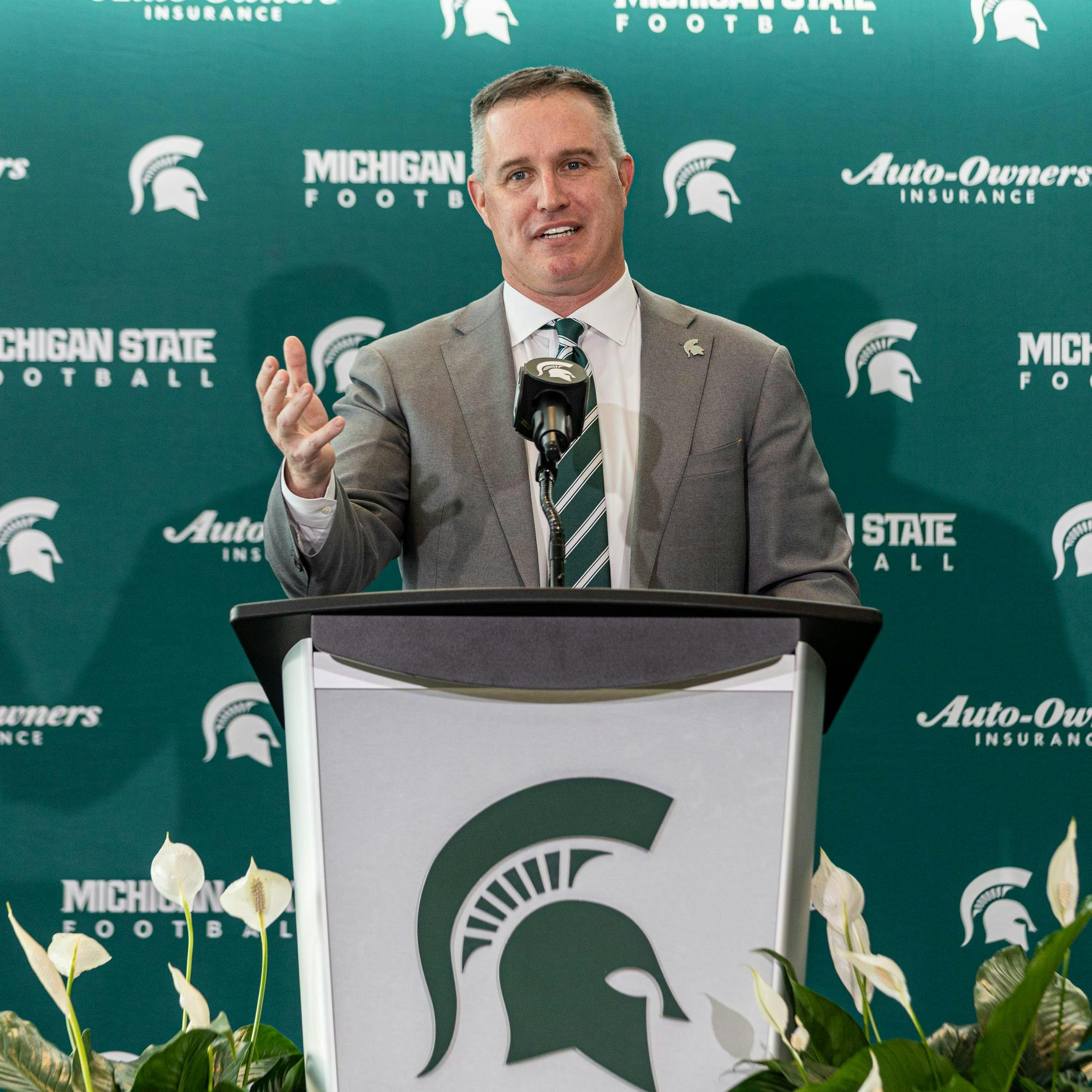
Michigan State University's new football coach Pat Fitzgerald interacts with reporters in the Tom Izzo football building in East Lansing, Michigan on Tuesday, Dec. 2, 2025.
What’s better than a Midwestern coach with outbursting passion, a keen defensive mind and loyalty that's been tested?
Apparently not Jonathan Smith.
On Monday, Dec. 1 Michigan State University hired this Midwesterner as the football program's new head coach. His name is Pat Fitzgerald, and he was announced to be the future of Spartan football only one day after Smith was fired from the same role.
“This program is storied with a deep tradition of passionate fan base and a commitment to excellence that spans way beyond the football field,” Fitzgerald said in Tuesday's introductory press conference. “My coaching philosophy is centered around being the best development program in the nation. We develop our young men as people, as students and as world class athletes. This will happen through a values based approach, and the two cornerstones of those are choices that we make every day: the choice of our attitude and the choice of our investment.”
The All-American linebacker
What’s as good as a head coach who knows the game? A head coach who’s played it.
Fitzgerald was born Dec. 2, 1974, to Flo and Pat Fitzgerald Sr. in the village of Midlothian, Illinois. He attended Carl Sandburg High School in Orland Park, Illinois, where he was a three-sport athlete, excelling in baseball, basketball and football. Of the three, his passion — and talent — was football, and by his senior year he had earned a scholarship to play at Northwestern University.
Arriving on Northwestern’s campus in the summer of 1993, Fitzgerald donned his purple and white jersey as a backup linebacker. He would have to wait his turn, and while he learned from the sidelines, he quickly earned a reputation for toughness and preparation. It wouldn’t take long for those qualities to show on the field.
In 1994, during his sophomore year, Fitzgerald became Northwestern’s starting linebacker and established himself as the Wildcats’ premier defensive leader. The following year — his junior season in 1995 — he broke out, helping Northwestern finish 10-2 with a Big Ten championship and a Rose Bowl appearance. Fitzgerald missed the bowl game after breaking his left leg in the second-to-last regular-season game against Iowa. Despite the injury, he led the Big Ten in tackles and won the Nagurski Trophy, the Bednarik Award, Big Ten Defensive Player of the Year and consensus first-team All-America honors.
Fitzgerald would win the same accolades again in 1996. The senior captain and the anchor to one of the conference’s best defenses would help Northwestern repeat as Big Ten Champions, this time with a 9-3 record.
“To be a Big Ten player, to be a player that’s been in Spartan Stadium with a neckroll on, to beat Michigan multiple times with a neckroll on, this goes a long way back for me personally,” Fitzgerald said. “I’m a Big Ten guy, and to be here with the history, the tradition, the passionate fanbase, the great young men that have come here before us and the great young men that I’m going to have the privilege to coach, I just can’t wait to get started.”
Fitzgerald would go down as one of the most decorated college football defensive players of all time and has since been inducted into the College Football Hall of Fame. In the 1997 NFL draft, Fitzgerald would go undrafted and chose to sign a contract with the Dallas Cowboys. Two weeks later, he was cut.
From Wildcat linebacker to head coach
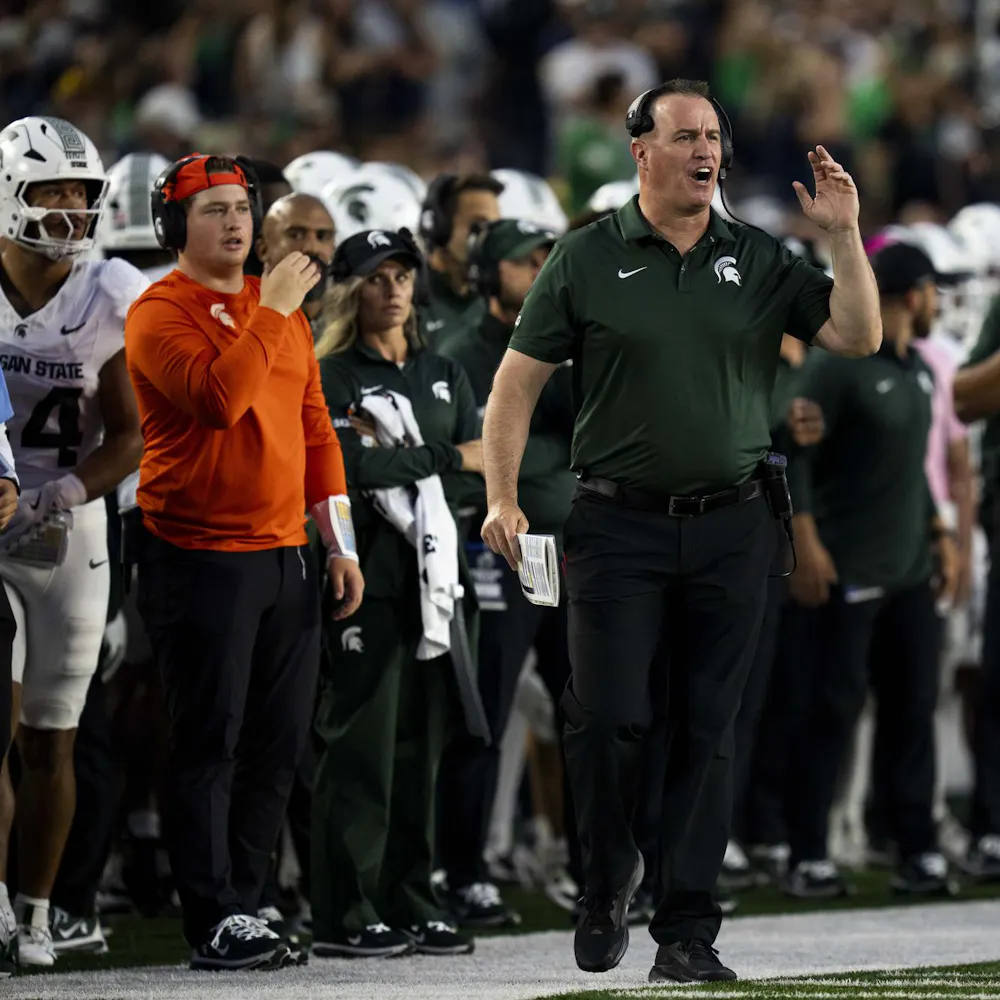
As a coach, Fitzgerald is known for his intense nature — the type of coach that wears short sleeve shirts even when the temperature touches freezing. He is also known for his defensive mind, something that he’s undoubtedly learned over his playing career.
“He's a passionate winner,” athletic director J Batt said during Tuesday's introductory press conference. “He understands the Big Ten and college football here in the Midwest. We have a shared vision for building championships and returning this program to a sweet level of success. We are fully committed to providing the resources and infrastructure required to compete at the highest level.”
Fitzgerald’s coaching career started only a few months after being cut by the Dallas Cowboys. In 1998, the young Fitzgerald would be hired by Maryland as a defensive graduate assistant. He would then bounce around to Colorado and Idaho in similar, smaller roles before being hired by his alma mater as a defensive backs coach in 2001. Little was he aware, he would stay at Northwestern for the next 22 years.
The reason for this extended stay was not just because of Fitzgerald’s loyalty to the Northwestern program, but also because of his promotion to Wildcat head coach in 2006 — which arrived sooner than expected, due to the sudden death of former Northwestern head coach Randy Walker.
Northwestern’s hiring of Fitzgerald made him the youngest head coach in college football at the time, and the youngest head coach in Big Ten history, a record that still stands today. At the time of his hiring, he was 31.
For 17 years, Fitzgerald and his Northwestern teams experienced both highs and lows. In his first two seasons, the Wildcats went 10-14. Over the next four years, they improved, winning 30 games and making four straight bowl appearances — though they lost all four. During this stretch, in early 2011, Fitzgerald declined an opportunity to interview for the head-coaching vacancy at the University of Michigan, further demonstrating his loyalty to the program.
In Fitzgerald’s seventh season — two years after declining Michigan’s interview offer — he would end Northwestern’s 64-year bowl game victory drought when his 10-3 Wildcat team defeated Mississippi State 34-20 in the Gator Bowl.
Support student media! Please consider donating to The State News and help fund the future of journalism.
Yet it was the latter half of Fitzgerald’s coaching career that brought the most success. In 2015 — his 10th season as head coach — Northwestern finished 10-3. Two years later, the Wildcats again went 10-3, capped by a Music City Bowl victory. In 2018, Northwestern marched to the Big Ten Championship Game after posting an 8-1 conference record, though it lost 45-24 to No. 6 Ohio State. That same year, Fitzgerald was named Big Ten Coach of the Year.
Similarly, in the Covid-altered 2020 season, Northwestern again rode to the Big Ten Championship where it again lost to No. 3 Ohio State. Following the Big Ten Championship loss, Northwestern beat Auburn in the Citrus Bowl, which was its first New Year’s bowl appearance since 1997.
During Fitzgerald’s 17-year tenure at Northwestern, he compiled a 110-101 overall record and a 65-76 mark in Big Ten play. He led the Wildcats to 10 bowl games — winning five — and made two appearances in the Big Ten Championship Game. For a program with Northwestern’s history, those results were far from poor; a look at the team’s year-to-year records shows seasons that ranged from outstanding to solid to outright disastrous. The low point of Fitzgerald’s tenure came after Northwestern’s 2020 Big Ten Championship appearance, when the Wildcats went 4-20 over the next two seasons — the worst two-year stretch of his career.
Fitzgerald’s breakup
Is blood thicker than water, or is the blood of the covenant thicker than the water of the womb? For Northwestern, neither proved true. On July 10, 2023, Northwestern University announced it was firing Fitzgerald, kicking its long-standing head coach to the curb. But the termination wasn’t about wins or losses — it stemmed from a scandal, one that would take nearly two years to resolve.
The news of Fitzgerald being fired broke when Northwestern University released a statement concerning Fitzgerald and his termination from the football program. It stated that he was fired for "his failure to know and prevent significant hazing in the football program" and discussed in detail how "eleven current or former football student-athletes acknowledged that hazing has been ongoing within the football program" while explaining that Fitzgerald was not aware of such instances.
Following Fitzgerald’s termination from the program, he filed a wrongful termination lawsuit against Northwestern University in Oct. 2023 claiming that there were "multiple breaches of contract… defamation, and other extremely harmful tortious conduct." Fitzgerald sought $130 million in compensatory and punitive damages. The lawsuit was recently settled by both parties in August 2025. Fitzgerald has since said he has felt vindicated by the settlement.
“You learn a lot through every experience that you have as a leader,” Fitzgerald said. “I absolutely love and adore the young men that I had the privilege to coach [at Northwestern] through those 17 great years. To come out fully exonerated and to see the statement that [Northwestern] made and to see the settlement that we came to an agreement with, I just feel 100% vindicated.”
A future of green and white polos, vests and quarterzips
It’s hard to win at Northwestern — the university is known more for its academics than its football. That’s what makes Fitzgerald’s 110 victories, 10 bowl appearances and two Big Ten Championship bids worthy of a second chance — worthy of Michigan State. Now dressed in green and white, with the aim of delivering wins to Spartan fans, Fitzgerald takes over as the 27th head coach in Michigan State history.
There will be a lot of things against him: not coaching college football in three years, not having any immediate players or coaches to bring over, coaching in a new era of college football, attempting to rescue a drowning football program.
At the same time, there will be a lot of things going for him: having a program that will invest in what is asked, having top-notch facilities, having supportive yet eager fans.
Now, the only question is how quickly Fitzgerald can lead Michigan State back to relevance.
“As I look around the landscape and we see some non-traditional powers that are playing for conference championships or maybe in the playoff conversation, you better believe Michigan State should be in that conversation,” Fitzgerald said. “And that's my job, and that's why I'm here.”