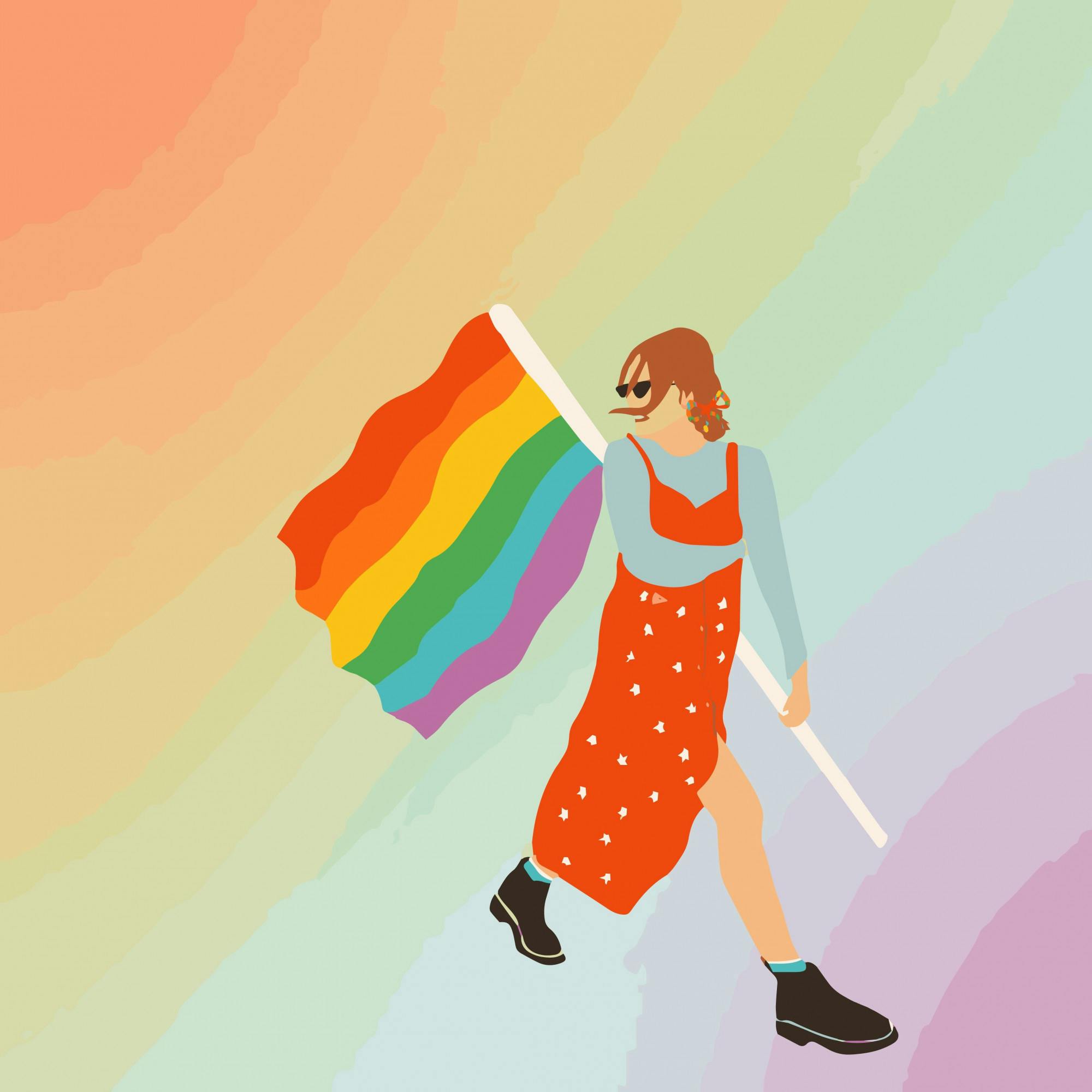
If you asked students at Michigan State University when their parents started dating, I’d bet half would say during college. In the Midwest, a region known for small towns and farmland, this is a common practice. Colleges provide a unique space for young people to gather, learn, and even love. However, the same often can’t be said LGBTQ+ students, who face a slew of challenges while dating.
One of the greatest challenges LGBTQ+ students encounter is finding a supportive environment, as acceptance can vary greatly between different regions of the Midwest. A trans student who grew up in rural Indiana may find Michigan liberating, while a trans student from Illinois may find Ohio more reserved.
This same reasoning applies to all Big Ten campuses, including Michigan State. Although MSU as a whole appears welcoming to individuals from such backgrounds, certain majors and campus organizations don’t reflect that inclusivity. LGBTQ+ students pursuing degrees in Business or Criminal Justice may face challenges in terms of finding relationships due to prevailing stereotypes within those majors of what students in those fields are “supposed to be.” Students majoring in Psychology or students of the James Madison College rarely invoke such stereotypes.
Greek Life presents its own challenges. While many fraternities and sororities have taken steps in recent years to incorporate inclusive language into bylaws, that doesn't excuse a history of abuse. As recently as January 2025, MSU’s Pi Kappa Alpha faced accusations of hazing and sexual abuse. Such behavior is unacceptable for any student, but LGBTQ+ students are particularly vulnerable. As a result, fraternities & sororities can be unsafe options for coming out or dating.
Providing LGBTQ+ students equally supportive environments regardless of major, sport, or fraternity/sorority requires Michigan State to champion inclusivity in all spaces, not just where it's convenient or easy. Additionally, it's incumbent on those privileged enough to inhabit supportive spaces to lead by example and promote inclusion at MSU.
Unsafe environments, whether intentional or not, are prevalent throughout campus. But dating in a supportive setting is a whole different challenge.
Simply identifying whether another student is part of the LGBTQ+ community – and whether they share a similar sexual orientation is a major challenge. To straight students, it might seem easy to spot someone who presents outside the gender binary. But the reality is that the LGBTQ+ community is incredibly diverse. With roughly 14 million adults in the U.S. (about 8% of the population) identifying as LGBTQ+, members of the community come in every form imaginable.
This makes it nearly impossible to know someone’s identity at a glance. Developing feelings for someone only to find out they’re straight has led me to my fair share of awkward embarrassment. Trying to find someone who both aligns with your identity and feels like the right match can be exhausting, and often feels unfair compared to straight students.
To combat this, MSU must destigmatize questions about student sexuality through education and outreach. This would not only create a safer, more comfortable space for LGBTQ+ dating, but also a space where students can learn about their own sexuality in an environment free of stigma.
Communication presents another major challenge for LGBTQ+ students. It's already difficult to find someone within the community you're attracted to, but connecting with them can be complicated. Social media and dating apps often strip away emotional nuance, making people feel more like chatbots than humans. This environment has given rise to harmful dating behaviors like benching, breadcrumbing, ghosting, and dry-texting — all of which are dehumanizing and can leave lasting emotional distress.
So, what makes this different from straight relationships? For LGBTQ+ students, the stakes are often higher. Because it's rarer to find someone who shares both identity and attraction, every connection feels more significant, and every loss more painful.Young gay men are three times more likely to experience depression, anxiety, body dysmorphia, and suicidal ideation, underscoring just how emotionally taxing these experiences can be.
It's imperative students recognize the humans beyond our social media screens, and how our online conduct affects them. Additionally, emphasizing the importance of being direct and nonjudgmental while engaging with other students can foster a culture of healthy dating behavior that benefits everyone.
LGBTQ+ dating is a complex problem, not only defined by sexuality, but by a person's interests, environment, and relationships. If MSU and its students help foster supportive environments across campus and educate each other on healthy behaviours, then we pave a path for LGBTQ+ Spartans to flourish in the future.
Noah Andres is a sophomore at Michigan State University studying criminal justice. His research involvement has focused on school shooting prevention, LGBTQ+ law enforcement and domestic political extremism. The views in this article are his own and independent of The State News.
Support student media!
Please consider donating to The State News and help fund the future of journalism.
Discussion
Share and discuss “GUEST COMMENTARY: LGBTQ+ students face unique dating struggles” on social media.