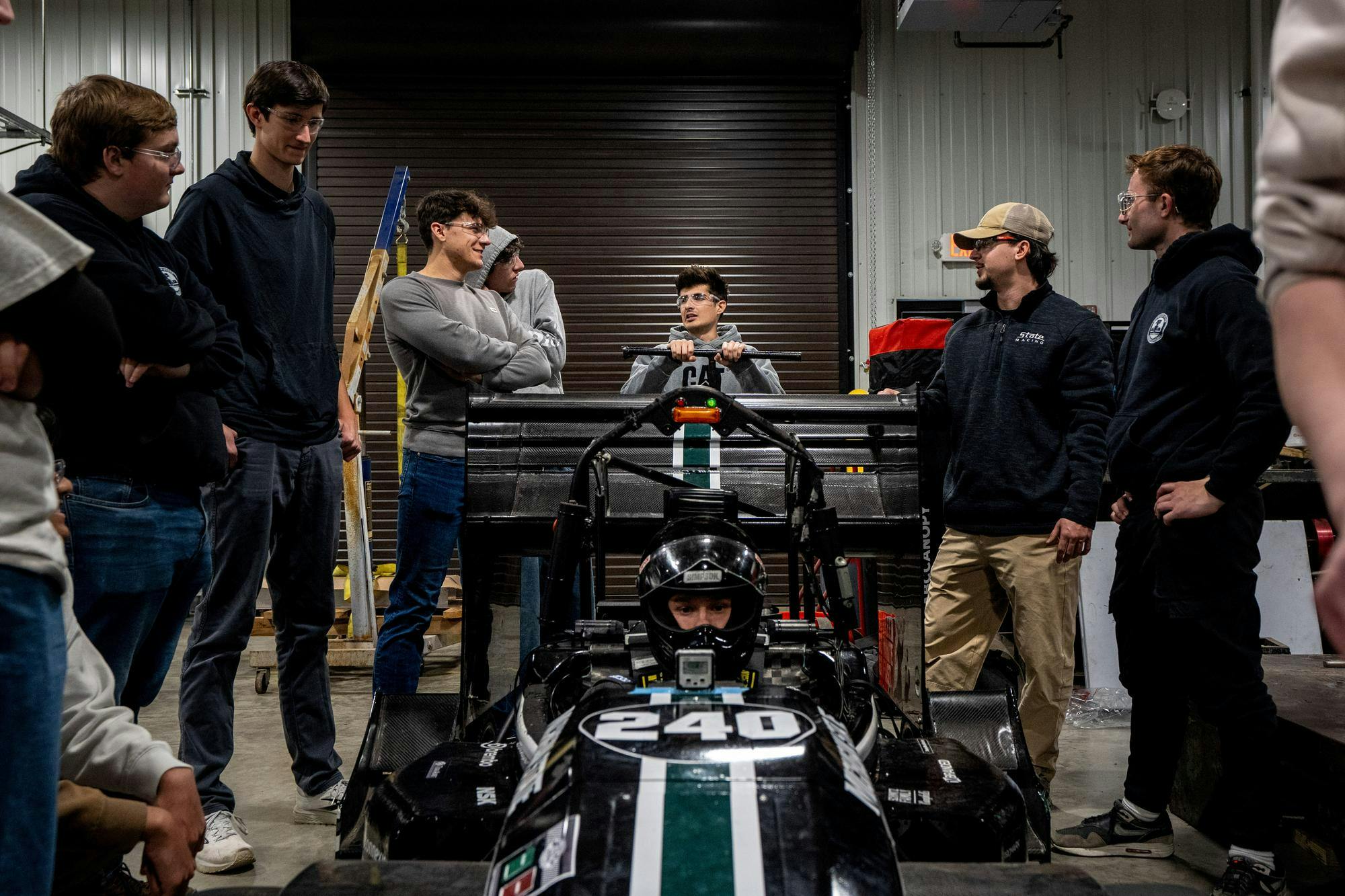
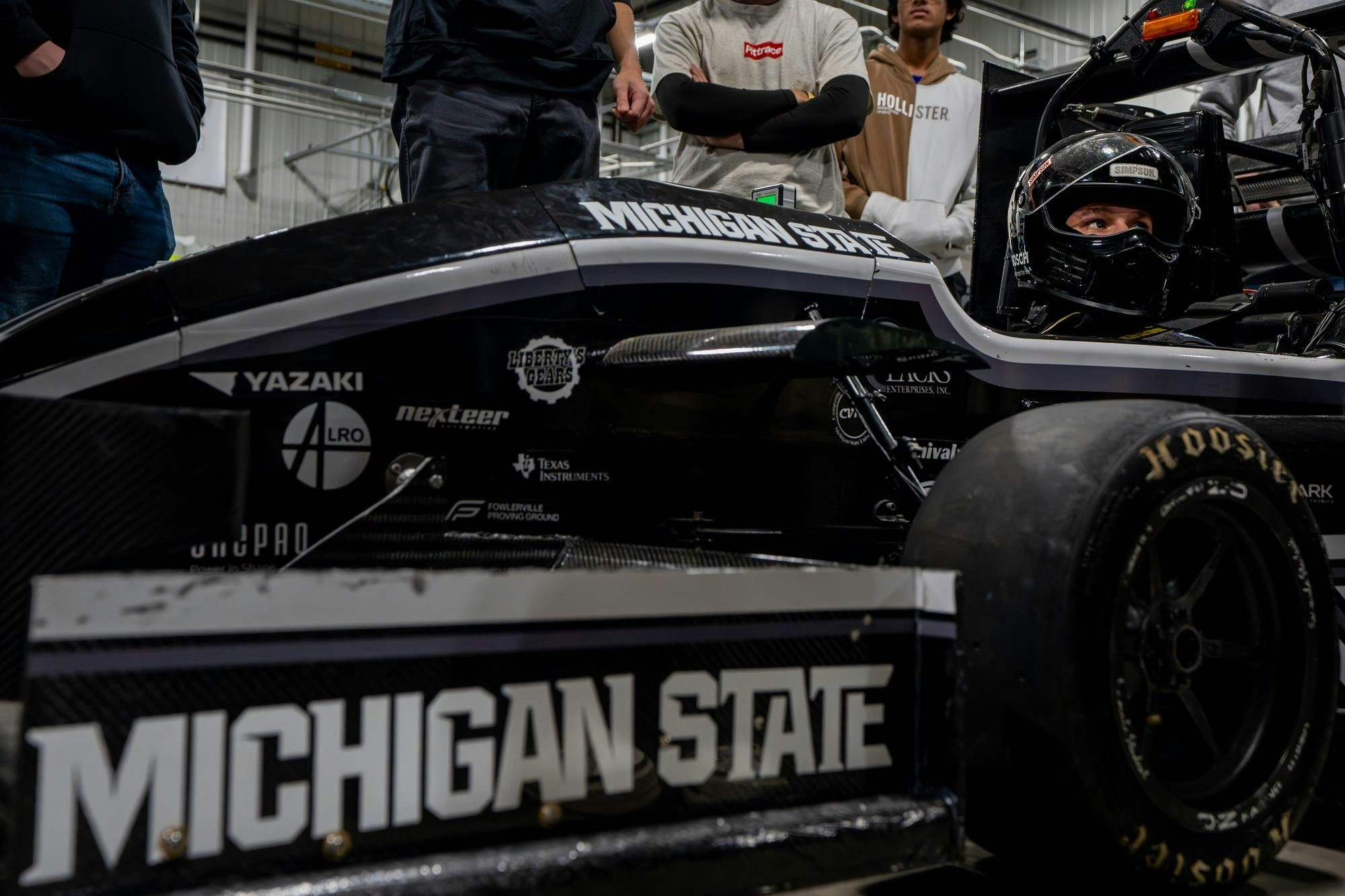
MSU student and member of MSU Formula Racing Team, Carter Ross, sits in car during a center of gravity test as the team discusses the next trial at Michigan State University's William A. Demmer Engineeing Center in East Lansing, Mich, on Saturday, Nov. 8, 2025.
Picturing Formula racing is easy: Think of 20 sleek cars darting through glittering cities — drivers in crisp suits, champagne showers and podiums that glisten under the European sun.
However, what we don’t usually end up picturing are the engineers behind those racing beasts building the cars bolt by bolt, fussing over suspensions and tire durability.
At Michigan State University, a group of students are living that unseen story. Inside a garage that smells faintly of motor oil, the MSU Formula Racing Team is a microcosm of Formula One’s world — except here, the engineers are also the drivers.
"We’re a student engineering-led team," Project Manager Nathan Marchywka said. "Our goal is to basically give students an opportunity to apply classroom principles in the real world."
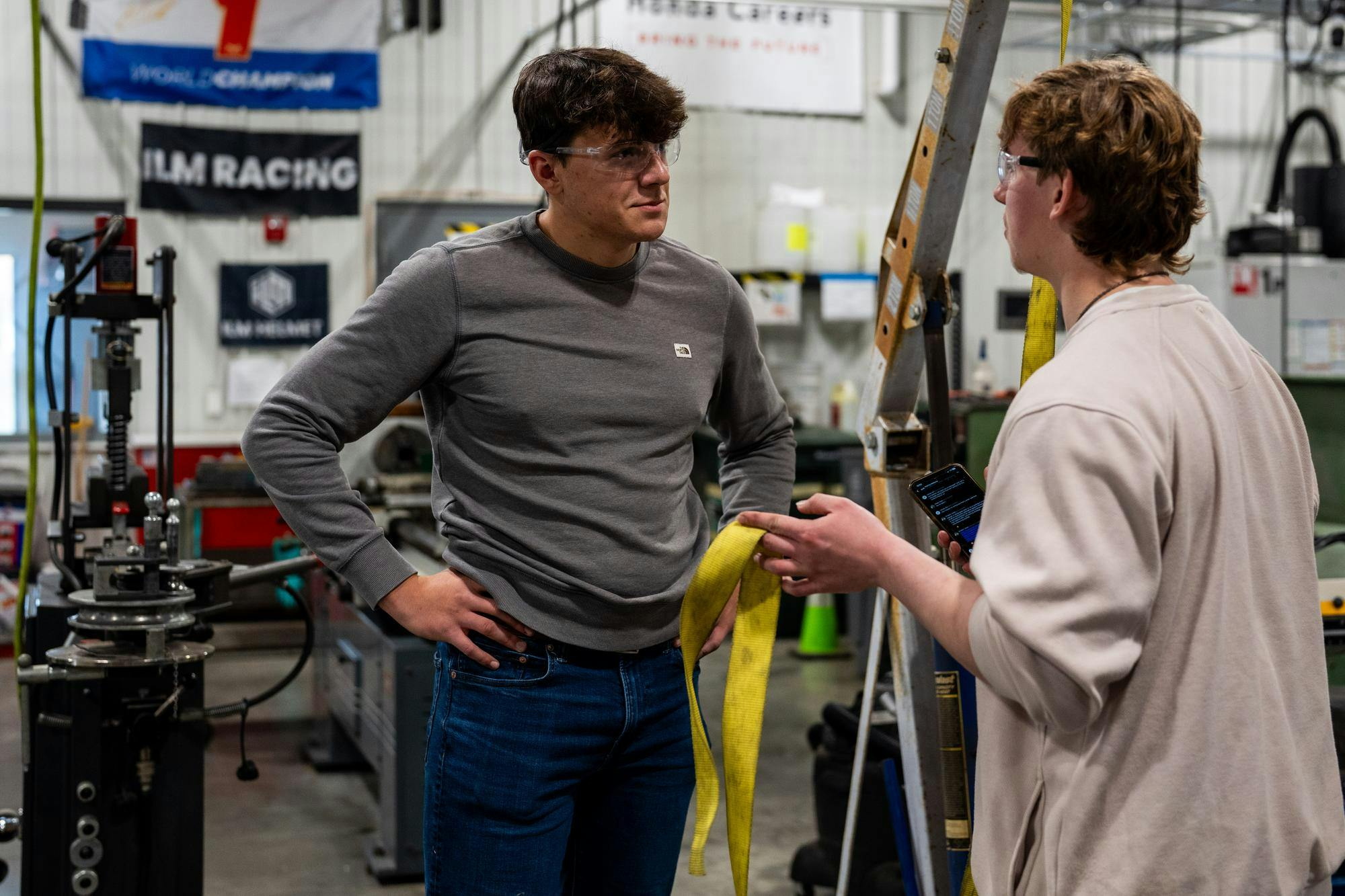
In the garage space, sparks flicker from a welding torch on the left while another student runs simulations inside their presentation room. This team of 20-somethings might not wear fireproof suits every day, but they share the same obsession as any professional pit crew.
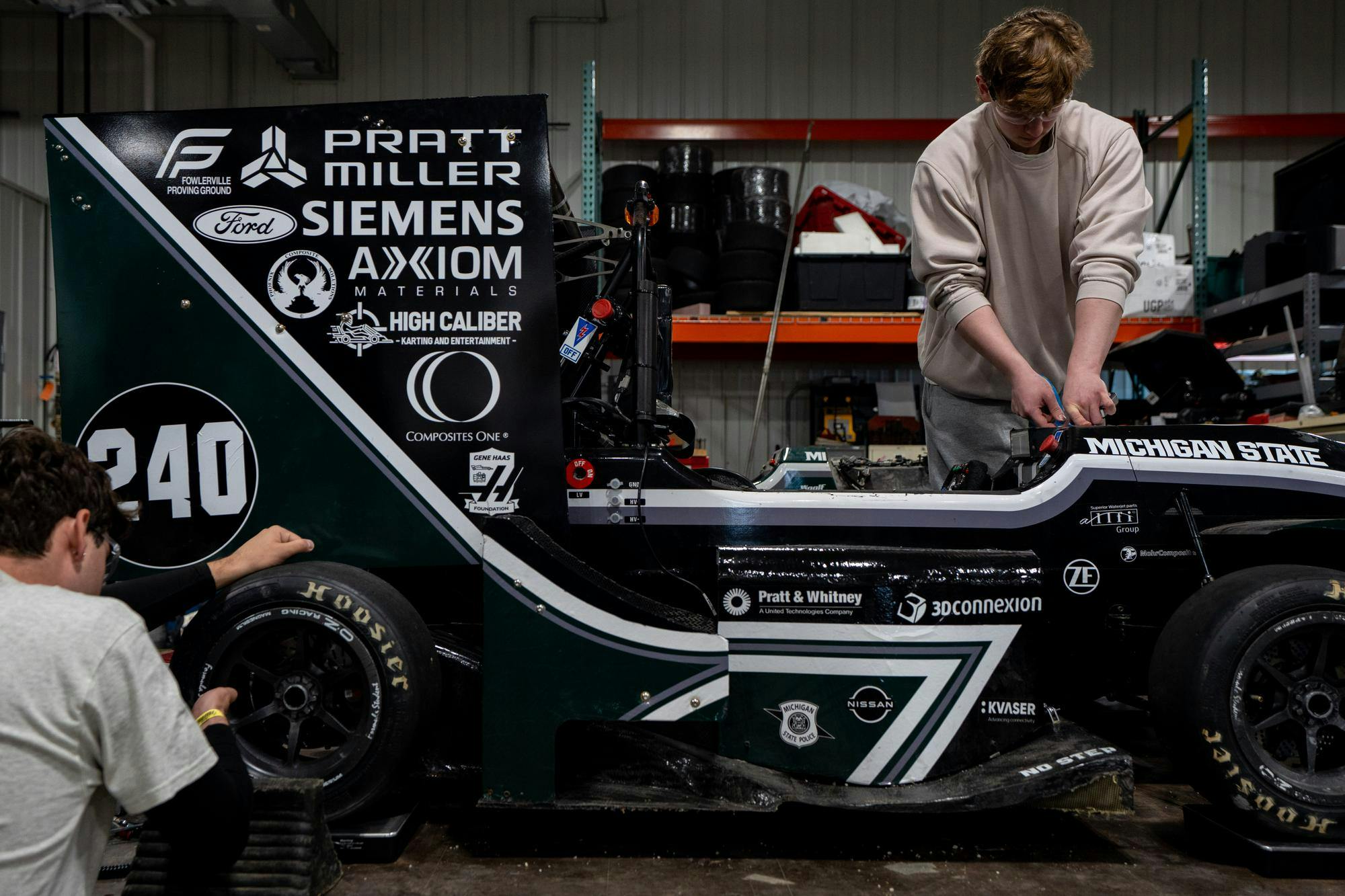
"It’s really awesome to explain to people how we’ve taken nothing and built it into something," driver and outboard assemblies lead Noah Beigel said. "The misconception, unfortunately, for people who’ve never heard of the club, is that they see the car, they see what we’ve built, but they don’t understand that 85% of what is there is what we’ve actually built ourselves here."
Every year, the team designs, builds and races a Formula-style car from scratch — and this year, they’ve taken on their biggest challenge yet: their first fully electric vehicle.
"It’s been a little weird recently because we just actually transitioned from a gasoline car to an electric car," Marchywka said. "This car you’re looking at actually is our first ever functioning electric vehicle. And the point of this is that the more efficient you can make your vehicle, the better you score."
But efficiency doesn’t come easy. Beneath the bodywork lies a labyrinth of circuit boards, sensors and wires — all designed by students who might have only seen those systems on PowerPoint slides a semester ago.
"People who learn circuits in class — they can build actual brand circuit boards here," Marchywka said. "They can integrate them with their vehicle and see how everything ties together."
And for Beigel, that’s the thrill — turning abstract lectures into something tangible and fast.
"We’re able to use everything we’ve learned in class, and then we go take it around the world and compete with it," he said. "It’s a really cool organization because we have the resources to build a car worth hundreds of thousands of dollars — just as a couple engineering students in college."
Still, the journey isn’t all speed and glamour. Sleep-deprived nights and problem-solving marathons are part of the routine.
"We went to Oakland’s competition and had a metal component shear completely off," Marchywka said. "We came back, stayed up all night creating a rudimentary solution, validated it and slapped it on the next day. We were running again — but yeah, that was 48–60 hours straight."
That mix of pressure and pride is exactly what Professor Matthew Meier, who teaches electrical and computer engineering, admires most about his students.
"They build a whole vehicle from raw materials every year," Meier said. "They design the chassis, suspension, electronics — everything. The time they put in is astronomical."
It’s more than an extracurricular, he added — it’s an experience that rivals an internship.
"Recruiters go to their competitions because they know those students will come in ready to go," Meier said. "Honestly, I think most of the time this is better than an internship. We’re the car state; the Big Three are here — Ford, GM and Chrysler — but beyond that, motorsports is a huge thing across the world, and we are taking part of that here."
Support student media!
Please consider donating to The State News and help fund the future of journalism.
The team’s work stretches far beyond the garage. With competition season running from June through October, they test, refine and race at events across North America — from Jackson, Michigan, to Toronto.
"At Michigan Speedway, we’ll be competing against about 100 teams in the electric division," Beigel said. "That’s our biggest and first competition. It’s a massive deal for us."
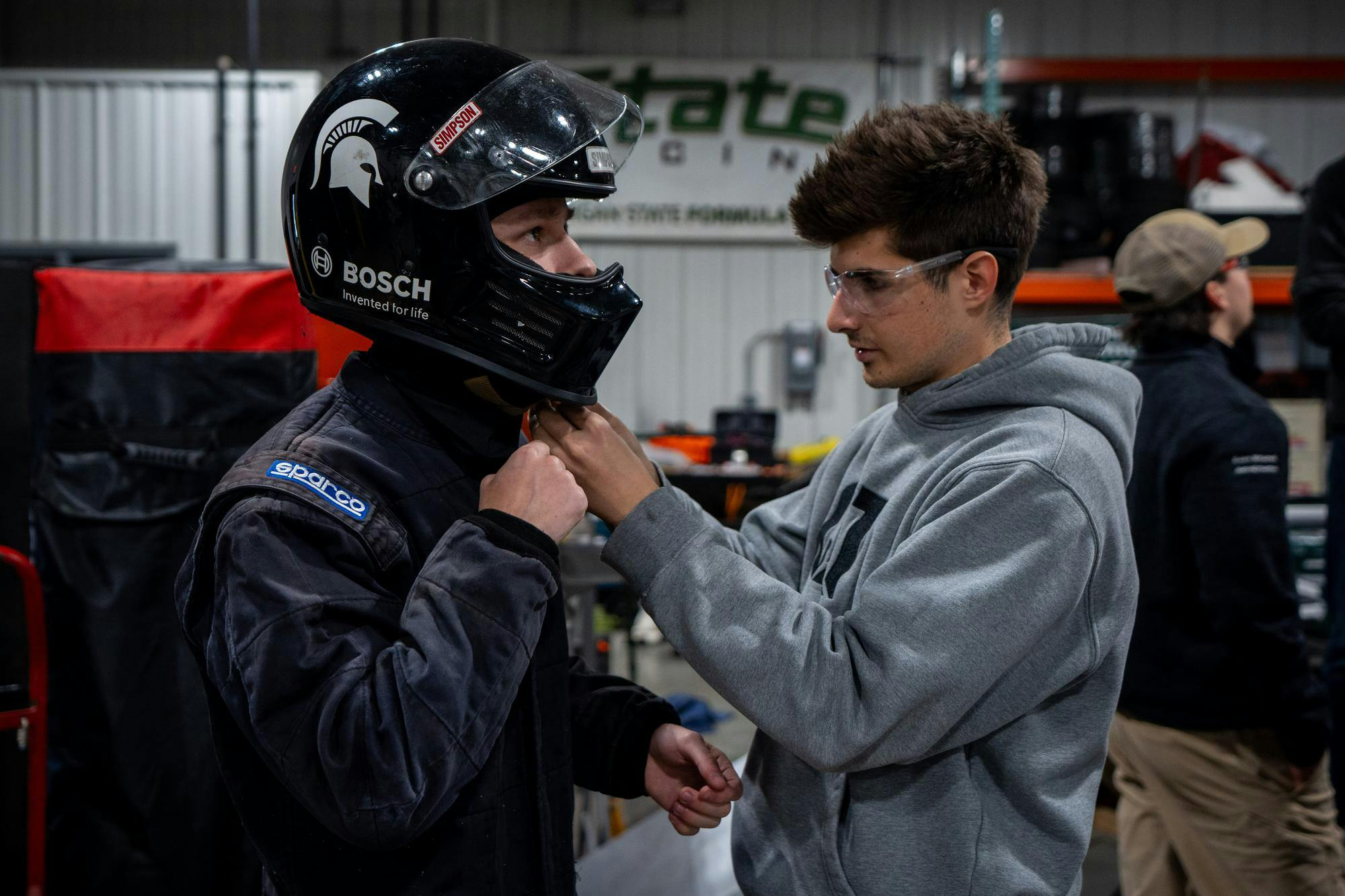
To prepare, drivers spend weeks conditioning their bodies. Formula-style cars don’t have power steering, so the steering wheel fights back — hard.
"Having strong forearms and a strong core is two of the most important things," Beigel said. "If I let myself relax in a corner, my head would just whip the other way, and I’d probably mess up. Our seat mold is also one of the most important things for handling turns; the more comfortable and rigid you are in the seat, the less you’re thrown around — and the more control you have."
Still, what makes the team special isn’t just its machinery, but its community. From the business team writing sponsorship emails to the mechanical engineers laying carbon fiber, each member contributes something essential.
"We allow students to stretch what they thought was possible," Marchywka said. "We’re teaching important life skills on top of that. And honestly, you can learn everything you need to know once you get here, the biggest thing you need is commitment."
Their current car — a sleek, electric-green symbol of Spartan ingenuity — is a reflection of a state built on horsepower, where these Spartans are rewriting what it means to be in the driver’s seat.
As Beigel said, "[They’ve] taken nothing and built it into something."
Discussion
Share and discuss “MSU's Formula Racing Team builds the future of racing from scratch” on social media.