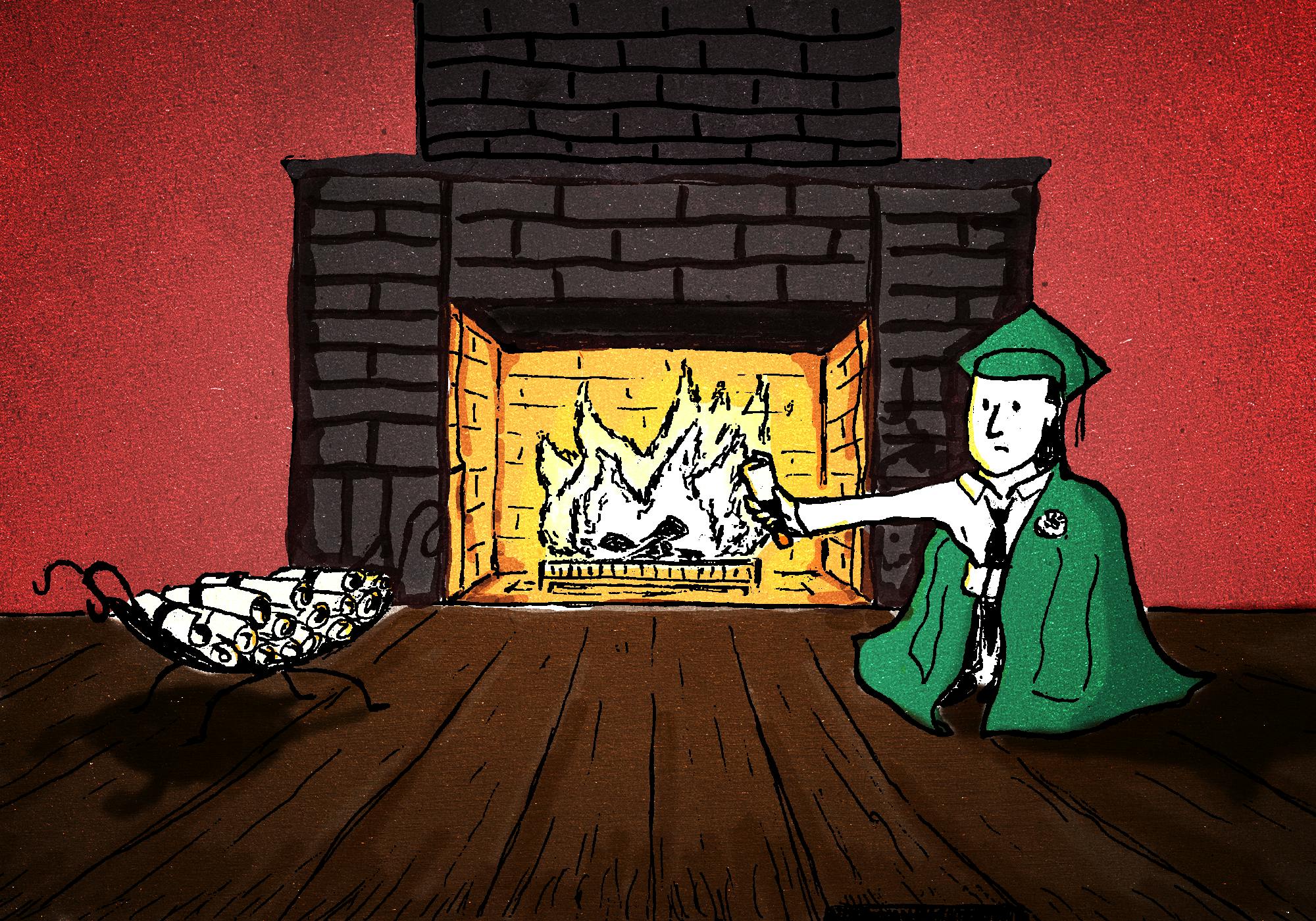
Attending a university to obtain a bachelor's degree has consistently been the most popular and recommended path for high school graduates. However, Michigan State University students and recent graduates say they're not seeing the benefits they expected.
With companies creating steeper requirements for employment, and mass layoffs adding a new level of competition between new grads and mid-career professionals, students are left wondering how much value they're really getting out of their four-year degrees. For many graduates, returning to college for additional certifications and education has become more of a requirement than an option.
Although the decision to return to school for a master's degree after college is usually based on individual goals, there's been a recent rise in "panic degrees" among new graduates. As the availability of entry-level jobs continues to decrease and unprecedented crowds of degree-holders flood the workforce, many students believe the only way to make it in the job market is to go back to school - even when they didn't plan to.
"It was something I was considering, but not necessarily too intensely. Now it’s like, I definitely want to do it more - less because I feel like I need to learn more, but more because it gives me a more solidified way out," professional and public writing senior Ashe Burr said. Burr originally sought a career in publishing, but recently had to make a switch to something they felt was more feasible.
Burr also mentioned a desire to leave the United States as a reason to pursue a graduate program, citing recent budget cuts. "Just given the nature of the United States and the way that funding for the arts and humanities are going, since that's what I study, it's a way out of this country, truly."
Programs outside the US would "not only have funding for the programs that I study, but they also would get me away from a lot of the uncertainty that I currently feel in this country. Everything I hear about the job market now is the absolute worst, and if I don't have to apply to 800 different jobs to get 5 interviews, that would be ideal," Burr said.
Although Burr values their undergraduate experience at MSU, the looming financial stress of student loans for a new graduate in an underfunded field today has lessened the direct benefits of a bachelor's degree.
"Marriage, children, those sorts of life steps don't even feel attainable anymore. The financial stress of college definitely doesn't help that aspect," Burr said.
Current students aren't the only ones feeling pressure to seek higher education. Recent graduates who aren't enrolled in master's programs are feeling the effects firsthand in the workforce. After graduating with a degree in Zoology, Class of 2025 alum Tyler Rybak is struggling after deciding to take time to work before entering grad school.
"As of right now, the outlook isn't the best. It's unfortunate timing as there are less funding opportunities available and no shortage of grad school applicants. Everything that's been happening in the past year has been extra motivation," he said. "The whole field seems to be in a bind right now, as far as that goes."
In a field where many roles are reserved for those with higher degrees, the funding cuts and influx of master's applicants have limited the prospects of anyone who didn't go straight to graduate school.
"It sucks to keep getting rejection emails from prospective advisors, but if they don't have the time or the funds, then they don't," said Rybak.
Another Class of 2025 alum, Caitlyn Sanders, graduated with an Animal Science degree and plans to go into academia, though she originally wanted to pursue animal rescue.
"Right now, with the economy, ultimately it is very difficult to get a full-time position post-grad. That's coming from somebody who has almost 8 years of experience working in shelter settings and being around that environment," said Sanders. She had planned to spend time "getting her foot in the door" after graduation, but in the last year she's looked into graduate programs that provide higher stability.
Sanders expressed that she has a different experience from many of her coworkers while working in a non-profit, but in another facility, she believes her degree would be more of a baseline than a boost.
"I do feel that getting a bachelor's is the correct step for most people if they want to work in a lot of fields, but it definitely doesn't hold the weight that it used to," Sanders said.
Support student media!
Please consider donating to The State News and help fund the future of journalism.
Discussion
Share and discuss “Students change post-grad plans amid job uncertainties” on social media.