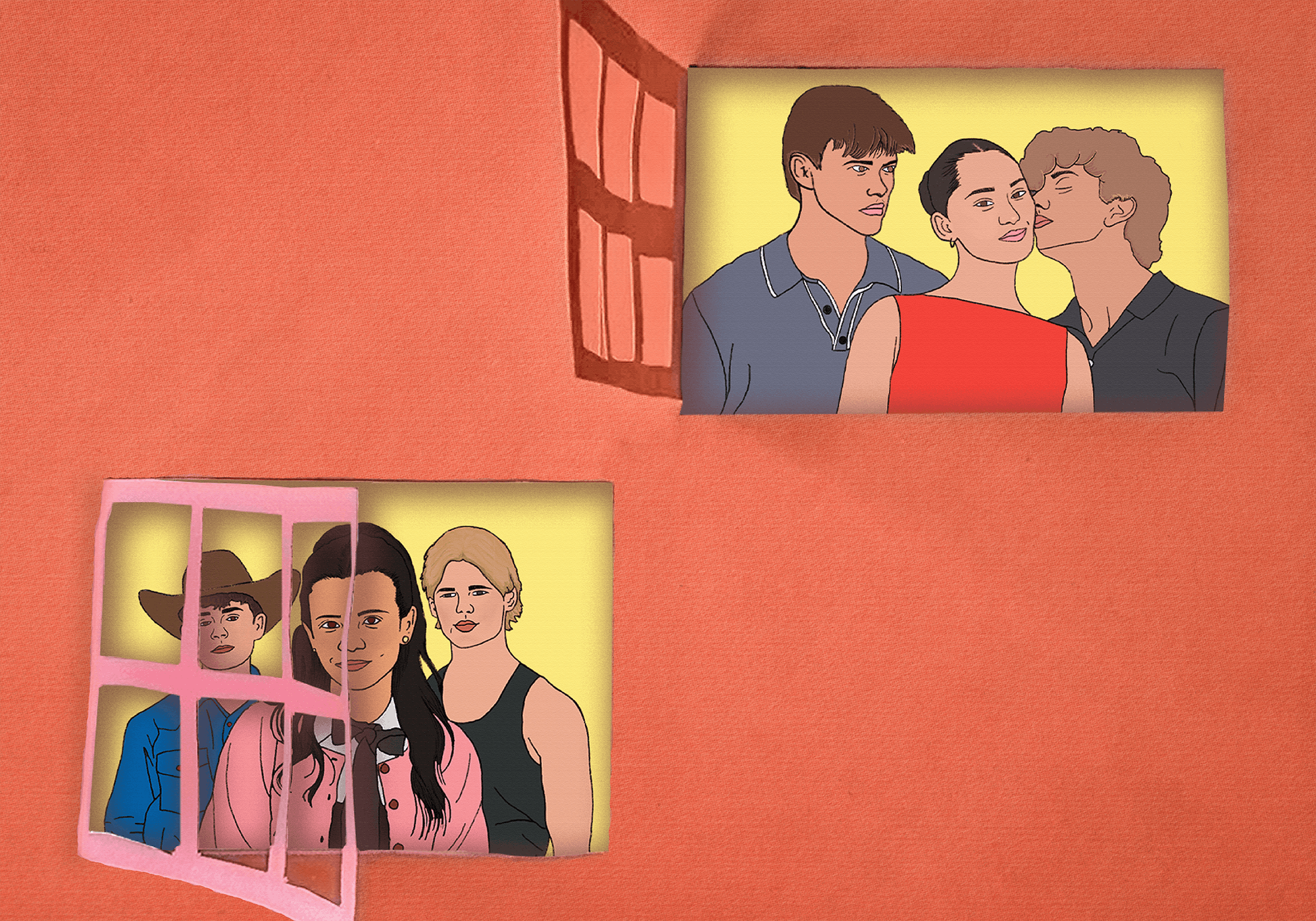
“My Life With The Walter Boys”, was originally written as a young adult romance novel in 2014 by Ali Novak. After getting its tv show counterpart, Novak introduced a 2025 sequel to pair with the original novel and the second season of the show. The show follows main character Jackie Howard as she moves in with her guardian family after an accident, and also finds herself stuck in a love triangle. The first season of the series was released in December 2023, with the second season released most recently in August 2025.
Popular among college students, the shows have accumulated a large following.
Associate professor in advertising and public relations Fashina Aladé said the popularity may be due to the familiarity of the shows.
“I mean, some of it is that these are shows they, to some extent, I think 'The Summer I Turned Pretty', these are probably shows they were watching in high school, and have grown up with and have stayed with them,” Aladé said.
Additionally, Aladé said a mix of “attractive actors and good writing” could also add to its popularity.
Kinesiology senior and a viewer of both shows Avery Sikora said social media also plays a large role.
“...I see a lot on social media, especially with The Summer I Turned Pretty, like fan theories about what's gonna happen in (the) next episodes, and those are usually the posts I see most viral related to the shows is like fan theories,” Sikora said. “...I think a big part of it, at least with “The Summer I Turned Pretty”, is they release an episode each week, so it builds a lot of anticipation and excitement for new episodes to come, and it always will leave you on a cliffhanger each episode. So that's where I see most social media posts about (it) is the anticipation and fan theories about next episodes or new seasons.”
Sikora said she personally was excited to watch “The Summer I Turned Pretty” because she had read the book series.
For psychology and criminal justice senior and “The Summer I Turned Pretty” viewer Talena Meechan, the show appealed to her because of the main character, Belly.
“I thought, at least for me, like Belly’s representation at the beginning of the show, kind of always being like the person that people don't really notice, and her friend Taylor, being the one that everyone talks to in school, was to me, I saw a little bit of myself in Belly, and that's why I originally started watching the show,” Meechan said.
Due to its popularity and origins as young adult books, “The Summer I Turned Pretty” and “My Life With The Walter Boys” audiences aren’t just limited to college students, but instead range from younger viewers to older adults.
However, with potentially toxic behaviors in romantic relationships, such as cheating and manipulation, consistently shown throughout both shows, can this actually harm the perception of healthy romantic relationships to the younger viewers?
Aladé said the scenes depicting toxicity can actually be perceived as learning moments.
“Certainly, they're learning. We're learning all the time from what gets modeled on screen. I think the important part is how it gets resolved. So it's not as though we should only watch things that are, you know, where everything's easy and hunky dory and works out perfectly, right? Like that's generally not what people's media diets are,” Aladé said. “So, you could consider it helpful that they're learning what toxic relationships look like and that, potentially, they're able to identify that, if they, you know, see that their favorite character on screen is not being treated well, maybe that helps the young people be more equipped in sort of spotting that in their own relationships and their friends' relationships. So I think there's a lot of potential to learn from that in a positive way.”
Aladé also said viewer's media consumption isn’t always the most important factor when it comes to learning.
“So, in my professional opinion, whether it's positive portrayals, negative portrayals, like if people have real-life examples of healthy relationships, whether that's from their parents or other adults in their lives, media is neither here nor there, right? It's entertainment. We can sort of see different ways of life. We can see what else is going on in the world,” Aladé said. “The real-world role models are always going to be 10 times more significant than the mediated relationships…I wouldn't say that that's like, ‘Media is bad because it's showing this’, but I think there's situations where I’d be a little bit more concerned, if someone's real-world environment is not providing the positive role models.”
However, Sikora disagrees on the basis that younger viewers may not have necessarily experienced romantic relationships.
“Even while watching that (“The Summer I Turned Pretty”), I always kind of have that in the back of my head, and I feel like that is because I'm older and have been in relationships myself. I know how there's supposed to be a balance, but for people, especially younger girls or girls who have never experienced relationships, seeing like dating within a family or family friends that you grew up with and causing drama and expecting zero consequences to happen, that's where, like, a lot of the toxic thinking comes from,” Sikora said. “I see people making edits and posts on social media that I assume are like younger girls making them, you can kind of tell that are idolizing, like, ‘Oh, like being in love with two brothers and having them both be in love with you is like the ideal situation’, and it romanticizes cheating and infidelity and all that, I think is extremely toxic to younger girls.”
Support student media!
Please consider donating to The State News and help fund the future of journalism.
Similarly, Meechan said younger viewers may turn to media to learn about concepts they may not exactly understand quite yet.
“I think that when, especially when you're younger and you don't know a lot about, like, how to manage friendships and relationships, you get a lot of your information from the media,” Meechan said. “And I think when, like, a lot of the popular show’s dynamic, where it's completely toxic like that, and like, no one is happy, it kind of sets this precedent that it's okay to be in a relationship where somebody treats you badly. I think something I've noticed a lot, especially too, is like solid relationships and shows like this, or like strong relationships when they're healthy, are often portrayed as, like, the boring relationship, and they never end up being the one that the main character ends with.”
Additionally, along with showcasing toxic behaviors within romantic relationships, Sikora and Meechan said there are also other harmful elements that younger audiences could potentially learn from the shows.
Sikora said both shows have similar concerns.
“I think a big harm is that both main characters, Jackie and Belly, don't really face any consequences for any of their actions,” Sikora said. “And I know it's a show (and) they can't go too deep, but both shows had like excessive (underage) drinking or cheating, and this, that, and the other, and they always got away with a slap on the wrist. And although teens are going to do that anyways, it's not realistic, and I feel like it promotes a lot of this behavior. And especially because actors are played by older people playing younger people, I've also seen, like, a lot of body dysmorphia, and girls dressing inappropriately, or this, that, the other for their age, because they're seeing 23-year-old actors play 15-year-olds.”
Meechan said it could also impact another portion of younger viewers.
“I think maybe that could, it could also be harmful to, like, younger boys growing up who witnessed like these toxic behaviors, and they think like somebody like Conrad, who has been, like, very emotionally closed off the whole show, and then he ends up being the one that Belly’s with in the end, at least in the books, and thinking that, like that's a way that you should carry yourself, and that's what you should do in your relationships, I don't think that's a good example to set,” Meechan said.
However, Aladé said the shows are capable of providing moments that can serve as positive models.
“I think there's a lot of potential for these shows to, like, help kids, you know, think through how they would handle similar issues in their lives,” Aladé said. “...I think there is as much potential for sort of good, helpful modeling as there is for any harm…I would probably lean more on the helpful side than (the) harmful side.”
Sikora said that there are moments that provide positive teaching moments for younger audience members, especially involving secondary characters, but doesn’t feel as though it’s enough to impact them.
“I think there's definitely good things that side characters do in both shows that could be very good advice for girls to listen to, but at the same time, I feel like they're always very short clips, or the main character will be mad at the friend for giving that advice,” Sikora said. “And while that's somewhat realistic, I feel like 95% of these shows are promoting more toxic behaviors, and then the moments that should be in the limelight are usually glossed over, or everyone forgets about like after they watch the episode. And I feel like this season, specifically on both shows, side characters at least, have been more adamant and gotten a little bit more of a limelight in calling out bad behaviors, but I feel like that's also after both shows have received a lot of criticism for previous seasons of not promoting good ideas for younger girls and younger audiences.”
Similarly, Meechan said in “The Summer I Turned Pretty”, the “harm would outweigh the positive”.
“I think Taylor (Belly’s best friend), she did eventually object (a) few times (to) what Belly was doing. But something I noticed a lot throughout the show is like nobody really seems to call Belly out that much for how much harm she's causing to everyone, and how much she broke up the family and hurt other people. I think maybe it could help some people, but I also think it could really hurt some people, too.”
Additionally, due to the popularity of these shows on social media, Sikora and Meechan said that users' opinions could influence the way younger viewers view and perceive the characters’ behaviors.
Sikora said she hopes younger viewers will learn from some users criticizing Belly’s actions in “The Summer I Turned Pretty”.
“...I know I can read a comment and get swayed in a certain way sometimes. So I hope they're reading the ones that are condemning it (Belly’s actions), because I have seen a lot more comments recently condemning, especially Belly’s behavior, because this season, Belly has been on one,” Sikora said. “But, I've seen a lot more criticism towards main characters, and they can still appreciate the show while criticizing bad behavior. So I hope girls are reading those comments. But I've also seen a lot of comments promoting or romanticizing the cheating and dating brothers and ruining, like, family dynamics and stuff.”
Similarly, Meechan said in terms of “The Summer I Turned Pretty”, the way one relationship is portrayed versus the other on social media by users can potentially affect younger viewers.
“To me, I always saw Belly and Conrad's relationship as very toxic and just not one you'd want to be in,” Meechan said. “But online, it's incredibly popular. It's way more common than people who support Jeremiah, and it's romanticized heavily, and it kind of is portrayed in a way that makes you forget about all the really bad stuff he's done to her and all the bad stuff she's done to him, because they're romanticizing the parts of their relationship where it was good and they didn't have that, like, resentment.”
Overall, Meechan said the shows can be misleading younger audience members about what a healthy relationship may look like.
“...I think it kind of sets this precedent that, like a good relationship has to be really dramatic, and there has to be drama. And I just don't think that the idea of a love triangle is a very healthy thing.”
However, Aladé said there isn’t “too much of a reason to be concerned”.
“So at the end of the day, typically when we're looking for, ‘Oh, you know, this show models something bad, it must have a bad impact on teens’, it doesn't usually work that way…With adolescents who are, like, deeply entrenched in these peer relationships, or like, in feeling the importance of these peer relationships, media helps them work through this stuff,” Aladé said. “...the nature of the effects of these shows is so dependent on whether kids are sort of talking about them (and) watching with adults in their lives that can really change the nature of that effect.”
Discussion
Share and discuss “"The Summer I Turned Pretty" and "My Life With The Walter Boys" popularity brings mixed reactions” on social media.