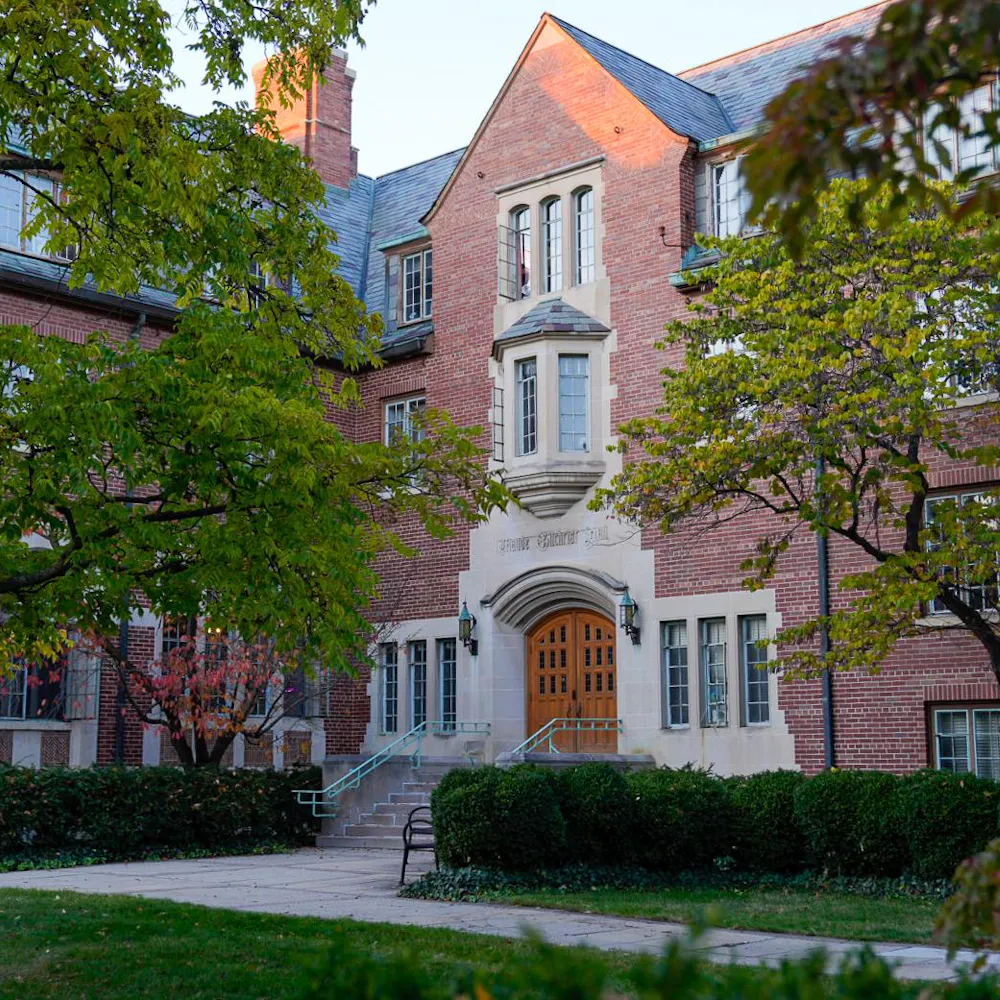
Michigan State University's Hannah Administration Building houses the administration of MSU in East Lansing, Michigan, pictured on May 23, 2025.
A growing share of Michigan State University students say that using violence to stop someone from speaking on campus is acceptable, at least in rare cases.
The percentage of students who agree with that notion has more than doubled in recent years, from 18% in 2022 to 38% this year, according to a recent report from the Foundation for Individual Rights and Expression, or FIRE, a non-profit that tracks free speech rights on college campuses.
The group surveyed 311 MSU students who were recruited through web advertising, email campaigns and university partnerships from Jan. 3 through June 5, 2025. Though FIRE says that it tries to ensure the results are representative of an institution, it admits that surveys can be subject to error or bias due to question wording, context and the order of questions.
Also growing are the shares of students nationwide who at least rarely would accept shouting down a speaker, preventing them from speaking on campus, blocking other students from attending a campus event and using violence to stop a campus event.
The data comes at a fraught time for campus free speech — student protests over the Israel-Hamas War have invited intense scrutiny from the current federal administration, while institutions like MSU have committed to remaining neutral on global issues. Meanwhile, political violence is on the rise in America, with experts noting the increasing frequency and severity of violent acts.
Those two forces collided on Wednesday, when conservative activist and Trump ally Charlie Kirk, whose myriad of recorded debates on college campuses propelled him to political fame, was assassinated at an event at Utah Valley University. Kirk visited MSU in April, intellectually sparring with students in his signature debate format while protestors looked on.
“However one feels about his activism, this is not how we should comport ourselves in the United States,” said Michelle Deutchman, the executive director of the UC National Center for Free Speech and Civic Engagement.
MSU in recent years has been the site of several contentious student protests, demonstrations and political events, the vast majority of which have not been obstructed or faced violence.
In April 2024, an MSU student was arrested after flipping over a table and punching two students who were demonstrating inside Brody Hall. The demonstration, set up by conservative student organization Young Americans for Freedom, featured a transgender flag and literature stating that “Men cannot be women.”
University Spokesperson Amber McCann said in a statement to The State News that freedom of expression is a “critical component” for the attainment of the institution’s goals of fostering an inclusive environment that supports students’ education and innovation.
“That is why MSU makes available online resources in support of freedom of speech, and has adopted guidance like institutional restraint in support of the university’s commitment to serve as a forum for civil and respectful debates, not proponents within them,” McCann said.
The right to express ideas and opinions without fear of government reprisal is firmly established in the bedrock of American democracy. But, Deutchman said that the actual value and benefit of protecting speech, including ideas that most people may find detestable, has eluded some people. Universities could play a part in educating students about the value of those protections, she said.
But universities are only one institution, Deutchman said, and any concentrated effort to combat political violence and an openness to it would need to involve various public and private parts of society — be they individual families or news organizations.
“Especially in a moment where political polarization rules the day — and we’re already starting to see it — this is becoming an issue about politics,” Deutchman said of Kirk’s assassination. “When really what it should be about is a violation of how we should be living in American society.”
Other findings from the FIRE report include that over a third of MSU students said they self-censor on campus at least once or twice a month. The university ranked 60th out of 257 American universities and was the third-highest-ranked institution in the Big Ten conference.
At the same time, FIRE gave the university an F grade for students’ perceptions of political tolerance on campus and for their perception of MSU's administration's support for free speech.
Deutchman said students could potentially benefit from classes dedicated to teaching how to have dialogues with people who hold opposing views and come from different backgrounds. Professors establishing no-video or audio recording policies in class could also help students feel safer experimenting with novel ideas without fear of social repercussions.
Without developing the "muscles" of open and respectful dialogue, she said, “I don’t know how we can expect that our future leaders and citizens are going to be able to do that, both in university and then when they get out into the world.”
Support student media!
Please consider donating to The State News and help fund the future of journalism.