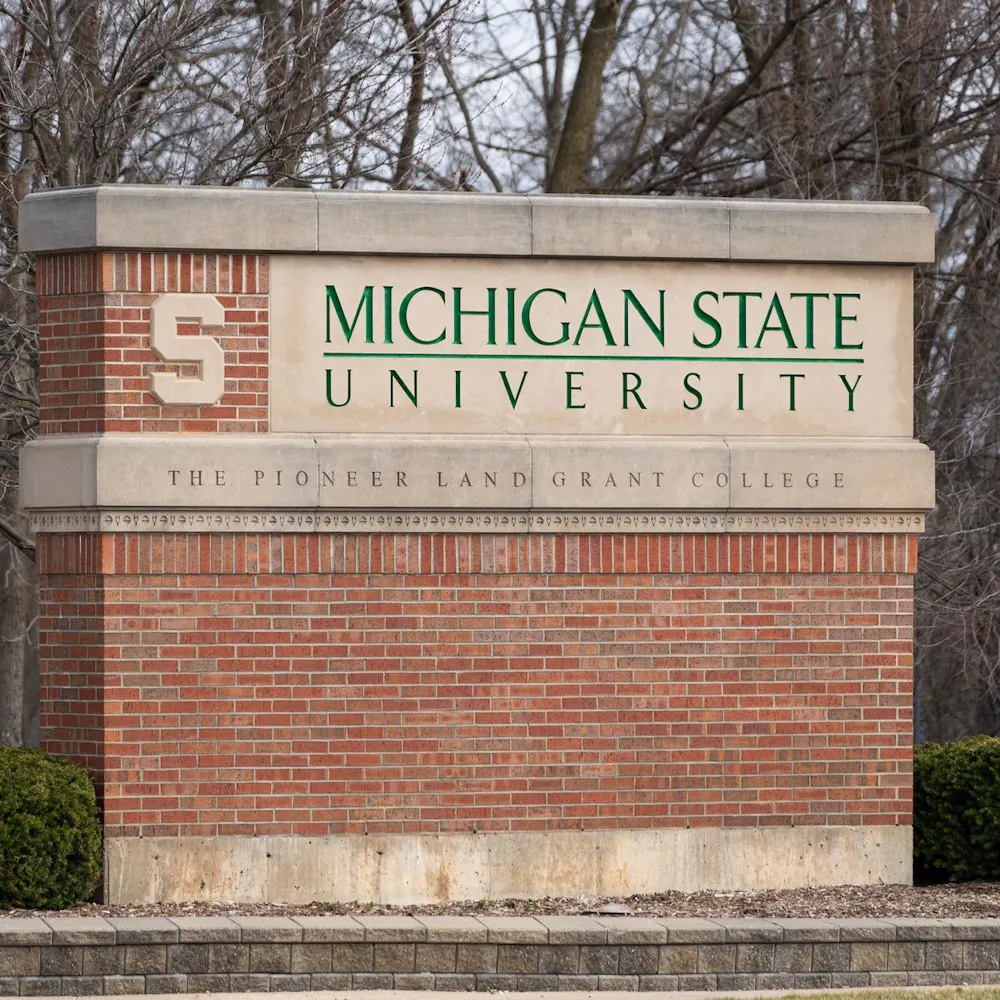
In the 1960s, Michigan State University Researcher Dr. Barnett Rosenberg was awarded a National Science Foundation grant that led to an unexpected breakthrough in testicular cancer treatment. On Tuesday, more than 50 years later, his accomplishment was awarded with a Golden Goose Award at the Library of Congress.
The recognition comes as MSU and its Big Ten peers advocate for their societal value in the face of the Trump administration's higher education crusade and its cuts to federal funding for university research. In fact, the breakthrough Rosenberg was recognized for is one that President Kevin Guskiewicz has regularly held up recently as an example of the importance of MSU's research.
Rosenberg’s daughter, Tina Rosenberg, was asked at Tuesday's award ceremony what her father, who died in 2009, would have said if he was at the ceremony, according to a recording of the event on the Golden Goose Award's website.
“He would have said you should fund federal sciences.” she said.
Rosenberg was honored along with lab technician Loretta VanCamp and graduate student Thomas Krigas, who made up his small research team.
When the group started their grant-funded work decades ago, they weren't initially looking for cancer treatments, according to The Golden Goose Award's webpage about Rosenberg's award. Rather, they were investigating how electric fields affected cell division in E. Coli.
Through their experiments, they eventually found that platinum compounds released from electrodes were preventing the E. Coli cells from dividing and warping them into an elongated form, the webpage says. That "serendipitous finding" ultimately led to the development of Cisplatin, a platinum-based chemotherapy drug that the FDA approved in 1978.
The coincidental nature of Rosenberg's breakthrough is largely the reason it's being honored. According to its website, The Golden Goose Award was inspired by a facetious honor that former U.S. Sen. William Proxmire gave out yearly to scholars working on federally funded research he saw as wasteful. Proxmire, a fiscal hawk, called it the "Golden Fleece Awards," and handed it out from 1975 to 1988.
Proxmire's arguments endure today. The Trump administration has framed its own cuts to federal funding for research as justified by its perceived wasteful nature.
Decades removed from Proxmire's sarcastic award, former U.S. Rep. Jim Cooper sought to counter the message by highlighting unforeseen scientific discoveries, according to the webpage. In 2012, Cooper's pitch came to fruition, when the Golden Goose Award's founding organizations gave out their first awards.
"The nature of scientific research is that its impact is hard to predict," the webpage says.
MSU Vice President for Research and Innovation Doug Gage echoed that framing in a press release, calling Rosenberg's Cisplatin discovery a "stellar example of how fundamental research can have unexpected, profound impact in a completely different domain."
He continued that, "The combination of curiosity driven research and applied research toward a specific outcome has been at the heart of the nation’s international leadership in science and technology. Strong federal support of both basic and applied research is essential for our continued dominance."
Today, Cisplatin is not only used for testicular cancer, but is a common chemotherapy drug, according to the Golden Goose Awards. Prior to Rosenberg’s research, the survival rate for testicular cancer was 10%. After Cisplatin, it rose to 90%.
Over Rosenberg’s decades of research, he was continuously awarded federal grants.
“It was absolutely critical, right?" said MSU College of Natural Science Dean Eric Hegg at Tuesday's ceremony "Because you have, in this case, the National Science Foundation who was funding really fundamental research, trying to understand how cells work."
Rosenberg was a biophysics professor from 1961-1979 and in the chemistry department from 1980-1997 at MSU.
"You can't predict what you're going to get, and this was a great example of that,” Tina Rosenberg said at the ceremony. “And sometimes it works out in a way with a lot of impact.”
Support student media!
Please consider donating to The State News and help fund the future of journalism.
Discussion
Share and discuss “MSU researchers honored for unexpected cancer treatment breakthrough” on social media.