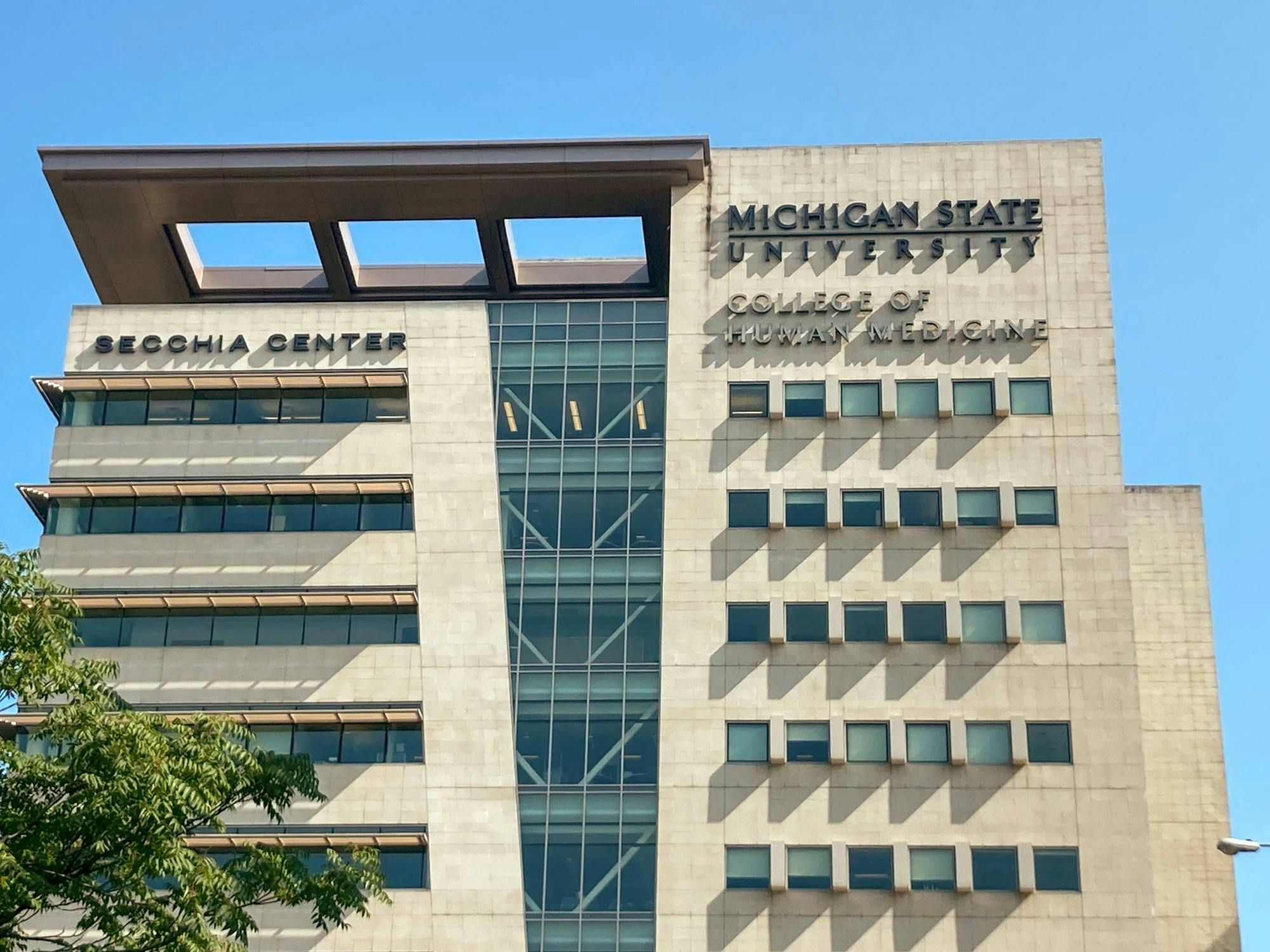
The dean of Michigan State University’s College of Human Medicine is resigning from his post amid a broader restructuring of the institution's medical programs that is contested by some involved faculty.
Provost Laura McIntyre announced to campus leaders Wednesday that Aron Sousa would be stepping down after serving as dean since 2022. He is accepting a new position as president of Rosalind Franklin University of Medicine and Science, based in Chicago, according to the announcement, which was shared with the The State News by a spokesperson.
Supratik Rayamajhi, associate dean for clinical affairs in the College of Human Medicine, will start as interim dean on Oct. 1, pending approval from the Board of Trustees.
Sousa’s resignation comes as MSU plans a reshaping of its medical programs. The so-called One Team, One Health initiative, announced by President Kevin Guskiewicz in February 2025, proposes merging the College of Human Medicine and the College of Osteopathic Medicine into one college, the creation of a wholly new "College of Health Professions," and establishing an institute for collaborative biomedical research.
University leadership has touted the project as a catalyst for improving students’ education, harnessing MSU’s medical research capabilities into a united agenda and bringing medical and industry partners into collaboration with the institution’s biomedical research arm.
But the initiative is not popular within the College of Human Medicine, according to an internal survey of the college's faculty, which was circulated among faculty Tuesday and obtained by The State News. Respondents said information about the plan and its potential impacts on their work has been scarce. They also argued that merging the Colleges of Human Medicine and Osteopathic Medicine — which, despite both aiming to produce physicians, differ in their practices’ root philosophies — would be unproductive at best, and a destabilizing mistake at worst.
Sousa has led the College of Medicine since 2022, after having served twice as interim dean, according to Wednesday's announcement. He helped establish a new public health research facility in Flint, which opened in August 2025, and another research park in Grand Rapids. In 2024, Sousa took on the role of Executive Dean for MSU Health Colleges in which he “began exploring new opportunities for university structures, alignment, and improved ability to produce outstanding healthcare leaders.”
Sousa did not respond to requests for comment at the time of publication, but he did address the news in a message to the College of Human Medicine sent Wednesday, and obtained by The State News.
Although he's excited to take his new new role, the decision to leave MSU “has been painful," Sousa said. He also celebrated the college's expansion of its educational reach in rural Michigan and touted its status as the leading college at MSU in total research funding.
"I know these are, at best, interesting times, nationally and locally, which means each decision spins off innumerable possible outcomes," Sousa said in the message's concluding paragraph. "I take solace that we have excellent leadership in the dean’s office, innovative and engaged chairs, and, especially, spectacular staff, faculty, and students. I ask you to remember that we are serving the people and not serving the person, and with that spirit you all will continue to do our noble, important work."
As a part of the One Team, One Health initiative, Sousa served on the council responsible for evaluating the plan's feasibility, including how to ensure the new and merged colleges gain accreditation.
That council is currently garnering feedback on its draft recommendations, which will be finalized in late October and presented for Guskiewicz to consider, Council Co-Chairs Kim Dodd and Norm Hubbard wrote in a message to college leaders last week shared with The State News.
Sousa was also a member of an earlier council, the Health Sciences Council, that first presented the initiative’s core tenets as options to Guskiewicz.
The council’s report found that the decentralized structure for MSU’s colleges and departments posed significant challenges for health sciences, including duplicating research efforts in siloed departments and hampering the programs’ ability to secure grant funding as a unified front. It also notes that drastic changes, like consolidating two colleges, “may face resistance and require careful change management.”
Results from a survey of the College of Human Medicine faculty provide a glimpse into the objections some have about the plan. More than half of the respondents said they are at least somewhat opposed to voting in favor of the merger, according to the survey.
“These institutions exist separately for a reason: the curricula, philosophies, and student experiences are distinct, even though they align in producing physicians,” one faculty member anonymously wrote in a survey response. “Combining leadership dilutes identity, undermines accreditation, and erodes trust among faculty, staff, students, alumni, and future partners.”
Thirty-two percent of respondents "somewhat disagreed" with the notion that the benefits of One Team, One Health outweigh the disruptions, while nearly 20% at least "somewhat agreed" with that idea. Another 48% said they either don’t know or “neither agree nor disagree.”
Furthermore, over half of respondents said they either "strongly disagree" or "somewhat disagree" with the statement that "the process for evaluating [One Team, One Health] has been transparent." Nine percent said they were indifferent on that point, whereas 18% responded "I don't know." Seventeen percent said they either "agree" or "somewhat agree" that the process has been transparent.
MSU Spokesperson Emily Guerrant said she had not seen the survey results and declined to comment on faculty sentiments regarding the initiative. She instead pointed to Dodd and Hubbard’s update on the plan.
“We recognize these discussions touch on areas of pride and identity across our colleges and programs,” Dodd and Hubbard wrote. “There is rarely an ideal moment to consider significant change in an organization as large and complex as MSU. That’s why your voices, perspectives, and experiences are essential. We are committed to transparency, inclusivity, and an evidence-based approach to ensure the final recommendations are both visionary and practical.”
Support student media!
Please consider donating to The State News and help fund the future of journalism.
Discussion
Share and discuss “MSU human medicine Dean resigns amid contentious restructuring” on social media.