Idly thumb through the Spartan football archives and what’s something that can be found?
Defense.
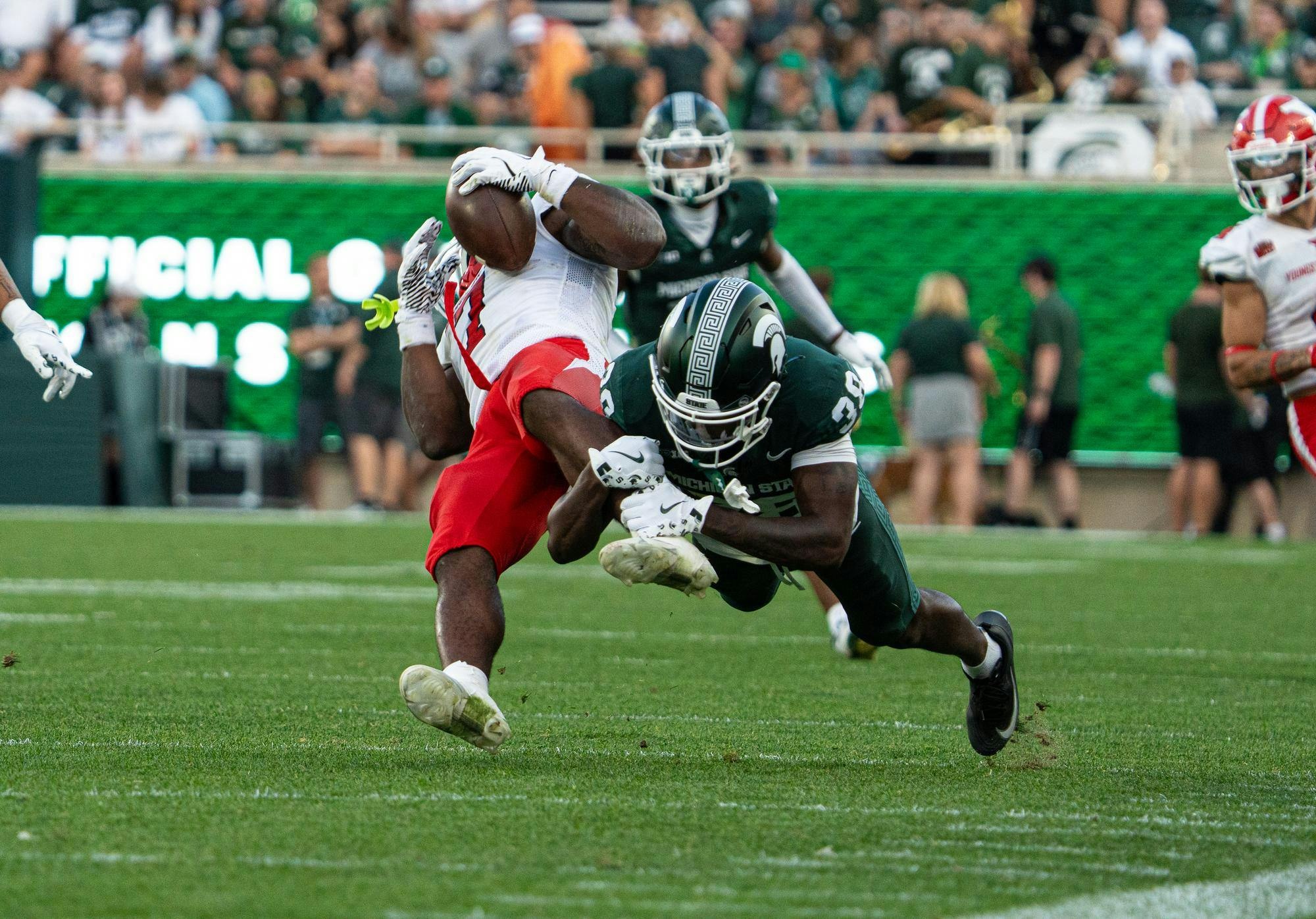
MSU defiensive back Dorian Davis takes down Youngstown State running back Jaden Gilbert (7) during the match up against Youngstown state in Spartan Stadium in East Lansing, Michigan on Sept. 13, 2025.
Idly thumb through the Spartan football archives and what’s something that can be found?
Defense.
It was once the Spartan pillar of power — the pride of the green and white — where defensive units were forged year after year, accumulating stops, turnovers, and unforgettable moments that will be regaled for generations. They brought championships, wins, and everything else that now feels few and far between.
But such good things are now something of a Spartan pastime, only memories to be reminisced. Going into its first bye week of the 2025 season, defense is something that Michigan State football (3-1, 0-1) needs to fix in order to win the big games.
"My expectation is for us to play better," defensive coordinator Joe Rossi said after last week's practice in preparation for No. 25 USC. "That’s what I want to see. If we’re more consistent, then it’ll be to the vision that I kinda had."
Unlike what Rossi says, MSU’s defense is consistent – just consistently inconsistent. This season, the Spartans rank in the bottom half of the NCAA in multiple defensive categories – 103rd in points per game (28.75) and 92nd in yards per game (384) – finding consistently in all the wrong places.
To strengthen these numbers and to reform this defense which has struggled so mightily, Rossi and his green and white squad must limit opponents passing efficiency, be better on third downs and generate stops in the red zone.
If such things can’t be obtained, then MSU’s offense must put up points. A lot of points.
An aerial assault's paradise
In today’s age of college football where air raid offenses, nifty quarterbacks and guru offensive coordinators scheme for passing success, the ability to stop opponents through the air becomes an important key to a championship team. Through four games, it’s apparent that MSU does not possess this important key.
Spartan success in stopping the opponent's passing game has been anything but good – meek would be a good label, bad at minimum. MSU’s opponents have gone 94-for-139 with 1054 yards and a 9-2 touchdown to interception ratio, putting MSU at 112th in the nation in defensive passing efficiency. This is a significant diminish compared to last year's passing defense, which ranked 54th in the same category.
So, what’s gone south, and why has stopping the pass been such a difficult task for Spartan defenders?
It all starts with accumulating pressure and sacking the quarterback, something that MSU hasn’t accomplished. This season, the Spartans have sacked the opposing quarterback six times, which ranks 95th in the nation. Four of these six sacks came during week one’s victory over Western Michigan.
When the Spartans have managed to generate pressure — which has been rare — they haven’t finished the job. Against USC, there were flashes of a promising pass rush, but the inability to sack quarterback Jayden Maiava highlighted a harsher truth: MSU’s pass rush still isn’t good enough to compete with the Big Ten’s aerial attacks.
The inability to generate pressure and record sacks correlates with MSU’s problem of covering receivers. Whether it be via miscommunication, misidentification, a lapse in technique or just the plain lack of talent, the MSU secondary has not done its job in generating optimal coverage. Too many receivers are open, leading to too many easy passes.
To stop an opponent's aerial assault demands complementary football – both by getting to the quarterback and by covering receivers. If this is displayed, consistent inconsistencies will no longer be consistent.
Three downs aren’t enough – there needs to be a fourth
If football was played with three downs instead of four, MSU’s defense would be a blueprint of success.
Unfortunately for Spartan fans, football is played with four downs, and four downs are infrequently seen when opposing offenses take the field against MSU’s defense. This is because the Spartans can’t seem to find a way to get off the field; unable to find that key fourth down that would end the drive.
MSU’s defense has allowed 23 third down conversions out of 51 attempts, a stat that ranks the Spartans 112th in the nation.
Support student media! Please consider donating to The State News and help fund the future of journalism.
Whoever dared to stay up and watch MSU versus USC witnessed this stat on full display. The Spartan defense would force the Trojans into a third down scenario, only to collapse when the play was run, prolonging the drive and keeping MSU’s defense in and its offense out.
During that game, the Trojans went 8-for-12 on third downs. It was a large reason as to why the Spartans aren’t sitting comfortably at 4-0 right now and is a large reason as to why they're at risk of losing more games in the future.
To see improvement on this issue, it comes down to execution, not just on third down, but on first and second down, too. If the Spartans can limit yardage on the first two downs, then third downs become easier, placing pressure onto the offense, and pressure on the offense always favors the defense.
If you bend, you shouldn’t break
Letting opponents drive into the red zone is one thing, but letting them score is a whole other problem, one that MSU has recently become accustomed to.
This season, when the Spartan defense has had its back against the wall, they have not fought back or adjusted well, allowing opponents to score 17 times on 19 redzone attempts, a statistic which ranks them 89th in the nation.
Redzone woes can be attributed to a handful of different factors. For MSU, their factors include communication issues and generating turnovers.
All year, no matter where on the field, communication has bested MSU defenders, creating identification issues, read issues, gap issues and coverage issues. When in the redzone, these issues seem to intensify, and MSU often pays for it by allowing a touchdown.
Like the fizzled communication, generating turnovers has also bested MSU defenders. Through four games, the Spartans have only accumulated four turnovers, ranking them 74th in the nation and playing key as to why offenses have such high redzone success.
Communication and turnovers are key to stopping offenses in the red zone. Communication builds awareness, awareness drives execution, and execution leads to turnovers — which means stops. Stack enough stops, and you start stacking wins.
When a side of the football isn’t performing, an extra week of practice, film and rest can go a long way. Experiencing its first bye week of the season with a winning record, MSU has the chance to fix these issues before traveling to Memorial Stadium on Oct. 4 to face Nebraska.