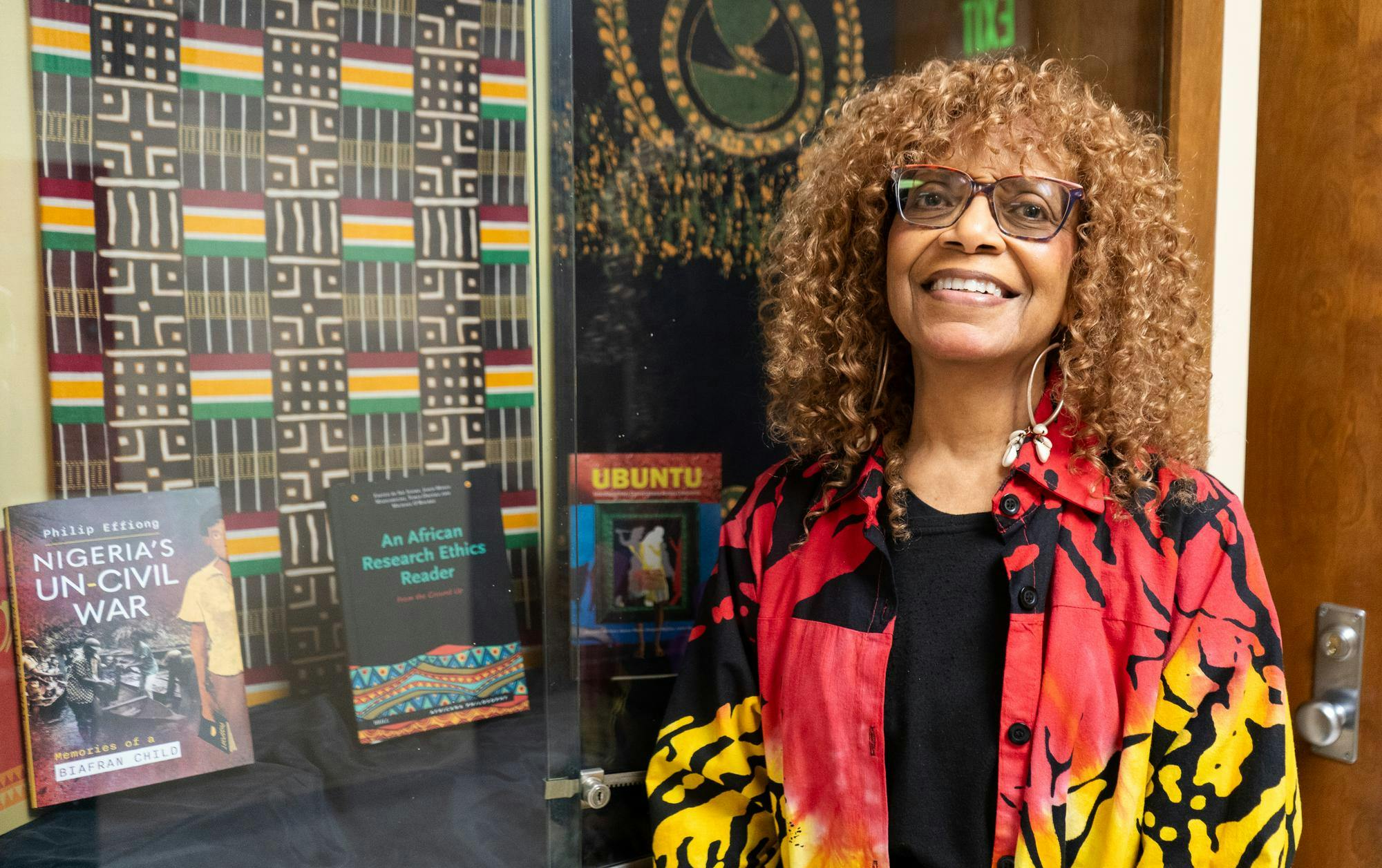
Denise Troutman was teaching at Bennett College in North Carolina when she came across an article titled "Black English" in Psychology Today. It was that moment years ago when she decided it was time to pursue a Ph.D.
"I decided it was going to be whatever major I needed to study Black language," Troutman said. "The major it had to be was linguistics, and I have no regrets."
Troutman, now an associate professor of linguistics at Michigan State University, teaches writing to first-year students and linguistics and sociolinguistics to undergraduate and graduate students. Whether the lens is through writing or linguistics, Troutman teaches her students about the history, practices, misconceptions and power of Ebonics. Ebonics, a fusion of the words "ebony" and "phonics," refers to African American Vernacular English (AAVE) as its own language. (The term itself is contested in the field; Troutman chooses to use the term "Ebonics.")
"I decided that there’s one way that I could help to interject change, that I could teach younger people regardless of their majors," Troutman said. "I want to make it so that it’s palatable for all students. So I’ve dedicated every semester to teaching about Black language so that there is some change that can take place regarding the attitudes and understanding of the knowledge about the linguistic system."
As Troutman introduces the topic of study each semester, she immediately addresses the misconceptions surrounding AAVE.
"I make the statement that it has been stigmatized and demonized, so I’m establishing that as a fact," Troutman said. "I want to demystify and debunk myths about the linguistic system that it’s just slang, that it’s haphazard."
There isn’t a class Troutman teaches where she doesn’t quote an author of a study on Ebonics. She quotes James Baldwin, "If Black English isn’t a language, then tell me, what is a language?"
In instructing about the origin of Ebonics, she introduces a variety of articles proposing their theories to where this language first began. She teaches that Ebonics is an Africanized linguistic system, using readings from "Spoken Soul: The Story of Black English" by linguist John R. Rickford and journalist Russell J. Rickford.
"On the coast of Ghana where they took those Black bodies, separated them from the same language speakers, they were in chains waiting for those ships to land in Africa and take them across that transatlantic crossing," Troutman said. "It was a horrific experience, but my key point that we have to recognize is that the language is in the brain. Their brains did not atrophy, they didn’t forget their first language and that language impacts the second language."
When Troutman introduces vocabulary derived from Ebonics, she challenges the ideology that these words originated from Generation Z slang terms. She speaks on how words like "bussin," an adjective referring to a food that is delicious, or "grill," a noun referring to a temporary or permanent dental overlay worn as a jewelry, are appropriated in General American English.
"It’s important to give credit where credit is due," she said.
The Oxford English Dictionary has supported this notion as it is working to create the Oxford dictionary of African American English, where it's published the first ten definitions.
For Troutman, Ebonics is her first language. Growing up she had Black teachers, so although she never experienced anyone devaluing her language, she knows this is a prevalent problem in the U.S. She teaches about this in her class through showing a documentary about the Ann Arbor Black English case in 1979.
The case, formally known as Martin Luther King Junior Elementary School Children v. Ann Arbor School District, began when a group of Black parents sued the school district on behalf of their students, claiming that their kids were being unfairly placed in special education or said to have learning disabilities. Ultimately, the judge ruled in favor of the students, reaffirming that the district failed to accommodate the linguistic needs of Black English speaking students.
"Brilliance is not determined by your language," Troutman said. "That has become one of my mantras to challenge these misconceptions that because somebody speaks Ebonics that they are ignorant."
MSU’s Writing Center also values linguistic diversity, according to its website. It teaches a "Writing Center Theory" class as a prerequisite to working there, and its language statement says "we challenge the notion of standard English as the only correct expressive form."
"It is a choice to accept the standardized linguistic culture at the expense of writers who use variations of English or other languages," the center's website says. "Instead, we take a position honoring the decades of advocacy done by others for greater language inclusivity. Thus, we affirm and support writers’ choices of languages, pronouns, English(es), stories, and perspectives."
The Writing Center did not respond to repeated requests for comment.
Troutman’s passion to interject change surrounding the discourse on Ebonics has manifested in many ways. In addition to teaching at MSU, she’s also contributed to journals writing about how AAVE is often seen as impolite, and she goes to the Lansing school district to work with teachers in helping them understand Ebonics through showing them the Ann Arbor Black English case.
With the current political climate putting diversity, equity and inclusion under attack, Troutman is proud MSU hasn’t changed its position on DEI.
Support student media!
Please consider donating to The State News and help fund the future of journalism.
"As long as our president, chief diversity officer, provost, deans, directors and our chairs are maintaining that stance, I will continue to teach this course," Troutman said. "I hope that MSU can serve as a model for what other universities can do and so that in a way, we can see this respect for home languages and home cultures."
Discussion
Share and discuss “'Brilliance is not determined by your language': MSU professor teaches power of AAVE” on social media.