When professor Richard Brandenburg first arrived at MSU in 1965, things were very different.
“At one point in time when you went to class, you were there, and there was no way for you to be interrupted unless the dean came and got you and took you out of class,” Brandenburg said.
He said in a previous interview with The State News that students now are in constant interaction with an outside world, “and it’s very distracting.”
“The distractions that technology allows interferes with learning,” he said.
As a result of his view, Brandenburg does not allow use the of laptops and cell phones during his lectures.
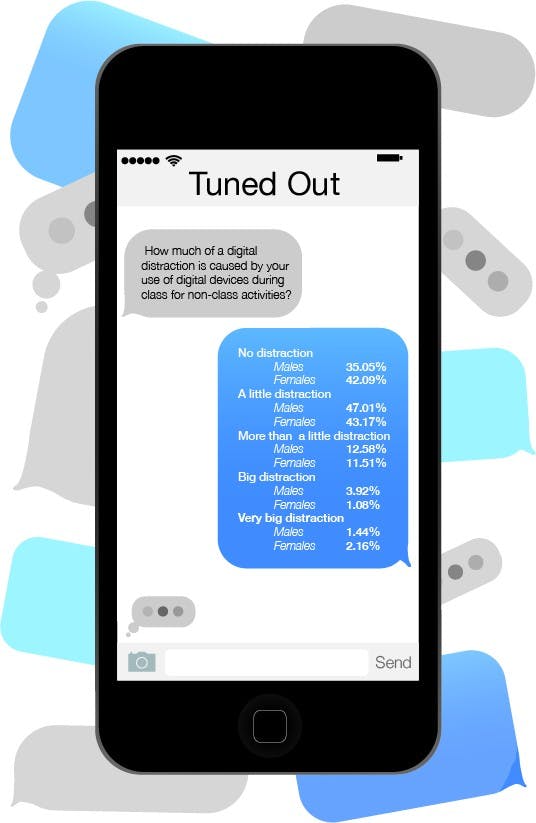
A recent study published in the Journal of Media Education found that undergraduate students use digital devices in class 11 times each day, on average, for non-class purposes. According to the study, more than 90 percent of students admitted to using their devices for non-class activities during class time. In the same study, 86 percent of students reported their reason for using their device was texting.
Limited attention
Without her iPhone, kinesiology junior Kristen Waters feels lost.
“I just feel like when I don’t have it I get nervous,” Waters said.
During her early morning classes, although most of her friends are still asleep, she’ll spend her time scrolling through applications.
“It’s hard to think (what we did) when we didn’t have them,” Waters said. “Having it right on you is just easy fast information.”
Waters said her phone serves as a distraction, admitting, “It’s probably not very good for my attention span.”
In April 2012, a study surveyed University of Pittsburgh-Bradford undergraduates and asked students to evaluate their texting in class in comparison to how well they learned.
According to the results of the students’ responses, professor Fang-Yi Flora We, the study’s principal author, found a correlation between students’ self-control and their sustained attention. In turn, their ability to remain attentive correlated to better cognitive learning.
Another 2011 study published in the journal Educational Psychology found that while 75 percent of the participants agreed receiving and sending texts ruins one’s ability to learn, 40 percent said it was acceptable to text during lectures.
Wei said students’ attachment to their devices represents habitual behavior, similar to drinking coffee or smoking.
“You realize it’s bad, but it’s very difficult for you to quit this behavior unless you go through some type of modification,” Wei said.
She said attempting to multitask even two things at once can prove too much for most people.
“Essentially, our attention is limited,” Wei said. “Nobody’s attention can be expanded forever. The question is whether you have already reached your limitation.”
Human biology sophomore Anthony Laszlo turns his phone to “do not disturb” during class in order to prevent being tempted.
Support student media!
Please consider donating to The State News and help fund the future of journalism.
“The material in class is usually a lot more important,” Laszlo said. ”(Using my phone) would probably take my mind off trying to learn something.”
‘Writing technologies’
Jeff Grabill, a MSU professor of writing, rhetoric and American cultures, argues that texting is not just changing students’ behavior in the classroom — it’s changing the way they write.
“The sheer volume of texting activity … it’s fairly obvious that (through) texting and other technologies combined, people are writing more than they’ve probably written at any time in human history,” Grabill said. “Most people use these handheld things that we carry around with us not as voice devices, but they use them as writing technologies.”
Grabill believes the role of smartphones and their ilk all depends upon how they are leveraged in the classroom.
“Any time that we give people technologies that allow people to access the world at their fingertips, the potential there is for (technologies) to be distracting,” Grabill said. “The possibilities are also there for teachers and students to use them as learning technologies.”
Check out discussion on distraction in the classroom.
Discussion
Share and discuss “National research shows use of cellphones in classrooms changing student learning” on social media.