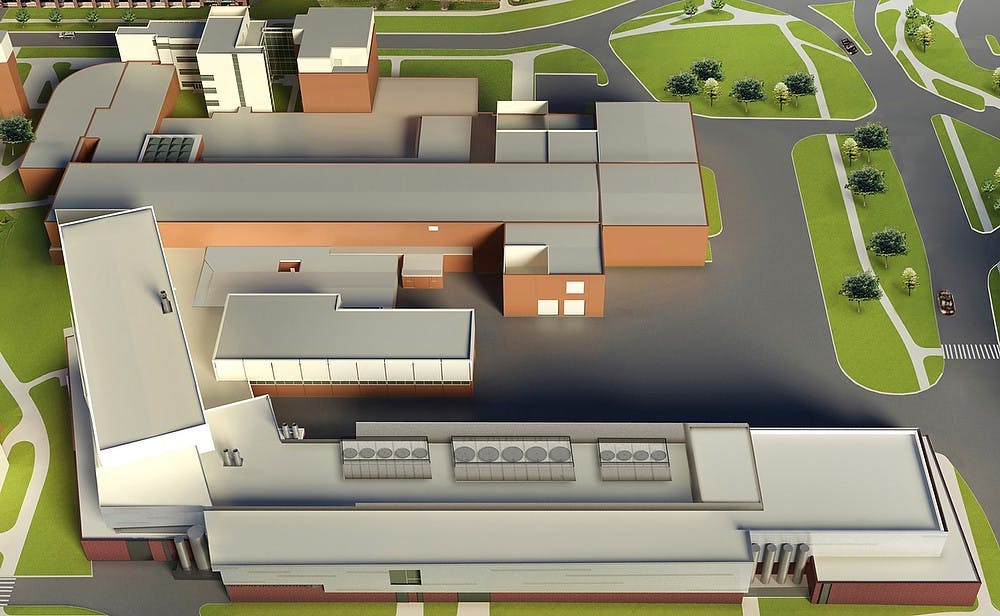
Despite the government shutdown, the federally– funded Facility for Rare Isotope Beams project, or FRIB, at MSU is going full speed, although construction has not started, officials said.
Construction for the project’s building has not begun and won’t start until April 2014. Current construction near the site of FRIB is a 27,000-square-foot high bay that will be generic research space and is not part of the overall project in terms of funding, said Thomas Glasmacher, FRIB project manager.
The building will be finished around April 2014. It will be used to put together and store equipment once the technical construction begins in October 2014, he added.
A federal appropriations bill will need to be passed for the FRIB building construction to begin, but there’s little doubt that will happen in time, Glasmacher said. Technical construction won’t require an additional appropriations bill.
For now, technical design continues, and Glasmacher said it’s about 60 percent finished.
“We’re making really good progress, it’s just a lot of work,” he said. “We try to not get so hung up on the political things that are happening. We just keep on moving forward.”
Long-term plans
FRIB is planned to be finished in 2022, but MSU is hoping it will be finished by 2020. The total cost will be $730 million.
When FRIB does come online, officials hope having a top-notch nuclear research facility on-campus will bolster opportunities for collaboration and continue to maintain the prestige of MSU’s nuclear physics graduate program.
Politicians also are excited for the project.
“Ensuring that it receives dedicated federal funding will continue to help Michigan stand out for hosting one of the premier nuclear physics programs in the country,” U.S. Rep. Mike Rogers, R-Brighton, said in a statement.
Next June, the Department of Energy, or DOE, which is in charge of the project, will review the technical design to make sure it’s ready.
Glasmacher said he’s confident the DOE will approve the design, since they’ve always been approved in the past. But he acknowledged there’s a lot to do to get ready, which is why there will be about 20 non-DOE reviews before the end of the year.
On Aug. 5, the DOE approved what is known as “Critical Decision 2,” as well as the start of civil construction planned for next year.
A statement from the department said the facility will allow researchers to move into “completely uncharted territory at the limits of nuclear stability.”
Construction of the research facility is expected to provide numerous benefits to the MSU community.
Plans to engage in international partnerships through research have been in the works for a while. A 2011 conference drew in researchers from across the world to discuss nuclear physics concepts and possible collaboration. At the time, officials were optimistic for the project going forward.
FRIB will, at least in part, help out the National Superconducting Cyclotron Laboratory, which could become outdated, officials have said in the past.
FRIB’s timeline hasn’t been without struggles, however, as the federal government has gone through past budget tussles related to science projects in general.
As recently as 2012, differing budget recommendations from the executive and legislative branches were as much as $18 million apart at some points.
Support student media!
Please consider donating to The State News and help fund the future of journalism.
Other countries, too, could catch up to the U.S. if funding struggles arise again.
Researchers from labs across the country have indicated that economic struggles in the U.S. could provide an opportunity for other countries to commit the necessary funding quicker than America could.
University confidence
MSU President Lou Anna K. Simon said in a statement that the university continues to do its part to move the project forward.
“One government review of FRIB after another have really demonstrated confidence in (MSU’s) financial stewardship, as well as our capacity to develop the devices and systems needed to push the frontiers of science,” Simon said.
The project supports the mission of DOE’s Office of Nuclear Physics. The facility will help scientists make discoveries in four main areas: the structure of atomic nuclei, nuclear astrophysics, studies of fundamental symmetries in nature, and applications of rare isotopes for society.
“FRIB will be an international center for discovery and innovation that will help drive Michigan’s knowledge economy well into the 21st century,” Simon said.
Research benefits
Explaining what an isotope is, FRIB Chief Scientist Bradley Sherrill said isotopes of elements, such as aluminum, are like different types of cars — they’re all cars, but some are rarer and more difficult to make than others. The naturally occurring isotope of a car is like a Ford Taurus, while the rare isotope is like a Cadillac STS.
Sherrill said the research people will do with FRIB is important to understanding the world around us, but it also has practical applications. Those applications tie in fields as diverse as medical procedures, nuclear power to help satisfy national needs, understanding atomic nuclei to keep the world safer from nuclear bombs, new ways to diagnose and treat diseases and finding out what to do with nuclear waste.
Sherrill works with 1,300 scientists from around the world who are ready and waiting to use FRIB.
“The scientific community around the world is ecstatic that this will be built,” he said. “They’ll be able to do research they’ve only dreamed of. For the scientists, it can’t come fast enough.”
Discussion
Share and discuss “Formula for FRIB's future” on social media.