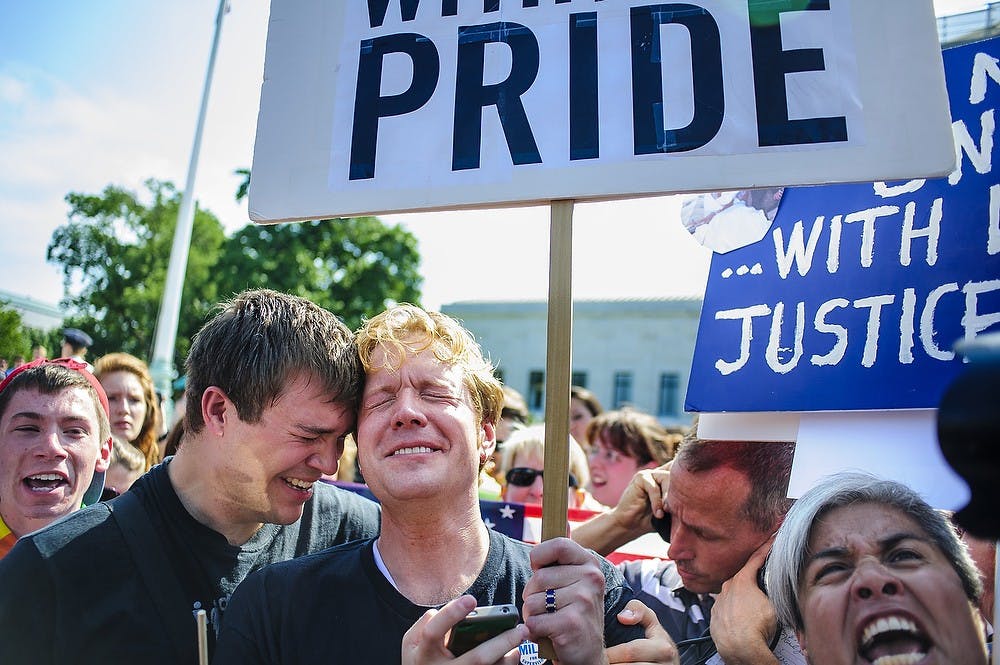
As lesbian, gay, bisexual and transgender, or LGBT, citizens and supporters gathered on the steps of the Supreme Court Wednesday morning, justices handed down two landmark decisions that sent the crowd into cries of celebration and ignited social media across the nation.
And with a decision heralded by President Barack Obama on Twitter as being, “a historic step forward for marriage equality,” media organizations and political junkies spent their early-morning hours poring over legal documents, attempting to decode the complex political jargon of the nation’s highest legal authority.
The cases
In a 5-4 decision, the Supreme Court found Section 3 of the Defense of Marriage Act, or DOMA, to be unconstitutional. The legislation, enacted in 1996 under former President Bill Clinton, previously established same-sex couples as being ineligible to receive the same federal benefits as heterosexual couples.
Justice Anthony Kennedy wrote the majority opinion, stating the court recognized DOMA perpetuated the unequal treatment of LGBT individuals.
“DOMA is unconstitutional as a deprivation of the equal liberty of persons that is protected by the Fifth Amendment,” Kennedy wrote.
The court also came to a decision on California’s Proposition 8, a voter-approved constitutional amendment that prevented same-sex couples from wedding within the Golden State. Also in a 5-4 decision, the justices found proponents of the proposition were ineligible from defending the legislation, as they themselves had no personal grievances to settle, according to Chief Justice John Roberts, who wrote for the majority.
“No matter how deeply committed petitioners may be to upholding Proposition 8, that is not a particularized interest sufficient to create a case or controversy under Article III,” he said.
Thus, the U.S. District Court’s decision in 2010 to overturn the amendment as unconstitutional was upheld, and Californians again have the right to marry whomever they choose, regardless of gender.
Historic decision
Fresh from proposing a package of legislation known collectively as Freedom to Marry, state Rep. Sam Singh, D-East Lansing, said he was excited to hear of DOMA’s demise.
“Striking down DOMA opens up federal benefits for gay couples across the country,” he said.
However, Singh lamented the court’s decision on Proposition 8, which only impacted California, adding he was disappointed the court didn’t find the prohibition of gay marriage unconstitutional.
Elaine Cao, a social relations and policy senior, said she witnessed social media light up after the decision was announced. An intern at the MSU LBGT Resource Center, Cao said she was pleasantly surprised with the court’s decision.
“Almost everything went our way, which was not what I expected at all,” she admitted.
Cao added she expected these decisions to be the first steps toward same-sex marriage being legal across the country.
Advertising junior Ka Lee said while she hasn’t had the opportunity to interact with many LGBT individuals, she supported the court’s decision.
“I think if two people love each other, then they should be able to get married,” she said.
Michigan impact
Even though the court’s resolutions failed to address marriage laws within the state, lawmakers and political action groups across Michigan were quick to weigh in on how the declaration will impact Michigan residents.
Support student media!
Please consider donating to The State News and help fund the future of journalism.
State Sen. Gretchen Whitmer said the court’s decision indicated that it was time for Michigan to move forward with its own LGBT legislation.
“I was proud to sponsor legislation to recognize same-sex marriages here in Michigan, and now with today’s ruling from the Supreme Court, it’s clear that it’s time to move forward on that process to ensure that same-sex couples have the same rights, opportunities and protections as everyone else in our state,” Whitmer said in a statement released shortly after the decision was announced.
Other politicians were quick to point out that Michigan voters still would need to go to the polls to change the state’s constitution, which was amended in 2004 to prohibit same-sex marriages and civil unions.
One of these public officials was Michigan Attorney General Bill Schuette, who released a statement shortly after the justices announced their conclusions.
“Michigan’s constitution stands, and the will of the people to define marriage as between one man and one woman endures in the Great Lakes State,” Schuette said in a press release.
Gov. Rick Snyder’s press secretary, Sara Wurfel, said the governor continues to focus on other issues within the state until voters have the opportunity to vote on LGBT legislation.
“If voters decided to change Michigan’s provision, he’d uphold and respect that as well,” Wurfel said in an email. “He’s focused on Michigan’s continued comeback, jobs, a healthy Michigan and our kids.”
Even without direct impact, Rawley Van Fossen, a social relations and policy junior, said the outcome stands as a beacon of hope for LGBT individuals.
“These decisions show students who are LGBT that they have value in this country,” he said.
Serving as the president of the MSU College Democrats, Van Fossen said he was very excited about the court’s decision, as he spent his work day anxiously reading the SCOTUS blog.
With the end of DOMA and Proposition 8, states across the nation including Michigan are left to sort out their own LGBT legislation. With proposals from Whitmer in the senate and Singh in the house, Michigan residents might have an opportunity to voice their opinion on same-sex issues in the near future.
Discussion
Share and discuss “Supreme Court declares DOMA unconstitutional” on social media.