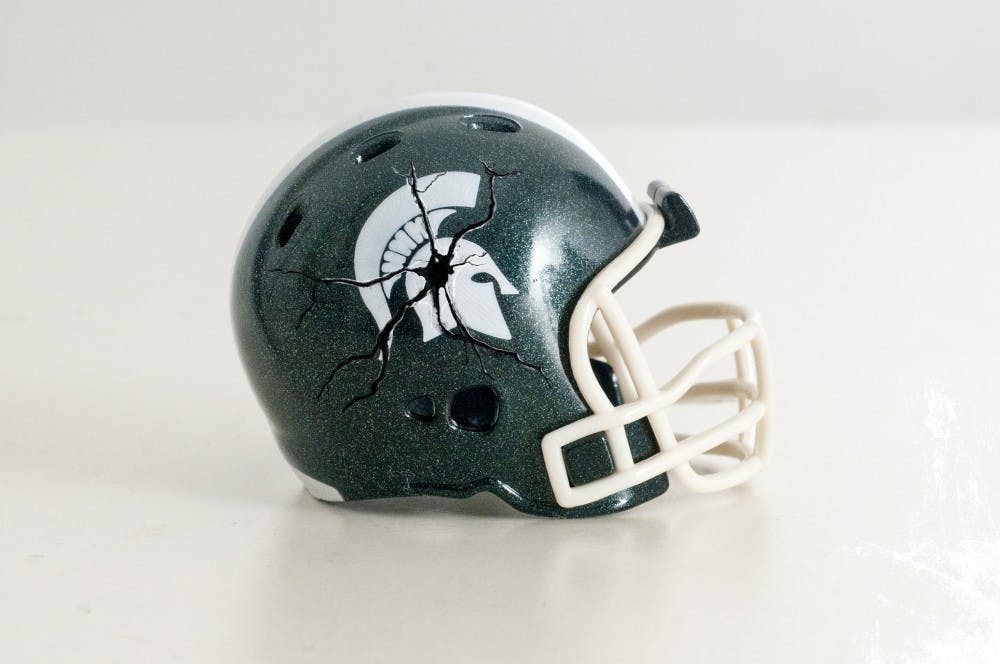
All Spartan athletes are prone to concussions — from football to tennis — MSU has seen them all. In males, concussions are seen most in football, and soccer for females, said David Kaufman, chair of the Department of Neurology and Ophthalmology.
Jeff Monroe, head athletic trainer who works directly with the MSU football team and assistant director of athletics, said there have been two football-related head injuries this spring semester, and about 18 episodes of head trauma last semester.
Former MSU football player Tony Mandarich — who played two stints in the NFL from 1989-92 with the Green Bay Packers and from 1996-99 with the Indianapolis Colts — estimated he suffered between six and nine “official” concussions since his freshman year as a Spartan to the end of his pro career, meaning ones that were documented. He said concussion prevention isn’t the only thing that’s improving, but the stigma of athletes and head injuries as well.
“If someone had a concussion, it’d be like ‘Quit being a baby about it, just suck it up.’” Mandarich said. “When you really start looking at the nuts and bolts of things, you’re talking about a brain trauma thing and an injury. It’s more than just sucking it up.”
The blow
Monroe said concussions are most commonly caused by an unprepared hit.
“They don’t have the ability to transfer the forces to their body,” he said.
A concussion happens when the brain suffers a trauma blow to the head from another athlete or a group, said Randy Pearson, professor in the Department of Family Medicine and the MSU football’s team physician.
After receiving a blow to the head, the first thing to do is to stop any physical activity, Pearson said.
“Most of the time concussions resolve on their own with just brain rest,” Pearson said. “Problem is that people don’t allow the symptoms to go away before going back to activity.”
Some of the signs of a concussion include headaches, sleep disturbances, mood changes, nausea, vomiting and any cognitive changes, Kaufman said.
The second step is to seek care of a health care professional, Pearson said.
He noted it is important for the brain to have time to heal, so the physicians allow the athletes’ brains to rest by taking them away from TV, computers and classes. Concussions usually take one to two weeks to heal, and some mild concussions can be gone in about four days.
Although some studies have shown concussions to have lasting effects on an individual, Kaufman said the effects are sensationalized. But even after the brain has healed, there can be post-concussion effects, which Kaufman said are rare, citing his research in his 28 years in the field of neurology. Post-concussion syndrome occurs when headaches last for several months.
Ringing your bell
James Madison College freshman Andy Creal suffered four official concussions from high school football, with the last one taking more than six weeks to heal. Creal said some of the symptoms, including constant headaches, were telling signs he suffered a concussion, but his only worry was the long-term effects.
“I knew what was going on, I was just like, ‘Alright, I’m not going to play, (so) what’s the point of getting an official doctor’s notice? Something else is not wrong,’” Creal said. “I knew what it was, I just didn’t know the long-term effects of what I’m doing.”
Creal said getting a concussion is seen as weak in the football world, at least where he played at, Pioneer High School in Ann Arbor, Mich.
“One week I didn’t play and the next week, I was getting these looks,” Creal said.
But Creal said he would tell anyone who has a concussion to get treatment, regardless of what other people say because the side and long-term effects could be serious.
Mandarich said the biggest difference in concussion treatment today compared to when he played is a deeper base of medical knowledge and education. He was formerly part of a class-action lawsuit against the NFL that alleged the league hid details about the risks of repeated brain trauma.
Support student media!
Please consider donating to The State News and help fund the future of journalism.
Athletes in all sports are more informed and conscious of the risks today, Mandarich said. He cited the NFL as an example of an organization taking steps to make the game safer by changing rules and improving equipment.
The 46-year-old Mandarich said he has definitely noticed things in his health and body that he suspects are “concussion-related,” such as forgetting things, but isn’t sure those can’t be chalked up to getting older.
“I think there’s definitely a price that I paid for it,” Mandarich said of his career.
“But I don’t regret it, and I wouldn’t have done it differently. … It’ll be interesting to see 10 years from now to see how it’s evolved because in the last two or three years, there’s been a lot of evolution and pro-active moves and lawsuits.”
Prevention
MSU takes measures to prevent concussions from taking place in all sports, including using Immediate Post-Concussion Assessment and Cognitive Testing, or ImPACT, a 20-minute system that measures processing speed, impulse control, reaction time and verbal and visual memory.
Kaufman said there is a neurologist who attends many football practices and all games to help if there is a problem with a head injury.
Monroe said MSU selectively recruits athletes, and those with a history of concussions might be eliminated from consideration.
While on the football team, players are given various information and protective measures to prevent concussions, including being fitted to their helmets, Monroe said.
Kaufman said football players are taught various blocking techniques — where and how to position themselves, how to prepare for a block and how to avoid various blows.
“A lot of it has to do with keeping the head and eyes elevated, approach another player with your head up rather than down,” Kaufman said.
Creal said he participates in intramural sports, including football, basketball and softball, but his past concussions are something he doesn’t forget.
“Every time I get hit in the head, I think, ‘What is that? Is it a concussion?’” Creal said. “It’s always on my mind.”
Discussion
Share and discuss “Hard Hitters” on social media.