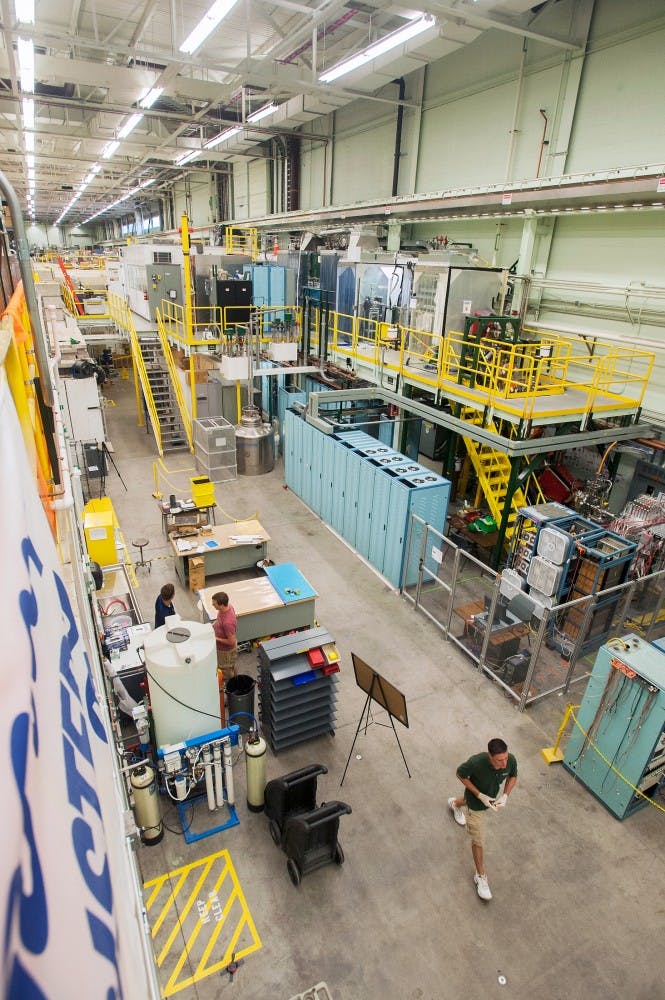
At a meeting Tuesday in Washington, the Nuclear Science Advisory Committee an advisory committee to the U.S. Department of Energy, or DOE, approved a report advising the DOE to continue to fund MSU’s Facility for Rare Isotope Beams, or FRIB.
Nuclear Science Advisory Committee deemed FRIB second in priority to receive funds, only behind a similar nuclear research facility in Virginia — a positive standing, said Mark Burnham, MSU’s vice president for Governmental Affairs. He said this was not a surprise to MSU because the Virginia facility is much closer to final completion than FRIB.
At the meeting, members of the nuclear science community discussed ways to manage the possibility of a smaller federal budget, FRIB Laboratory Director Konrad Gelbke said.
This fiscal year, MSU had hoped to receive about $40 million in federal funding for FRIB, he said. Instead, FRIB is receiving $11 million until March, a “continuous resolution at last year’s funding level” for six months, Burnham said.
The U.S. Department of Energy Office of Science funds the majority of the project, while MSU and the state provide the remainder. FRIB is estimated to cost $680 million and could be online by 2019, but has a more reasonable deadline of 2021.
Burnham said the next term’s funding will not be determined until the U.S. budget is set, but FRIB’s completion is running on time and within its budget.
To continue allocating funds to FRIB, the NSAC had to determine whether or not they would advise the DOE to close a similar facility in New York. The Nuclear Science Advisory Committee advised the DOE to stop supporting the New York facility, Burnham said.
Gelbke attended the meeting and said this was a difficult recommendation made by the committee. From an international standpoint, Gelbke said it would be a “hard blow” to shut down any such nuclear research facility.
“I’m glad that FRIB moves forward, but I am also saddened … that the nuclear science program might be shrinking,” he said.
Gelbke said federal funding still is in the discussion stage, and nothing has been finalized. The report will go to the DOE, where a course of action likely could be determined within a week, he said.
When hearing FRIB’s funding was still a national priority, zoology freshman John Owens said he believes ensuring this facility will assist in MSU’s appeal to students, faculty and researchers.
“If we build it here then we’d obviously be drawing in more faculty and academics to come here and research here and use the facility,” Owens said.
“If we build (FRIB), it would generate more funding for the university as a whole.”
Support student media!
Please consider donating to The State News and help fund the future of journalism.
Discussion
Share and discuss “DOE advised to keep funding FRIB project” on social media.