To Amanda Freis, attending MSU seemed larger than life.
The thought of leaving Daggett, Mich., a small town with a population of about 260 located in the Upper Peninsula and coming to a big university was a dream to the social work senior.
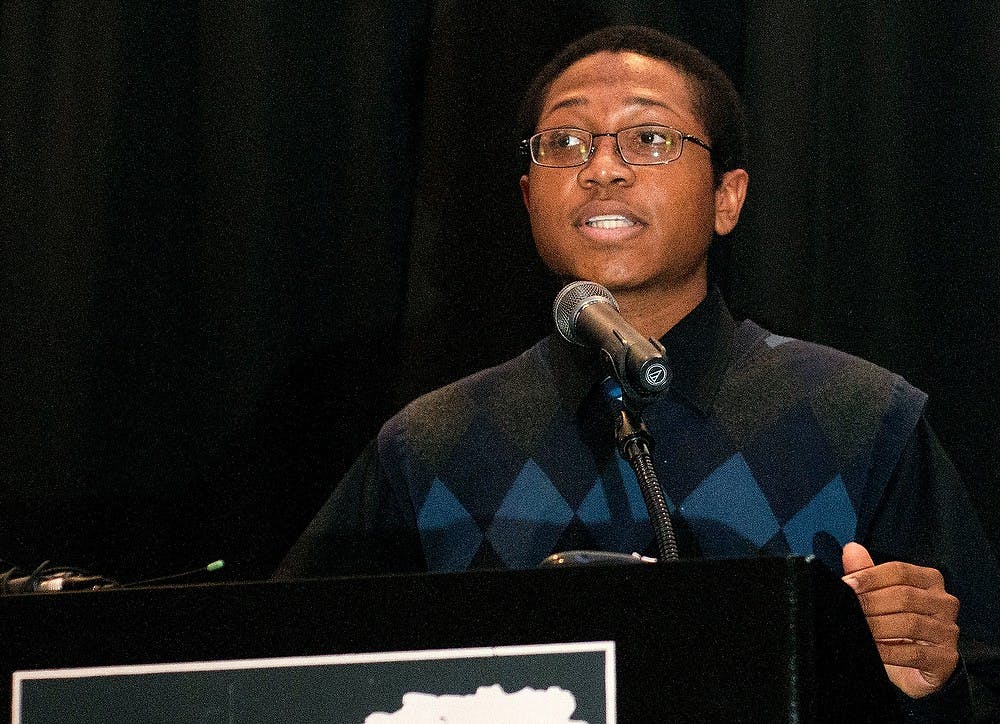
Hospitality business freshman Antonyo Tigues speaks at the 2012 Michigan Pre-College and Youth Outreach Conference on Monday, Nov. 19,2012 at the Kellogg Hotel and Conference Center. Tigues talked about a pre-college program that helped him feel more confident about entering college. Katie Stiefel/ State News
To Amanda Freis, attending MSU seemed larger than life.
The thought of leaving Daggett, Mich., a small town with a population of about 260 located in the Upper Peninsula and coming to a big university was a dream to the social work senior.
But Freis said it became more of a possibility when she attended 4-H Exploration Days at MSU throughout her middle and high school years.
She said this pre-college program was a major proponent in her realization that attending MSU, or another university like it, was an option for her.
“I graduated with 20 kids and my incoming class here was 8,000,” Freis said, chuckling. “So, the culture shock wasn’t as big because I had been to this campus every year, for like, six years in a row, and it … was really, a smooth transition.”
This is a situation many students might face when approaching college and is what MSU’s pre-college programs aim toward easing.
Pre-college programs are academic sessions available to middle school and high school students who are looking for direction when considering attending college.
On Monday, hundreds of MSU pre-college program leaders gathered at Kellogg Center for the Fifth annual Michigan Pre-College and Youth Outreach Conference.
At the conference, MSU program leaders and coordinators from across the state were able to exchange ideas, tell stories and find out how to make the current programs more effective.
Hiram Fitzgerald, the associate provost for University Outreach and Engagement at MSU, was one of three MSU administrators proactive in creating a forum in which coordinators could gather.
Fitzgerald said there are pre-college programs across all disciplines, such as music, engineering and education.
“Whatever it might be, (the program) involves trying to orient children toward higher education as an aspiration or goal,” Fitzgerald said.
According to Zachary Constan, an outreach coordinator at the Superconducting Cyclotron Laboratory, the most rewarding part of these types of programs is the fact that people who attend are able to work with MSU students, faculty and staff “on their level.”
“It’s all volunteer and they come out … and the (high school students and teachers) say, ‘I can’t believe how valuable that was to me — talking to the students,’” he said.
This was true for social work sophomore Charletta Hill, from Detroit’s Renaissance High School, who attended two pre-college programs: one in seventh and one in ninth grade.
For Hill, the programs she attended were part of the reason she chose to attend MSU, she said.
“I was able to go the classes on my own without being on a schedule or (having) a curfew, and I got to make my own decisions that reflected college,” Hill said. “They gave us more tips on the social aspect (and) the living part of the college.”
Support student media! Please consider donating to The State News and help fund the future of journalism.