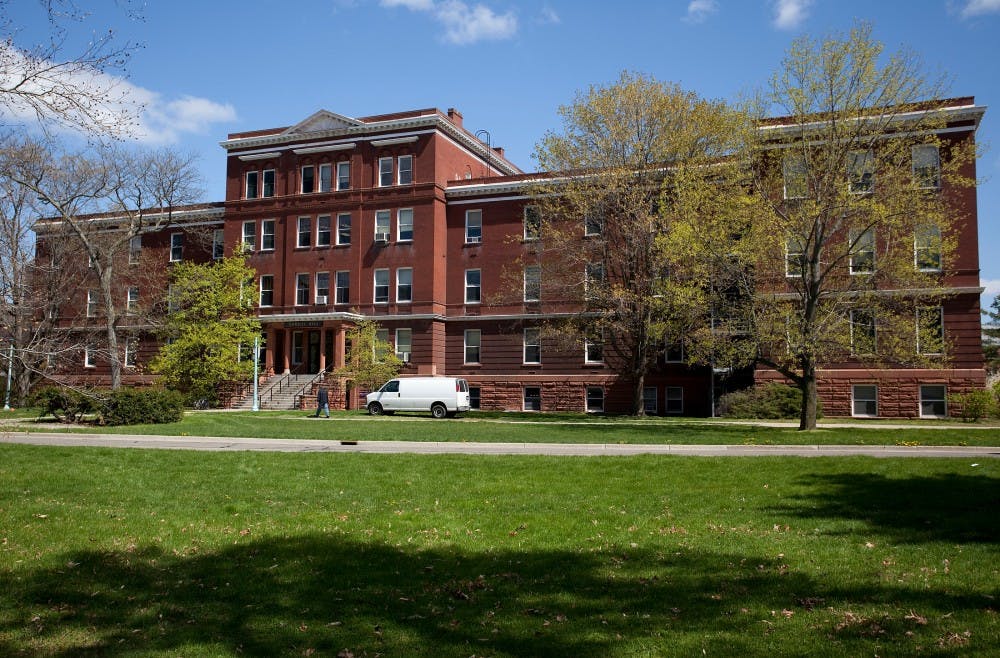
More details about the demolition of Morrill Hall surfaced last week during the MSU Physical Plant’s monthly Construction Junction meeting.
University engineer Bob Nestle said the building — which was built in 1899 — has outgrown its usability and it is becoming more difficult for the hall to adapt to the growing technological needs.
“(The) primary reason was the wood structural frame would not handle the kind of weight it needed to hold classrooms,” Nestle said.
Dennis Hanson, a design representative for the project, said during the meeting that the demolition will start May 6 — the first day of summer break — and the area will be turned into a “green space” by the time students arrive next fall.
The space will include sidewalks and benches, as well as a sign commemorating the building.
Hanson said the occupants of Morrill Hall have been moving to different buildings on campus since it was decided by the MSU Board of Trustees in June 2010 that the building would be demolished.
Only the history department remains in Morrill Hall, and it will move to Old Horticulture by the new year.
Crews will move in after Christmas break to rid the building of asbestos — minerals that are used to make many products such as floor tiles, pipes and building materials.
When buildings are demolished, asbestos can be released into the air and be harmful if inhaled.
Hanson said the public will not be exposed to the asbestos, as the building will be sealed off when the construction crews work to reduce the amount of asbestos released into the air when the building is demolished.
Portia Vescio, the assistant director of MSU University Archives and Historical Collections, said Morrill Hall’s construction was an instrumental moment in MSU’s history.
“(Morrill Hall) helped greatly expand the women’s population on campus,” Vescio said. “(It was the) first experiment with living and learning, and they took all of their classes and meals (in Morrill Hall), as well.”
Although it’s unsure how much the project will cost, Hanson said some of the iconic red sandstone and some wood used to construct the building will be sold to help lower the cost for the university.
Hanson said the sandstone was very popular in buildings at the turn of the century and has been used in many buildings, such as the Empire State Building.
Computer engineering sophomore Derrick Hanley said he was a little disappointed when he heard of the demolition of the historical building and thought the building might make a good museum.
“I feel like history is too important to tear down,” Hanley said. “I feel like they should leave it up.”
Support student media!
Please consider donating to The State News and help fund the future of journalism.
Discussion
Share and discuss “Physical Plant reveals further details of Morrill Hall demolition” on social media.