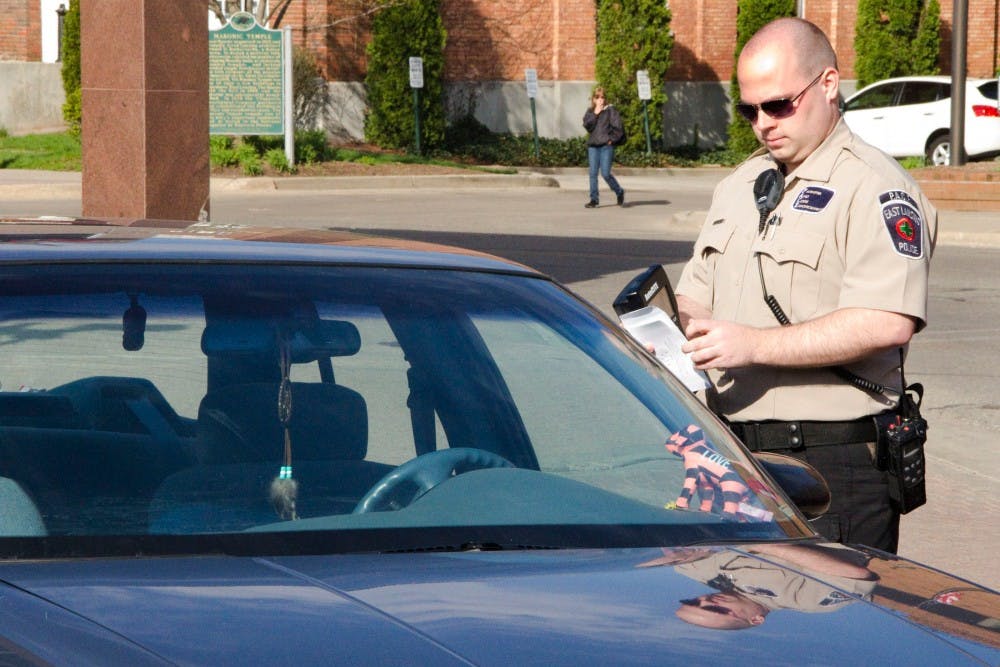
With a change to Michigan’s parking law on the horizon, parking offenders who fail to pay designated fees for three or more parking violations on time will face more pressure to pay up if they don’t want their driver’s licenses put on hold.
Under the state’s current vehicle code, the Secretary of State office can be contacted and a person’s license could be held from renewal if the offender leaves six tickets unpaid and fails to answer to the ticket issuer or to local courts if the tickets have gone outstanding for more than 10 days after the offender is notified by the court.
The new policy, signed into law Feb. 16 and slated to go into effect May 16, will lower the number of unpaid tickets a person can have from six to three before other consequences and fees kick in, until Jan. 1, 2018, when the bill will revert back to its initial six.
Although he initially opposed the bill, State Rep. Mark Meadows, D-East Lansing, said he voted yes on the finalized version because of the added sunset clause.
“It’s not hard to get six tickets, especially if you live in East Lansing,” Meadows said. “It got changed so that it was only a temporary measure — it’s really designed to facilitate the paying of collection.”
In East Lansing, parking tickets brought in about $1.3 million during the 2010-11 fiscal year. MSU Parking Services collected about $2.3 million from the 111,585 parking tickets issued in 2011.
Fred Woodhams, spokesman for the Michigan Department of State, said Michigan’s Secretary of State office cleared 3,200 parking holds that were on record in 2011.
At this stage in the process, Woodhams said there is no real way to quantify the effect the legislative change could have on ground level, as each Michigan municipality handles negligent parking tickets differently in accordance with state law.
“This law was something that was pushed by some cities in the state — some cities prefer to boot vehicles or impound them if there’s too many tickets out there before sending it to us,” Woodhams said.
The legislative change will have no tangible effect on how parking officials in East Lansing issue tickets, East Lansing police Capt. Kim Johnson said.
However, the number of parking cases going to the 54-B District Court to take further action on fee collections might go up because of the new law, Johnson said, although he said it’s too early to tell for sure.
“Maybe it could encourage everyone to actually comply and pay their parking tickets, but it’s not going to affect how we do our business,” Johnson said.
If a driver incurs six unpaid parking tickets on campus, MSU police Assistant Chief Mike Rice said the car usually is taken to an impound lot or the university will attempt to collect on the tickets before the case is sent to the next level of collection.
Rice said the university cannot tow a vehicle until it has six unpaid parking tickets, which could lead to more cases being sent to the courts after a driver incurs three unpaid
parking tickets.
Although paying parking tickets should be a “no-brainer” for anyone who receives one,
comparative cultures and politics sophomore Sixtine Berquist said there could be an increase in students who find a surprise the next time they go to renew their license under the new law.
“College students don’t have money all the time, so they could pose more of a risk for not paying their tickets,” Berquist said. “But if they know they can’t pay, though, they should be more careful where they park and be more responsible for their actions.”
Support student media!
Please consider donating to The State News and help fund the future of journalism.
Discussion
Share and discuss “Mich. parking law to change in May” on social media.