Many students and community members throughout the country count on student-athletes at major universities to carry their sports programs, but when looked at in the classroom setting, many are being stereotyped as academically inadequate.
When looking at college athletics from an academics standpoint, some can be quick to judge, said Jim Pignataro, associate athletics director for student services and director of student-athlete support services.
“Every subpopulation has stereotypes of some sort,” Pignataro said. “It’s really up to the individual — within every sport we have a wide range of majors, academic ability and overall academic interest.”
Certain stereotypes associated with student-athletes also are recognized by those outside of the athletic department and student population at MSU.
Associate sociology professor Toby Ten Eyck, who taught a sports sociology class last fall, said there are a lot of negative stigmas surrounding athletes and what they choose to pursue academically. Often, people assume athletes choose “easy” majors rather than ones perceived to be more difficult, such as majors in math or science fields, he said.
“There’s a history of athletes and certain majors here at MSU,” Ten Eyck said. “When one athlete is seen by others as being successful in a major, it is emulated … these (successes) can lead some athletes to think it’s also the right major for them.”
This stereotype isn’t specific just to MSU, but rather to all large universities with renowned athletic programs, he said.
“It’s not much different if you’re at Ohio State, Michigan or Notre Dame,” Ten Eyck said. “There’s always pressure there because people probably care more about whether you make the tackle or 3-pointer than if you’re getting a 4.0 in advanced calculus.”
Having been an athlete himself, Ten Eyck said he knows the stereotype is true to some extent, but many students are starting to prove they can strive in both areas.
“Although there’s been more emphasis on academics in recent years, it often comes second because there’s a lot more thrill and quicker payoff in athletics,” he said. “Ten years ago I would have said (athletes) didn’t care, but I’ve seen a lot more student-athletes realizing that education is important.”
Common majors
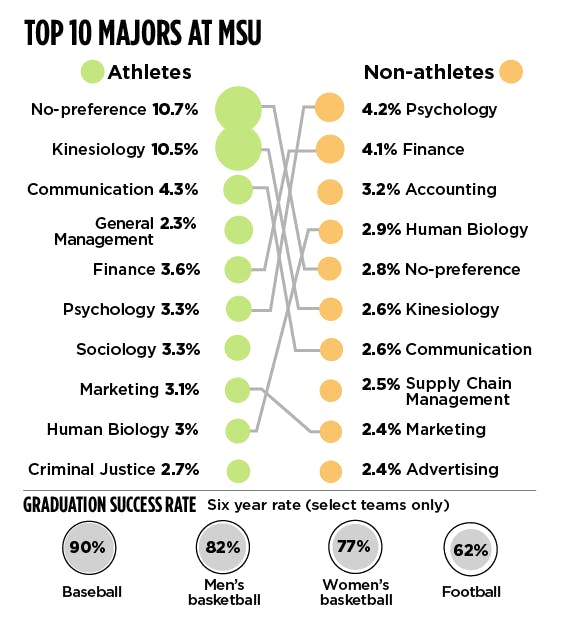
Of the more than 700 student-athletes at MSU, approximately 46 percent fall within the top 10 most popular majors among athletes, according to data from MSU’s Office of the Registrar. Seventy-five of those students are no-preference majors, followed by the No. 2 spot of kinesiology, which 74 student-athletes currently are studying.
Pignataro said the athletic department encourages student-athletes to major in no-preference as an underclassman, since it might benefit them academically in the long run.
Instead of jumping into a major, student-athletes in no-preference have time to adjust to college academically and athletically first, Pignataro said.
“I think from an eligibility standpoint, it’s in their best interest to choose no-preference for the first two years of school,” he said. “By narrowing down the options, it gives them the ability to discover what they really want to study.”
Although these numbers are not exactly proportionate with those of the university as a whole, the top 10 majors among student-athletes and the general student population do show some similarities. According to the Registrar’s website, about 30 percent of all undergraduate students at MSU are studying majors that fall within the top 10 student-athlete majors.
Psychology is the most popular major among undergraduate students at MSU, with a total of 1,457 students, or about 4 percent of the undergraduate population. Psychology ranks sixth among athletes with 23 students enrolled in the undergraduate program, which equals slightly more than 3 percent. No-preference and kinesiology also fall in the top 10 overall majors, with a combined total of 1,870 students in both fields.
Finding the time
To help student-athletes find a major that best fits their schedule and personal academic goals, the university offers a variety of resources such as advising, counseling and tutoring at the Clara Bell Smith Student-Athlete Academic Center and also a special kinesiology course designed to guide students through the process of major exploration, Pignataro said.
MSU Associate Athletics Director John Lewandowski said there has been a strong commitment to academic support since the Smith Center was built in the late 1990s.
“Especially during (athletes’) first year of school, it’s important to help them develop proper study habits and get a handle on managing time,” Lewandowski said. “The biggest challenge that any student-athlete faces is the budgeting of time — they have to be driven, competitive and able to make sacrifices.”
But along with help also comes discipline. Students must regularly attend class and also are required to maintain a certain grade-point average set by the NCAA. If they don’t meet the expectations, there will be disciplinary action, Pignataro said.
Support student media!
Please consider donating to The State News and help fund the future of journalism.
“I think because athletes are competitive by nature, they set higher standards for themselves,” he said. “The (Athletics) Department has requirements. We expect they go to class, perform well and make progress toward a degree … as long as you set expectations, most people meet them.”
But time management is not something unique to student-athletes.
For civil engineering freshman Nick Wojno, balance is the key to success when juggling the demands of college life.
Although he is not an athlete, Wojno, as many other students at MSU, has other responsibilities to uphold.
With a time consuming major and a 15 hour per week job at Kellogg Center, Wojno said he has to focus on getting everything done on time — and he doesn’t have the athletic department to keep him in check.
“I do my homework as soon as possible so that I have time for other things,” Wojno said. “Time management is definitely important.”
Like many other college freshmen, men’s basketball senior guard Austin Thornton changed his major multiple times in his first few months of college. With the help of advisers at the center, he said he was able to find out exactly what he wanted to do.
“They’re doing a great job with pointing you in the direction of what you want to do and getting you into the right classes,” Thornton said. “I decided to pursue human resources because those were the classes that I did better in and it’s what I enjoy.”
Breaking the mold
The stereotype against student-athletes is all too familiar for women’s basketball senior guard Taylor Alton. While being classified as an athlete at a university with a nationally recognized sports program does come with some perks, there is a certain mold that she hopes to break during her time at MSU.
Alton said although there still are some athletes that fit the stereotype, she is working hard to separate herself from the pack.
“It’s really tough, but it comes down to time management and discipline,” Alton said. “You can’t be lazy, you just don’t have a choice.”
As an animal science major, Alton ultimately hopes to fulfill her long-standing dream of becoming a veterinarian. Being on the basketball team has given her the structure she needs in order to be successful, she said.
“I’m looking to do what I can for this team, but also recognizing why I’m here and understanding that these are my long-term goals,” she said. “I’m not going to be able to make a career out of basketball when I’m 40.”
Discussion
Share and discuss “Major misunderstandings” on social media.