Editor’s note: This story has been changed to accurately reflect the number of years since Obama’s election.
Change. Reinvention.
Editor’s note: This story has been changed to accurately reflect the number of years since Obama’s election.
Change. Reinvention.
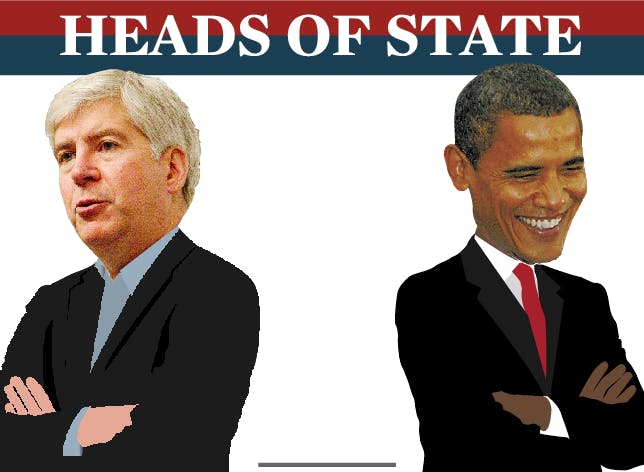
Two taglines, echoed by two candidates, from two different ends of the political spectrum.
Despite their different ideologies, both came with promises to help a nation and a state pick up the pieces of their shattered economies.
Both sought to change political culture, to inspire citizens to look toward the horizon with optimism instead of despair. In 2008, Barack Obama was elected president on the promise to use the power of government to fix a broken system, just two months after the stock market crashed and pitched the nation into the worst recession since the Great Depression.
Two years later, Rick Snyder, a Michigan native and businessman, was elected on the promise to rebuild businesses. Since that time, both leaders have seen their approval ratings decline. A year in, Snyder has accomplished an astounding amount of his agenda, analysts have said. Next year, America will decide whether the president’s policies are what they bargained for.
Snyder
Almost exactly a year ago, Rick Snyder overwhelmed Lansing Mayor Virg Bernero in a win of about 60 percent to fill the Michigan governor’s seat.
The win came after Snyder, a moderate Republican, almost entirely beat a lineup of hard-right conservatives in the primary race in August 2010 — even in the face of a Tea Party craze that spread to many areas of conservative America.
But for most of his term, Snyder’s approval ratings haven’t come out of the mid-30s.
The drop came after several key policy decisions, EPIC-MRA President Bernie Porn said, including multimillion dollar cuts to higher education resulting in tuition raises at MSU. These increases sparked a heated controversy between university officials and state legislators regarding the exact amount of the percentage increase.
In addition to the tuition increases, cutting the Michigan Business Tax in exchange for taxing retirement pensions also lost him a great deal of support among the older demographic, Porn said.
In March, the Emergency Financial Manager bill — a piece of legislation Snyder signed giving emergency managers the power to override certain powers of local governments — sparked large protests at the Capitol, with several thousand showing up on the Capitol lawn to rally against Snyder’s policies.
“A neutral person cannot dismiss the fact that a great deal has been accomplished in the first nine months,” said Doug Roberts, director of MSU’s Institute for Public Policy and Social Research.
One factor associated with this has been Republican control of the legislature with 26 Republicans and 12 Democrats in the Senate. Republicans swept the House in the last election as well, gaining 19 seats for a 63-47 majority.
Despite his low ratings, Snyder’s policies are what Michigan needs, said C.J. Demmer, a member of the MSU College Republicans.
“Yes he’s raising taxes (on) old people and cutting education,” Demmer said.
“But if the situation doesn’t improve, we won’t be able to afford those institutions anyway.”
But Residential College in the Arts and Humanities sophomore Abbie Heath isn’t sure the state is being led in the right direction, although she said Snyder is in a hard position with the state’s downtrodden economy.
“I resent some of the things he’s cut, like public education,” Heath said.
“It’s not the direction I would choose.”
Support student media! Please consider donating to The State News and help fund the future of journalism.
Obama
Almost three years ago to the day, the man who would become the first black president of the U.S. basked in a decisive win under the stadium lights set up in Chicago’s Grant Park.
Obama took the presidency with the support of about 57 percent of Michigan residents.
On campus, sociology and women’s and gender studies senior Stephanie Fluegeman, who spent the weeks leading up to the election canvassing Obama signs, remembers South Neighborhood erupting with a roar.
“I remember just hearing his speech and feeling like it was a moment that I was going to remember forever,” Fluegeman said. “It was just truly thinking it was change.”
Since then, the numbers have not looked as optimistic. A poll released last month by Lansing polling firm EPIC-MRA shows 38 percent of Michigan residents approved of the president’s job.
“Everything is based on the economy, and people think the economy is in great trouble — in shambles,” Porn said.
The fall is enough to put him in danger of being a one-term president, he said.
Michigan is seen by many political analysts as a necessary state to capture to reach the necessary number of electoral votes.
The 2009 automaker bailout was one of the landmark policy moves of his presidency so far, along with plugging a party-lined health care reform bill through Congress and pushing through a multibillion dollar stimulus package.
“There were politicians who said it wasn’t worth the time, wasn’t worth the money,” Obama told a group of workers at a GM assembly plant in Lake Orion, Mich., last month.
“They should come and tell that to the workers here at Orion.”
But Fluegeman still hasn’t seen the change she voted for, specifically in making more leaps in health care improvement.
“I understand things take time. … (But) taking more than three years to put those things into action has been a little bit disappointing,” she said.
Although he was somewhat naïve about making drastic changes, Obama has done a good job on the whole, political science junior Jarrod Starkey said.
“You can say it all you want, but you can’t get everything done (in four years),” Starkey said.
“This guy is maybe not quite the savior we were looking for, but I still think he’s the right guy.”



