It was the quiet that got to him.
History senior Chris Rivard grew accustomed to London’s noisy bustle during the past few weeks of his study abroad class. But this was different.
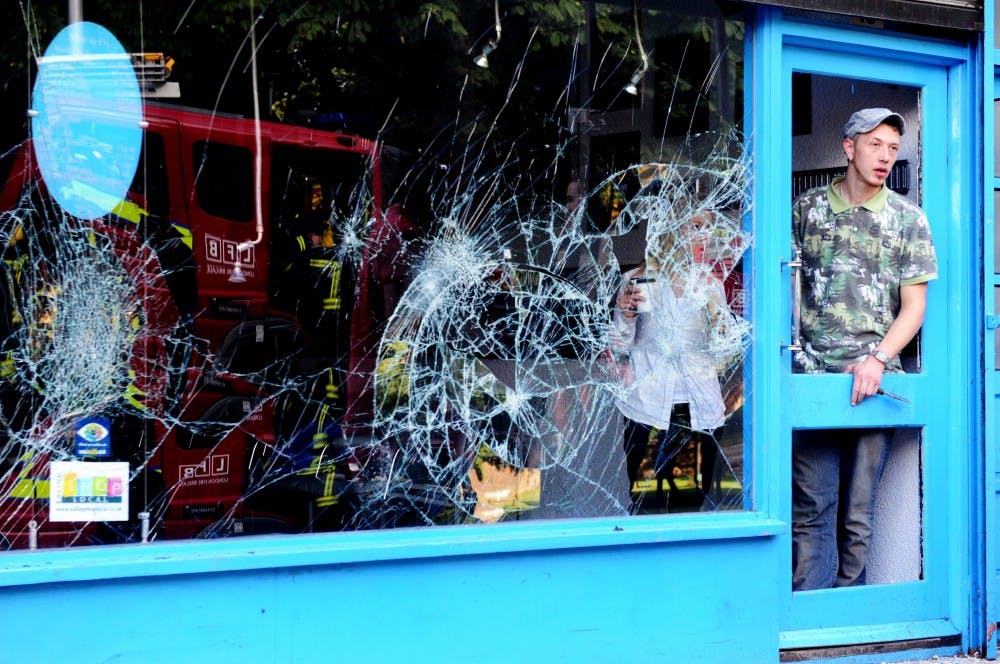
Shopkeepers begin to clean up on Ealing High Street following a night of civil unrest on the streets of London, on August 9, 2011. Disturbances broke out late on Saturday night in Tottenham and the surrounding area after the killing of Mark Duggan, 29, and a father-of-four, by armed police in an attempted arrest on August 4. Prime Minister David Cameron returned home from his summer holiday in Tuscany, Italy to respond to the rioting.
It was the quiet that got to him.
History senior Chris Rivard grew accustomed to London’s noisy bustle during the past few weeks of his study abroad class. But this was different.
After the first two nights’ raging riots — in which masked youths fought police with makeshift weapons, looted storefronts and torched middle-class neighborhoods — an eerie still blanketed the city.
Rivard said people avoided one another on the street and didn’t make friendly chatter anymore. On the tube, London’s subway, riders avoided eye contact and buried their faces in the morning paper.
Last week, more than 60 MSU students remained in London, finishing up internships and study abroad courses, as young rioters fought police and scorched portions of the city following the killing of a 29-year-old protestor by police. It is not certain if the protestor was armed, reports indicate.
According to officials from the Office of Study Abroad, all remaining students were scheduled to depart for the U.S. on Friday and Saturday of last week.
“We’ve heard that all of them are safe,” said Brett Berquist, director of the Office of Study Abroad.
Accounts from students in London and study abroad officials show none of the students were affected directly by the rioting, although some came in close contact with the chaos.
The next day, Tuesday, Rivard’s class visited Greenwich, an older neighborhood in London’s outer ring. Upon climbing the hill where the Royal Observatory is perched, the class turned around to face the skyline, where a column of smoke rose from the burning ash in the city below. It grew so thick the class left several hours early, as shopkeepers lugged wooden boards to barricade their windows.
Amid escalating violence that spread to other major cities across the country, London police took to the streets armed with rubber bullets — just hours after Rivard stood at the Royal Observatory — while British Prime Minister David Cameron authorized the use of water cannons to control rioters and looters.
In recent days, Cameron and other British senior officials have adopted a “zero tolerance” policy against rioters and have laid plans to go after looters “picture by picture,” according to some news reports.
More than 1,400 already have been arrested in the nation’s capital in connection with the sudden onslaught of violence, and at least 2,500 nationwide have been taken into custody. Children as young as nine have been photographed stealing alcohol from stores, even as record-high numbers of police combed city streets in an attempt to crack down on perpetrators.
Former New York City police Commissioner William Bratton was brought on as an adviser by Cameron, a move criticized by some senior officials, including Hugh Orde, head of the U.K.’s Association of Chief Police Officers.
London’s premier shopping districts also felt the effects of what some are calling the country’s most severe violence in more than two decades.
Journalism senior Kathleen Loftus said in an email that program officials at CAPA International Education encouraged her to take time off work at Aylwin Communications Ltd., where she was completing a public relations internship, as police officials kept watch over uneasy central London shopping district West Kensington. Loftus returned to the U.S. on Saturday.
“It was a bit frightening living by one of London’s premier shopping streets … since riots and looting could easily (have) been done closely,” Loftus said in the email. “It’s a shame people would destroy such a nice city, especially when so much work is being done in preparation of the 2012 Olympic (Games).”
Support student media! Please consider donating to The State News and help fund the future of journalism.