After taking a year’s worth of MSU classes, Siqi Chen finally took her first steps on campus.
As a member of the MSU-China Turf Program, she is one of 72 Chinese senior undergraduate students majoring in turfgrass management who began a two-week orientation Friday before heading off to turf management internships around the country for the fall semester.
As juniors last year, the international transfer students took MSU classes at their universities in China — taught by 15 MSU professors who traveled abroad with the program — in preparation for their assigned internships.
With 72 students, the MSU-China Turf Program — which ranks in the top three in the nation — has the largest intern class to date. Fifty-six of the students have internships at golf courses, while the remaining 16 have research-based internships.
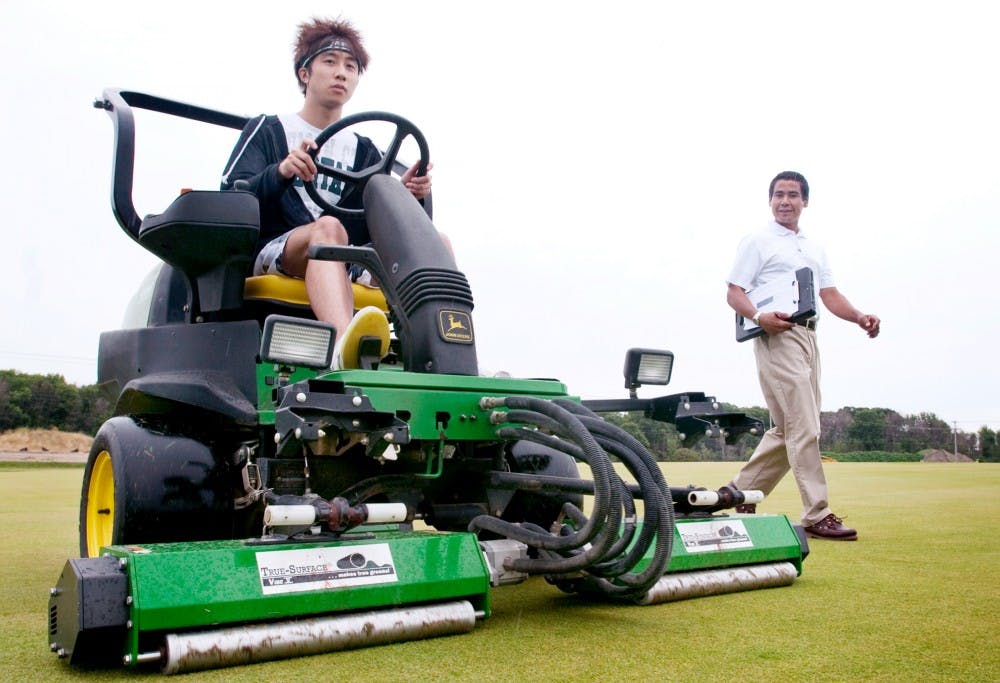
During the two-week orientation, the students are getting social security cards, opening bank accounts, learning about income taxes and having hands-on equipment training, program coordinator Yusong Mu said.
“During the internships, they are operating all sorts of golf course turf equipment, so we’re getting them better prepared for their internships,” he said.
Unless they have internships at MSU, the two-week period is the only time they’ll spend on campus, before immediately leaving for the semester.
Students are going to work at 30 different golf courses in Arizona, Florida, Illinois, Maine, Maryland, Michigan, Montana, New Jersey, New York, Ohio and Oklahoma.
“I think it’s a great opportunity for us to come to America to do some internships,” Chen said.
“I think it’s very valuable.”
Growing toward success
The agreement among MSU and Chinese universities regarding the MSU-China Turf Program was signed in 2004, and the first interns came to the U.S. in 2006.
In the initial year, the program had 21 Chinese students come to the U.S. for internships, and including the 72 for the fall, 256 interns will have completed the program.
The program’s rapid growth has been attributed to the developing golf and turf industry in China. Compared to the U.S., China’s industry is very immature.
“Right now, golf course managers don’t have a degree,” Mu said. “Getting this degree from Michigan State really means a lot.”
Although China’s industry is growing, the nation as a whole has fewer than 500 golf courses, compared to Michigan, which has more than 800 in the state alone, MSU-China Turf Program Director Dr. Taylor Johnston said.
The international transfer students will return to China after their internships, graduate in May with degrees from MSU and their universities and ultimately will become their nation’s leaders for the industry.
The international degree program has gained such a notable reputation that MSU has been able to help students earn internships at highly respectable golf courses, Mu said.
This fall, among the 56 golf course interns, two will be going to the Baltusrol Golf Club in New Jersey — which has hosted seven U.S. Opens and its first PGA Championship in 2005.
After other MSU departments have reached out to Johnston about mimicking the turf program’s guidelines and organization.
“We have more students in this program through the MSU-China program than we have resident students in turfgrass management at Michigan State,” Johnston said.
“It’s highly successful in going on five years.”
Support student media!
Please consider donating to The State News and help fund the future of journalism.
A beneficial experience
Interning at a golf course, the students will start at the bottom and work their way up, which will give them an opportunity to gain a variety of experience.
“They might start out doing course setup and raking bunkers,”
associate professor and turf specialist Dr. Kevin Frank said.
“Eventually, when they’ve showed they can do that responsibly, then they may step up to mowing the rough, and eventually they’ll be mowing the putting green and setting the hole location.”
The two-week orientation the students are in now will be
particularly useful for those headed to golf courses because the Chinese students have never been exposed to any kind of turf management equipment.
At Maryland, Chen will be doing lab and field research, but she is not sure what specifically that includes.
She said she’s interested in soil sciences and nutrition and expects she’ll be able to explore both of those areas while doing research.
Frank — who has hosted three research interns in the past — will have one intern this fall, but he said research depends on the faculty member.
“It’s a good experience,” Frank said. “You get somebody eager to learn just like any of the undergraduate students at MSU.
“Whether it’s in the field or in the lab, you really have the opportunity to mold these students.”
Discussion
Share and discuss “MSU welcomes Chinese turf interns” on social media.