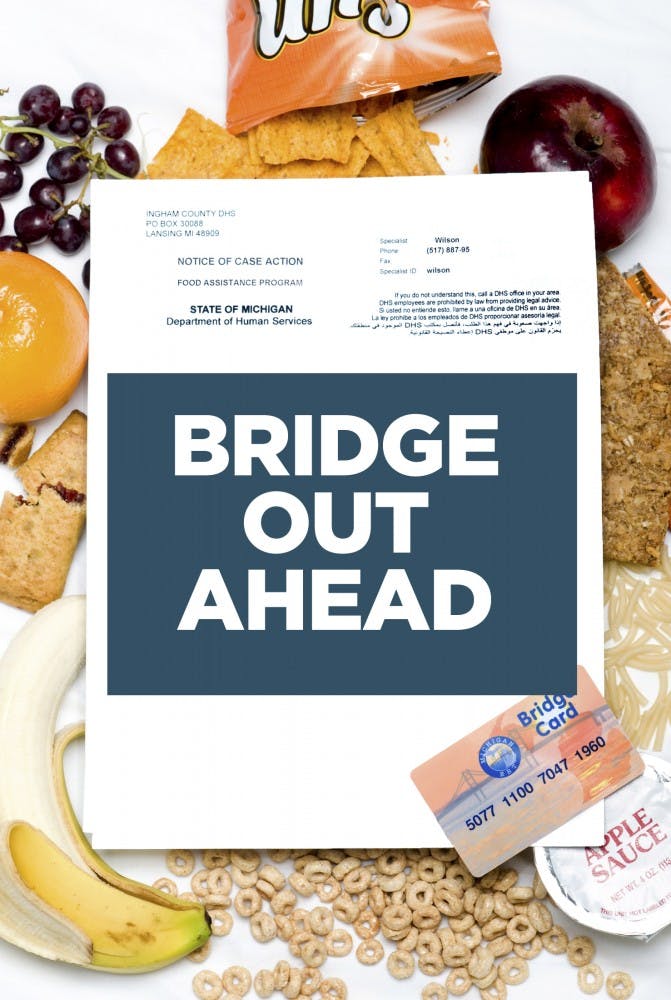
Had Grafmiller opened the envelope, he would have read the following, a confirmation of his fears: “Program changed. You or a household member no longer meet the criteria to receive Food Assistance due to student status.”
“It’s probably going to be better overall for the economy,” Grafmiller said. “But for me … I have to get a job now. … I was really disappointed.”
Grafmiller is one of the estimated 18,000 – 20,000 Bridge Card owners who are balancing college with other responsibilities, according to the Michigan Department of Human Services.
For years, college students have been able to receive up to $200 from the card to spend on food products by simply proving their income was too low to pay for their housing.
But as of today, thousands of those students will lose the assistance and support the card offers.
For some, the loss is minimal — there always have been other means of paying for food. But for some students, the loss of the card means stress, another job, tightened finances or even a decline in health.
“Food was never a problem,” Grafmiller said.
“I could always have food because I always had that money. Now it’s like … will I have to peanut butter and jelly it up for a week?”
The hunger game
One area of Bridge Card reform began with a college student — the daughter of state Rep. Joe Haveman, R-Holland.
During a conversation with Haveman, his daughter expressed her frustration at the blatant misuse of Bridge Cards by students who came from families who could afford to pay for food.
“She was appalled by the way this welfare was being used,” Haveman said.
“We realized it was all over campuses everywhere. We started trying to make noise about it.”
For the past four years, Michigan has seen an increase in the number of people applying for the state’s food assistance program. Between February 2007 and February 2011, the program grew by 62.5 percent.
And compared to the state as a whole, the number seeking assistance in Ingham County has grown even faster — 75.6 percent — in the same time period.
Although the program is distributed through the Michigan Department of Human Services, the program is funded federally through Department of Agriculture.
Those who cheat the system aren’t harming the state of Michigan directly, but they are taking away funds that could be going
elsewhere, said state Rep. Mark Meadows, D-East Lansing.
“If you’re looking at the total amount being spent in the state and you peel off the number who is inappropriately issuing them, ultimately you have a bigger pot of money,” Meadows said.
“Theoretically, they could increase the amount to those receiving Bridge Cards.”
As of February 2011, the average Bridge Card user in Ingham County received $131.92 per month. The maximum amount allotted to the card for food is $200.
Support student media!
Please consider donating to The State News and help fund the future of journalism.
In January, Maura D. Corrigan was named the new director of Michigan Department of Human Services and changed the guidelines of the Bridge Card to match federal regulations.
Under the former guidelines, college students had been eligible for the card simply because they were college students.
Now, students will have to go much further to prove their need, said Christina Fecher, a spokeswoman for Michigan Department of Human Services.
“A lot of issues came to light from the state legislatures,” Fecher said.
“They brought up the attention of the issue and worked with us to insure integrity.”
Some students are in agreement with the new standards.
Journalism junior Jon Gaskell, who is going for his second degree after graduating in 2009, said the department’s initiative has been one that is long needed.
Gaskell pays for his tuition on a combination of federal student loans and a job.
Still, his budget has limited his diet — Hamburger Helper without the hamburger, a lot of pasta and frozen vegetables with little fresh fruit.
Yet, he won’t get a Bridge Card.
“The cost of those people that abuse Bridge Cards — that is assistance (and) nutrition that is taken out of the mouths of more needy people,” Gaskell said.
Meal ticket
Everyday, dietetics junior Amber Rosalez checks her mailbox in anticipation of a letter that might change everything again — the time she has, the stress she feels, even her weight.
Rosalez got her Bridge Card in November 2010.
Living on student loans, she found that, even when using the MSU Food Bank, she still did not have enough food.
Friends encouraged her to apply for the card, and being a college student and independent of her parents, Rosalez was accepted.
“I am doing research now on campus, and I’m still a full-time student,” Rosalez said.
“I don’t always have time to cook things from scratch. If I’m really short on time, I can go to Goodrich’s (Shop-Rite, 940 Trowbridge Road,) and get a frozen meal.”
In spite of the inconveniences, having her card taken away won’t be a life-or-death situation for Rosalez.
What does frustrate her is the number of people not attending college who abuse the card.
One of her friends, a video-game junkie, works 15 hours per week. He receives $200 monthly from the Bridge Card.
Another friend, also not attending college, recently sold his Bridge Card for money.
Gail Summerfield, the front end manager at Goodrich’s, said she sees Bridge Card users at the store, but what is bought with the card greatly varies.
Although she was unable to comment on the uses and abuses of the card, Summerfield said, on occasion, she does see a Bridge Card user use the card to pay for food and then use cash or another credit or debit card to purchase more expensive items, such as alcohol.
“Sometimes, you’ll see a split thing,” Summerfield said. “But that’s not the norm.”
State Rep. Bob Genetski, R-Saugatuck, is working on a draft of a bill to heighten restrictions on all Bridge Card users, not only college students.
The bill requires regulations such as a picture ID on the Bridge Card and makes it illegal to trade the cards.
For Rosalez, the inequality adds extra frustration each time she checks her mailbox.
“If students are selling them, what makes people think the rest of the population isn’t selling Bridge Cards just to supplement their living in those ways?” Rosalez said.
Future of food
Getting the help he needs has long been an uphill battle for media arts and technology junior Taylor Reschka.
It began two years ago with financial aid. Again and again, Reschka was told receiving aid was “impossible.”
He has a job on campus but was limited to working 29 hours a week. And even then, there’s competition to get the maximum number of hours.
Then there was his status — he had been claimed as a dependant by his father. But Reschka hadn’t talked to his father in almost a year.
He was completely independent, paying for all college expenses by himself, yet still had trouble receiving aid.
Working through the red tape was exhausting mentally and time consuming. There was an emotional factor as well — Reschka had to present his mother’s death certificate and have friends and family write letters confirming that Reschka was receiving no financial help from his father.
After years of working through the issues, Reschka finally was approved financial aid.
But he’s worried that to qualify for a Bridge Card, he’ll have to go through the whole process again this summer.
“I’m afraid I’ll have to go through that process again,” Reschka said.
“It would take too long to get to it, and by that time you’re struggling with bills.”
Although the bill Haveman is working on only specifies students who are dependant on their parents will be barred from a Bridge Card, he also said independent status alone will not qualify college students for the Bridge Card.
“I would hope we wouldn’t grandfather certain groups in,” Haveman said. “Everyone gets reevaluated.”
Meadows said those who still meet the federal regulations — which look at monthly incomes and countable resources — will be able to have a Bridge Card.
“I do not think there will be significantly fewer students who have a Bridge Card,” Meadows said.
“I think most who applied and received a Bridge Card are qualified.”
Still, students, such as Reschka, are concerned the actions of students who have been frivolous with the cards now will cost them.
“(Some students) have a standard of living, but that has to change when situations change,” Reschka said.
“For me, I just need to survive.”
Discussion
Share and discuss “Bridge out ahead” on social media.