For Kristine Patterson, homelessness is an issue that is all too real.
“It’s more of a personal thing for me,” Patterson said. “My dad was homeless for a while, and he suffered with alcoholism before passing away from it in 2007.”
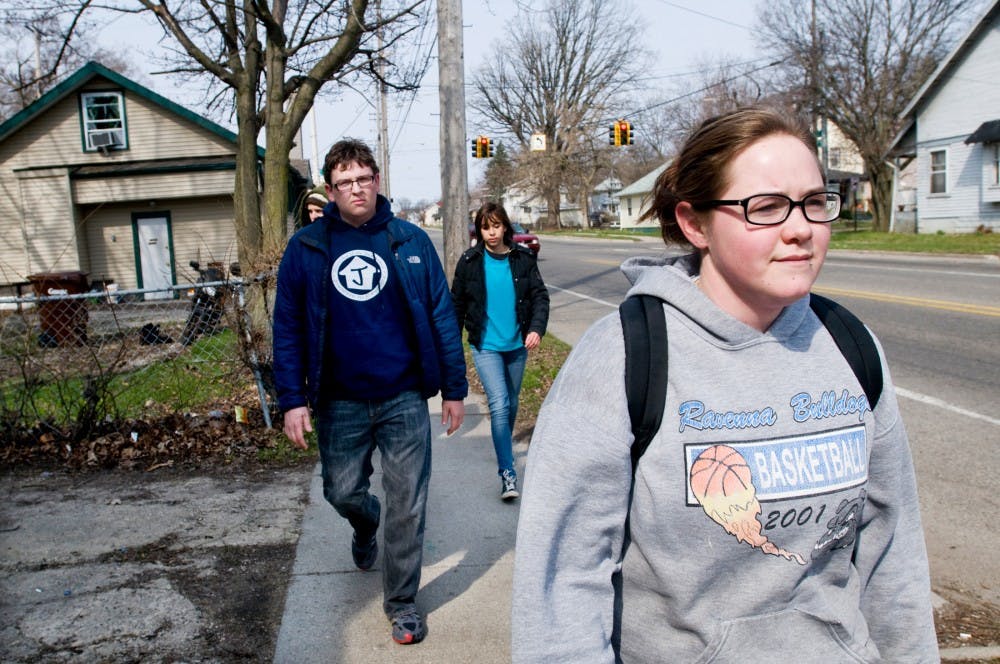
Social work senior Kristine Patterson, far right, leads her “family,” religious studies junior Dan Phillips, center, professional writing junior Caron Creighton, right, and Lansing resident Mitchell Carpenter, as they walk Friday morning on Kalamazoo Street in Lansing.
For Kristine Patterson, homelessness is an issue that is all too real.
“It’s more of a personal thing for me,” Patterson said. “My dad was homeless for a while, and he suffered with alcoholism before passing away from it in 2007.”
The social work senior signed up for MSU’s second annual homelessness simulation with the memory of her father and his battle lingering in the back of her mind.
She said the simulation provided a short glimpse of the struggles her father went through while dealing with his addiction.
“Every homeless person I see, I can see my dad in them,” Patterson said. “It really makes you think.”
Real-life experience
The simulation, hosted by Students for Peace and Justice and Students for Social Work, gave students the opportunity to experience first hand the obstacles and hardships homeless individuals face on a day-to-day basis. On Friday and Saturday, four students, including Patterson, braved the rainy weather in hopes of gaining a new perspective on the issue.
“Homelessness is a huge issue,” Patterson said. “They’re not invisible people, but it is an invisible problem.”
Students were placed into a mock family with specific roles and scenarios throughout the experience.
The roles included two war veterans suffering from post-traumatic stress disorder, alcoholism and substance abuse and two individuals with schizophrenia and bipolar disorder and do not have access to medication.
With only the clothes on their backs, the students were forced to navigate through a series of activities to gain a better understanding of the Lansing area aid system and the resources available to people in need.
“The goal is to spread awareness among individuals as well as gain a new perspective as students,” said Elizabeth White, the president of Students for Social Work. “People don’t realize the loops that homeless people have to jump through to get services.”
Although students know the simulation was not 100 percent realistic — since they know they will have the luxury of sleeping in their own beds the next day — it can be an eye-opening experience, White said.
A place to call home
For Chad Bullard, his wife, Cherri, and two children, Madysen, 5, and Elijiah, 3, the issue of homelessness didn’t disappear overnight.
When Chad Bullard suffered from an injury, temporarily leaving him unable to work, he was laid off from his job in Lansing.
As a result, the Bullard family nearly lost everything they had and were forced to find alternative living options.
“We lost everything — our house, our vehicles. Everything was gone,” Chad Bullard said. “It just goes to show that this can happen to anyone. One day you can have everything, and the next it could be gone.”
After hearing about Haven House, 121 Whitehills Drive, they decided to give it a shot since it was the only shelter in the area that would take in full, two-parent families.
“The main motivation for taking the next step and coming here was our kids — separating our family was not an option,” Chad Bullard said. “They deserve the best life possible, and we’re going to make sure that’s what they get.”
Support student media! Please consider donating to The State News and help fund the future of journalism.
Although facilities, such as Haven House, might not be appealing because of the adverse connotation associated with them, the Bullard’s said the shelter truly was an amazing place.
“You see a negative stigma around homeless shelters,” Cherri Bullard said. “We were scared and nervous at first — it took the worry out.”
Throughout their experience, both Chad and Cherri Bullard said the most important thing they learned was to not get discouraged.
“You have to stay positive,” Chad Bullard said. “If you want something bad enough, you will do everything in your power to make sure it happens.”
As for their future, both parents have jobs and housing lined up and plan to leave Haven House with a completely new outlook on life. When back on their feet, they said they will volunteer to help people who find themselves in similar situations.
“There’s people here to help you work up from the bottom, but you also have to be able to help yourself,” Chad Bullard said. “You just have to take life one day at a time.”
Close to home
Although there are a few standout homeless individuals within the city limits, East Lansing police Capt. Kim Johnson said the overall issue of homelessness is not much of a problem.
“We live in a very giving community,” Johnson said. “Our residents usually don’t mind helping out by donating cans, money or food.”
He said the police usually only respond to calls from residents who show concern for individuals, mostly homeless, trespassing on private property.
“As far as public property goes, they have a right to be there,” Johnson said. “If they’re not disrupting the peace, causing problems or soliciting, we don’t have a problem with them.”
East Lansing Assistant City Manager Marie McKenna said the city’s primary role is to keep residents safe.
“If a homeless person is a danger to the community, we make sure they get the help they need,” she said. “No one elects to be homeless — it’s usually circumstances that are beyond their control. It’s certainly a devastating issue.”
Community assistance
One thing the participants of the simulation realized was how many resources are available within the Lansing area, Patterson said.
“There are so many resources available,” said Dan Phillips, a religious studies junior, who also participated in the event. “You just have to know where to find them.”
Throughout the day, the students made stops at various social service facilities, such as Capital Area Michigan Works, 2110 S. Cedar St., Salvation Army, 3800 W. Saginaw St., Joe & Shirley’s Place, 324 Detroit St., and the Department of Human Services, 5303 S. Cedar St., all in Lansing, to get a feeling of what is offered to the less-fortunate within their very own community.
“There (are) so many avenues in which individuals can go through to find help,” said Barbara Poma, a career adviser at the Capital Area Michigan Works. “You just have to have patience.”
Although many resources are out there, they’re not always easily accessible, she said.
“Every year we turn down anywhere from 1,300-1,800 people,” said Angie Mayeaux, an executive director at Haven House. “It’s very difficult.”
She said donations and volunteers make a huge difference when dealing with these facilities.
“There’s a lot of things you can do to assist people that are in greater need,” Mayeaux said.
“This (simulation) is a great opportunity to raise awareness and help out a good cause.”
Prior to the simulation, participants collected canned goods from residents in Chandler Crossings and then donated them to the MSU Food Bank. They also donated clothes and blankets to the Salvation Army.
“Its a great help,” MSU Student Food Bank Director Nate Smith-Tyge said. “We give directly to students — it’s a great support for the MSU community and students in particular.”
Patterson said she plans to take her life experiences and use them to help others in the future.
“Everybody has a story,” Patterson said. “They’re not just a bum on the street — they had a life once, and they still have a future. It’s up to us to help.”