The initial plan was to move to Scotland.
Actually, John Jeffery’s first plan was to create his own line of alcoholic beverages and sell them through a company in Chicago. Jeffery created the line of drinks but was less successful at starting up a company. He decided to go back to school.
The problem was — where?
“In this country, there is almost no academic training for distilleries,” Jeffery said.
Not wanting to move his family across the Atlantic Ocean for school, Jeffery’s search brought him into contact with Kris Berglund, a professor of forestry and engineering at MSU, home of the only artisan distilling program in the nation. After a series of e-mails, Berglund recruited Jeffery, now a food science graduate student, to work at MSU’s distillery.
Michiganders give $1 billion to the alcohol industry annually. Until 1996, all of the profit left the state. But Michigan’s artisan distillery industry has been growing, in part because of Berglund and MSU.
“This is something we are the best at,” Jeffery said. “There is nothing like this in the county.”
Fruitful beginnings
For Berglund, vodka was the answer.
The question didn’t relate to weekend activities or even intoxication. In 1990, Berglund was looking for a way to diversify Michigan’s economy by finding new uses for agricultural products.
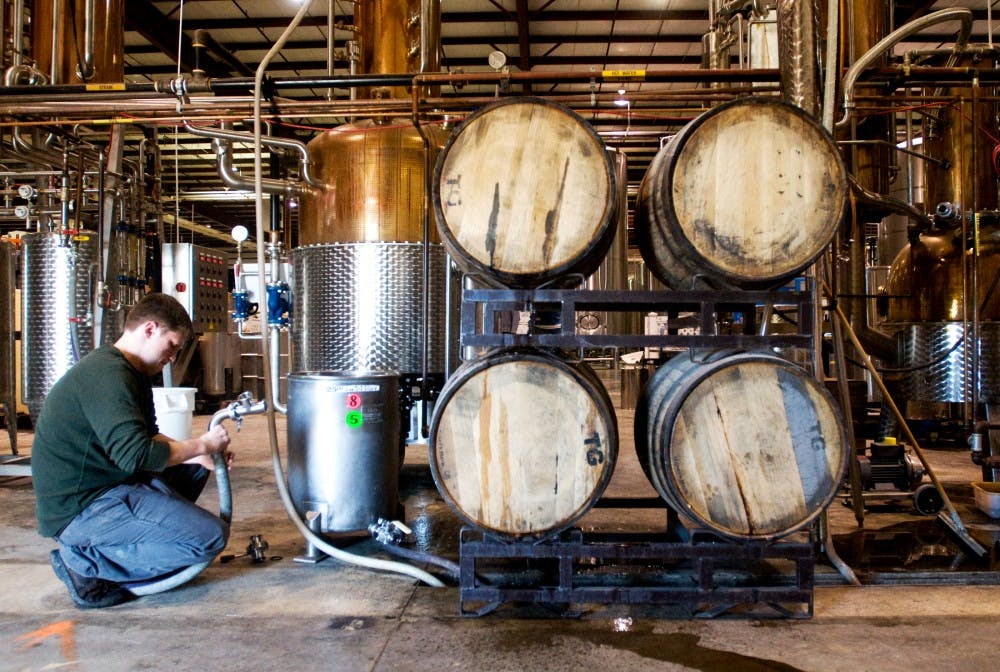
The answer lead to the creation of MSU’s Artisan Distillery Program and a distillery run by MSU. Located near the back of the Michigan Brewing Company in Webberville, Mich., the distillery is a hub of industry-supporting activity. Classes and seminars are held, research is conducted, grants are written and excess spirits for other companies are stored. Two 27-foot cylinders tower above the operation — the largest vodka still in the state. With it, the distillery brings thousands of dollars back to MSU.
Because artisan distillers make smaller, more personalized batches of spirits often with fruits, Michigan, the second most agriculturally diverse state in the country, is an ideal place for the industry. Besides leading the nation in producing blueberries and cherries, Michigan is also one of the top producers of apples and grapes, according to the Michigan Department of Agriculture.
Berglund saw potential.
“I’ve always worked quite a bit in the fermentation field,” Berglund said. “I could see no one else in the whole U.S. was doing much in this area.”
Agriculture won’t be the only Michigan industry to benefit either, said Sharon Kegerreis, an author of several books on the Michigan wine and spirits industry.
“People are looking for way to help Michigan grow in the present as a destination for not only tourism but culinary food and drinks,” Kegerreis said.
The artisan distilleries industry in Michigan took off with a law change in 1996 that reduced the cost of a brandy distilling license from $10,000 to $150. After meeting with the MSU Michigan Agricultural Experiment Station — now MSU AgBioResearch — the Michigan Department of Agriculture and others involved in the industry, Berglund went on a research trip to Germany, bought a still and started the MSU Artisan Distillery Program. In 2008, Berglund, working with Rep. Barb Byrum, D-Onondaga, passed Public Act 218, allowing distilleries, for a $1,000 licensing fee, to create a variety of spirits including vodka. In 2010, legislation passed that made it possible for distilleries to sell their product in their showrooms.
“From the very beginning, the university has been a part of this,” Berglund said. “We have a very central place in this industry.”
Working ‘still’
If an apple a day keeps the doctor a way, a bottle of apple vodka from Uncle John’s Cider Mill should last the month — there are 20-30 pounds of apples in every bottle.
For Mike Beck — president of Uncle John’s Cider Mill and a fifth-generation farmer — hard cider, brandy and vodka made from apples was the next logical step in the orchard’s business.
“It’s something I’ve always had an interest in,” Beck said. “Ever since MSU got their first still, that definitely encouraged me.”
Uncle John’s artisan distillery is one of 14 in the state of Michigan — all were created in the past 16 years, many with help from MSU. But the business has yet to make a tangible impact on the state’s economy. The combined product of all distillers represents less than half of 1 percent of total consumption of spirits in the state, said Don Coe, chairman of the Michigan Commission of Agricultural and Rural Development. Michigan laws regulate the sale and distribution of spirits that make it difficult for smaller ventures to compete against larger, more popular and often cheaper drinks.
Support student media!
Please consider donating to The State News and help fund the future of journalism.
“Michigan distilleries have had real difficult time getting their products into the market,” Coe said. “I sell more spirits in the city of Chicago where we do have a distributor … than we can sell in the state of Michigan.”
Berglund estimates that all 14 distilleries combined can produce about 8,000-12,000 cases of spirits, but this year, the industry will produce only about 5,000 cases. A shame, Jeffery said, because if Michiganders did buy alcohol made in the state, it could benefit everyone.
“If one out of every 10 bottles (bought in the state) were made in the state, close to $100,000 would go straight to the state,” Jeffery said. “It helps business.”
Berglund said when the market matures, he expects it to bring in about 4 percent to 5 percent of the market, or about $40 million dollars.
It will take time for the industry to develop, but between education, research and assistance MSU is offering the industry, many believe distilleries have a future in Michigan.
“This was a prime example of what needs to happen to build a new industry,” Coe said. “MSU was an incubator. … (This is) part of the land grant mission. They did their job.”
Discussion
Share and discuss “Spartan Spirits” on social media.