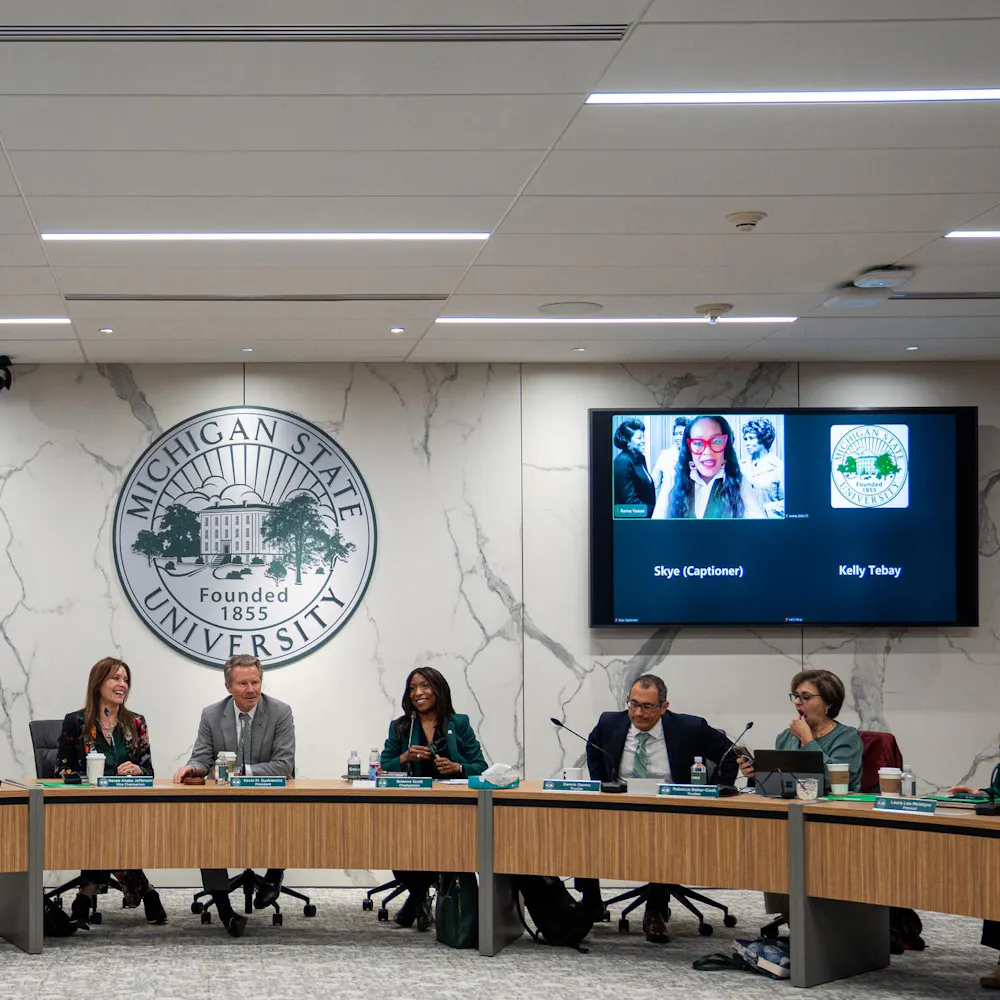
Democrat Mark Meadows and Republican John Knowles debated funding for higher education, affirmative action and ways to improve the relationship between students and permanent residents in East Lansing on Wednesday night.
The candidates are campaigning to fill the 69th District seat in the state House of Representatives, which includes East Lansing, Meridian Township and Williamstown Township.
To give more college students a financial break, Knowles said the Legislature needs to review how it funds higher education.
"It should be one of the top priorities of the Legislature," he said. "Higher education funding is more than a nice thing."
Meadows, 59, was more specific to the crowd of about 45 people at the Union, a mix of students and East Lansing-area residents.
He said the Legislature could make the first two years of college tuition-free, adding that students from low-income families should get more money to attend school.
"We have more students that would qualify for this than any other university in the state," he said, speaking about MSU.
Knowles, 26, a former member of the city's University Student Commission, which gives city officials input from the student community, said he has the experience to bring MSU students and East Lansing residents together.
He graduated from the MSU College of Law in the spring.
"This is an issue I've worked with for a number of years," he said. "As a state representative, I'll be a leader in this area."
Meadows drew on his support as a former mayor and East Lansing City Council member when discussing how to unite the community, saying he helped form the Community Relations Coalition, which works to address conflicts and differences in the city.
Emily Castle, a social relations sophomore and member of the MSU College Democrats, said the debate was rather inoffensive.
"Both were in consensus on a lot of the issues," she said.
Both Knowles and Meadows supported affirmative action, but they differed on when it should be used.
"The time has not come for us to end affirmative action," Meadows said, adding that 200 years of oppression can't be ignored.
Although opposed to the Michigan Civil Rights Initiative, a proposal to ban racial preferences in university admissions and government hiring, Knowles said he thinks affirmative action should be revamped so it is based on socioeconomic class.
"Our society has changed," he said.
"Affirmative action doesn't reflect the realities of the 21st century."
Kris Turner can be reached at turne112@msu.edu.