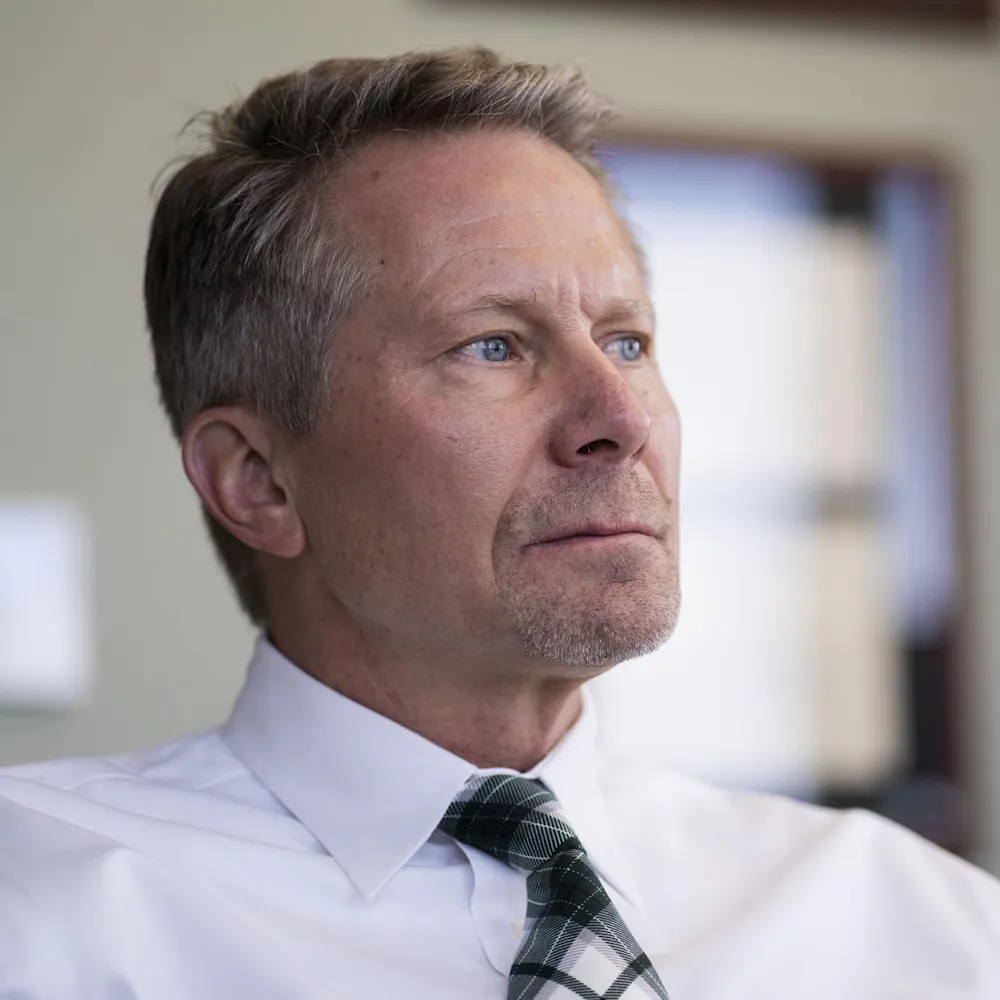
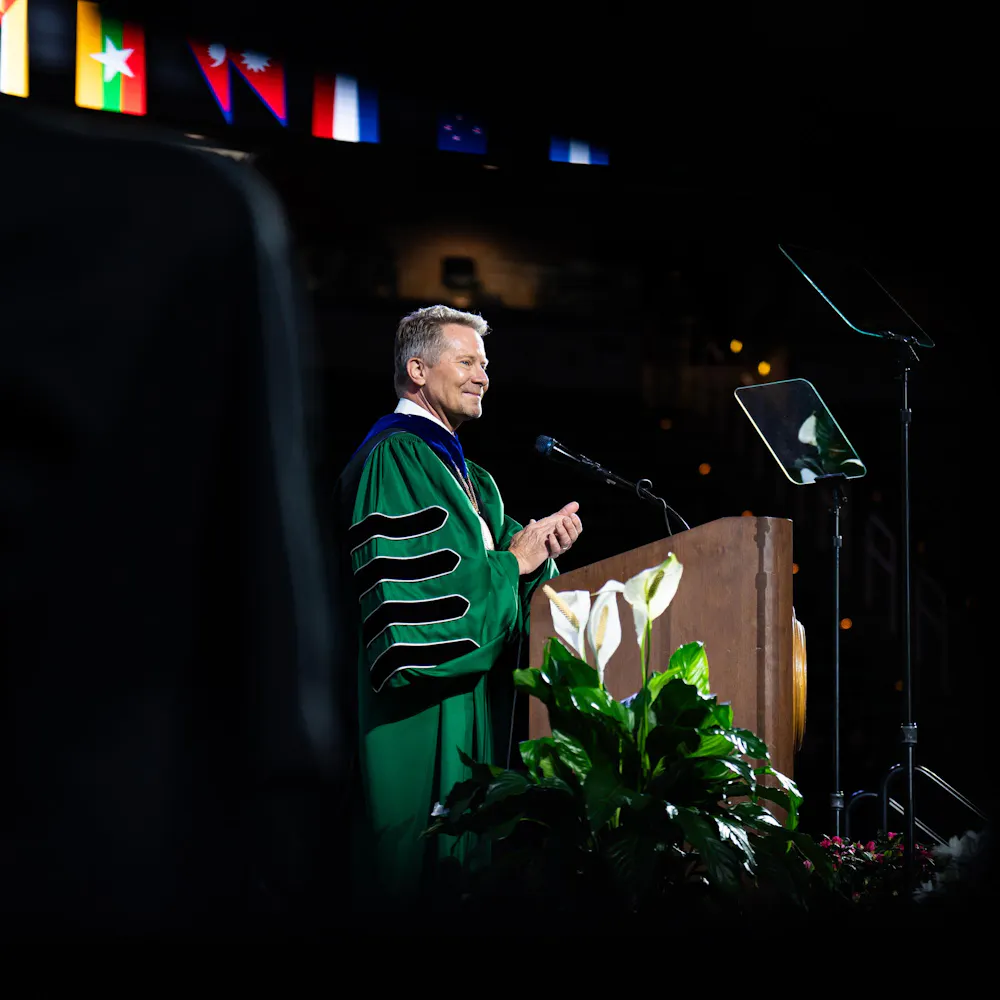
On August 1, Kim Wilcox took over as MSU's provost, a position formerly held by President Lou Anna K. Simon.
Wilcox took time during his first day on campus to sit down with The State News and talk about his job, his impressions of MSU and his vision for the future of the university.
SN: It's your first day on job, what kind of pressure do you feel to make an impact?
Kim Wilcox: Tough question, because impact can mean so many different things. An operation of, I don't know what we got here, 50,000, 60,000 people ... to have an impact on all of those people is a challenge, at least to have an impact that people can see and appreciate. I think there are some things that we can do to have an immediate impact, but I think more importantly there are things we can do today that will set the direction of the university. The departments we take for granted, the programs we take for granted, the stuff that's going on, somebody had to think of and start working on.
That is the greatest impact that we can all have, you included. The kinds of things that the students and the student paper and student senate, ASMSU, the leaders, the kinds of things you shape, the way you shape the view of the students today, steers the university. You know, when I was here in the 60s the big deal (for students) was divesting in South Africa, and we (the administration) divested in South Africa ... I always try and stop to think, it's not about today. It's about 30 years from now, 50 years from now, 80 years from now, that's really where our impacts all play out.
I think everything we do has a long-standing impact. There are things that we can start to do right now ... I think we have a special responsibility to think about how we attend to student needs and interests right now. Basically the (MSU Board of Trustees), the students and the administration are partnering to fund our financial problems. That's a pledge of trust. We've been doing budget cuts, so we can't handle any more. It's not about raising tuition, it's about planning for tuition. We have money from the state, we have money from donors, we have money from tuition, we have money from all kinds of sources, how do we plan so all those dollars make the best university we can? This is what we're trying to create. We have to plan now, all of us together, to create the best university. To make sure that the best students can get here, regardless of how much money they can afford to spend, make sure the best faculty come here to teach them, make sure the very best operation is here. I think there is an opportunity to think a little differently about the administration and the provost's office, how decisions are made, how budget planning, in particular, takes place.
SN: I've seen President Simon walking down Grand River Avenue unharrassed by students. I can't say that Coach Izzo would be so lucky. There doesn't seem to be that kind of connection between students and administrators that there is with our sports icons. Are you going to do anything to try to increase visibility and interaction with students, or is it your job to be more in the shadows?
W: You asked two or three different questions there. It's one thing to increase connection, and that doesn't necessarily imply in or out of the shadows. I don't have the venue that Tom Izzo has in front of millions of people. I suppose I could go to some large classes of 400 or 500 students, but that wouldn't be wise, in terms of educational value, to have me standing around talking. So what I have to do is work with students in the right ways. Certainly ASMSU is a way. Certainly The State News is a way. It's important to me to communicate. But I'm not really interested in being visible for visibility's sake. My goal is to be as connected with the students' needs as I can be, and to help them understand my thinking as best as can be. You can't have a city of 50,000 people and have everybody agree on everything. I've got a role, which has to do with preserving and planning for the future of the university. I'm going to make some people happier than others in that process, because you can't make everybody happy all the time.
And for me to do my job well, I need to have the best understanding of the students' collective needs ... the extent to which it becomes about visibility, that's not the point at all. The president has to be the visible person. She ultimately speaks for the university, and I take my orders from her ... that's more her role than my role, and part of this is about crafting complementary roles.
SN: How do you plan to stay apprised of student issues and student concerns?
W: I plan to meet regularly with student leadership ... I plan on being as responsive to you (The State News) and your callings as I can be. I want to get out. You know, I spent four years working in the Holmes Hall cafeteria, and I always kind of liked dorm food (booming laugh). I hope to get out and have dinner in residence halls, literally be out and about, and get a sense of what people think. If there's other ways, I'm looking for other advice too, if people have ideas.
SN: Do you have anything in place with ASMSU or other student leadership?
W: No. We talked about it during the interview process, but I haven't done anything. It's my first day on the job here, give me a break! (laughs)
SN: You talked a little about ensuring that students get a high quality, unique experience at MSU. What kind of steps are you going to take to make sure that happens?
W: The first step you've already seen. I need to talk to the leadership of the campus ... I need to listen to students to see how much they're feeling like they are really having a unique experience here, and what makes it unique in their eyes. How is it that a student in agriculture feels that his experience has been different here than someone who is in agriculture at a school that doesn't have a (medical) or law school? That means there's got to be some kind of connection, maybe not classes, maybe not courses, but some kind of connection, philosophically or culturally, on the campus that makes it different than it might have been otherwise.
I felt a bit of it when I left. There's a cultural piece that I can't really put my fingers on very well that I think was somewhat unique. And that was before we had a great basketball team!
SN: What is your impression of the culture here at MSU? Is there a prevailing mode of thinking, and how would you describe that?
W: I think there's a great love of life. I mean that in two different ways. This is a great, fun place. When I think back on my days at MSU, we had a lot of fun. I've lived in town two weeks now and I've seen people at check-outs, I've talked to the students who were working at (the MSU Dairy Store) on Sunday night and having fun. And when they're getting off work they're going to go out and have fun. There's a joy of life there.
But also, the enjoyment of life goes to the spirit of the day. You go to some campuses and it's just serious. It's like, 'This is terrible work that we've got to do. My goodness, the weight of the world. We've got problems to solve, oh my goodness.' We know we've got problems to solve here, but it's about enjoying it, there's something positive about the activity ... it's that love of life that I think is a common value. We're not a snob school by any stretch. In fact, we want to have a wide range of students here. I was one of those kids. So there's that kind of commitment to values, that kind of comes from an optimism about the future.
SN: Your job as provost is to be in the somewhat awkward position of mediating between the interests of the administration and the interests of the faculty. How do you walk that line?
W: I always start with reminding myself that at the end of the day, everybody wants the same thing. I don't know a professor at Michigan State University that doesn't want the university to get better, that doesn't want it to be the best university in the country. None of the administration that I've met so far wants anything any different than that. That's important, because that's not true in every environment. There are situations where people have competing values about what the long term goals ought to be. But I don't see that as a problem here at all ... As I said before, some decisions are going to be more appealing to some people than others. I always try to do everything I can to share as much information as possible, as much background information, so that when a decision is made, we all have the same information.
If you start with the notion that everybody wants the same thing, and you share all the information, then the rest of it isn't a problem.
SN: In what respect is your job as provost being a politician?
W: Every administrative job at a university is part politician - the politics of the students, the politics of the faculty, the politics of the different departments. A provost also has to be involved, to a certain extent, in the politics of the state. And that's just not the partisan politics, the legislature, the governor and the rest, but also the business politics.
How much of my job? If you wanted to argue that everything you do with departments and faculty is politics, then you can start to say all of my job.
SN: How much is being a public servant?
W: All of it. I never wanted to be a department chair, but I got kind of roped into it. I didn't think I'd like to do it, but I loved it. I could help all the students in the department, I could help all the professors in the department. t was great. The extent to which we make Michigan State University the best university, that really is attuned to the needs of the state, the needs of the students, we're serving the public. So I always try to think of what this university's going to be like in the year 2050, because that's my goal, really, is to make sure this university's a whole bunch better in 2050 than it is in 2005.
SN: To what extent is your job to be an innovator?
W: My job is more to encourage and facilitate innovation than to innovate. Remember, we've got several thousand of the smartest people in the world here, serving as faculty. That's a lot of smart ideas. If I was going to say, "Hey, I'm in charge, I've got some great ideas, let's go with mine," that wouldn't be a very good use of resources. My job is to help all those people be as innovative as possible and get their ideas implemented.
SN: How involved were you in the budget and setting the tuition?
W: I was primarily an observer. I got here just the beginning of that week ... I had the privilege of sitting in on most all of the meetings and listening to the discussion.
SN: The budget is set now, what is the next big issue on your plate?
W: The budget is set in a way. Budgets continue to evolve through a year. The board approved the budget plan for the year ... we're still much in the throes of budget implementation. ...
We also have identified budget cuts. Most of those are identified, but not quite all of them. There also is a commitment to investment in some areas, particularly academic quality, that we are just beginning to plan on how we are going to invest ... to make sure it has the broadest impact. ...
You have to start (planning) at every level - provost, dean and department. You have to start planning budget for a year from now, and how much we can commit to those kinds of pieces. And that's really where my head is right now. I really want to look closely at how we make those kinds of decisions - who we're going to recruit and how they fit into the entire university.
SN: President Simon sees the mission of the land-grant institution and staying true to the core values of a land-grant as being essential to the future of MSU. What does it mean to be a land-grant institution in the 21st century?
W: For me, a land-grant institution is an institution that's committed to the public. And committed to disseminating information as broadly as possible. And committed to creation of knowledge that serves the broadest population.
We need to be doing not solely rocket science. There's a place for rocket science, but we need to also be worried about knowledge that's going to make a difference in people's lives. And as the world changes from agriculture to industry and now to - it's called a 'knowledge' economy ... we need to think differently about how to apply the same values. For most of us, we're not going to drive a tractor, but we have to understand the world. ...
To be successful, you're going to have to have a knowledge base that's 21st-century oriented, and a set of skills that's 21st-century oriented. What does that mean? My grandfather, great-grandfather, was a homesteader. Things didn't change much in his life in terms of technology. I think he was probably still farming with horses when he died. That's not true now ... you need to have some knowledge of the world, and you also have to have the skills that are flexible enough to relearn the world.
SN: You said one of the values of a land-grant institution is to provide as wide of access as possible. Today, when many Americans have access to a college education, where is there a need to provide access?
W: There's greater access now than there has been any time in the past. But access and appropriate access, I guess, is something I'd like to make a distinction between. I believe there's something fundamentally different about a research university from other universities. The fundamental difference is this is a place where we don't just share knowledge, we create knowledge. We are here believing that we don't have all the answers, and we're trying to find more of them. A student who's at a research university, I think, has a different experience from a student who's at another university. They have it two ways. One, they work with a different kind of faculty. Textbooks are great, but the stuff in a textbook is, at best, three years old. ... Here, when your professors stand up and talk, most of them are talking about today's stuff, not three-year-old stuff. Three years is a long time.
But the other way is this sense of culture where we're all trying to actively pursue a different world. Now, I think there's a role for that kind of access in the state, different from just access to a degree. And I don't mean to diminish a degree, but it's a different kind of access.
I don't think that we are over saturated with positions for students, by any stretch. We have more students who would like to come here than we can accommodate, and that's because of the nature of the experience.
This university is doing everything it can to make sure that wide access maintains. We have, the last several years, grown the enrollment even though the budget went down. That's a pretty strong commitment to access. This budget cycle, the board made sure that those with the least financial support would not be cut out. In fact, we have been successful in making it as accessible or more accessible for those most in need. So we're trying to do the best we can to make sure the able students can come to Michigan State University. We can't serve everybody. ... We're going to make sure the ... students who want to come here are able to come, regardless of their background.
SN: Make a sales pitch for MSU as a long-term investment. What is your vision of this university a decade from now?
W: A decade's probably to short, but I'll try to answer your question. You've heard President Simon. She wants us to be the premier land-grant institution in the country, and in the world. I think that's more than achievable. I think it's going to take a lot of work on all of our parts but I think it's more than achievable. ...
We have to be a university that understands people and cultures in a richer way than we have in the past. ... We have to, all of us, all 50,000 of us, have a better understanding of how people live, how they got to be who they are and what they value, or we can't fulfill our goal of moving information to all of society. That's our land-grant value. All of society doesn't end at the Michigan-Ohio border. It goes around the globe.
We have to be able to marry science and technology with this cultural understanding, and that's a two-edge sword. One, make sure the science and technology activities are the best for the world. That is, are we studying the types of plant diseases that are really going to plague the population of the globe. ... There are tens of thousands of people dying in Africa every day of diseases we cured thirty years ago. That doesn't sound like an internationally engaged university doing its job.
What are the big questions we're going to be facing in the next 50-100 years? Lets just take genetics, for example ... have we answered the question of stem cell research, and the moral rightness of it? Some of us have, some (others) of us have, but they came up with different answers. That's being a real university, wrestling with those questions, and taking leadership.
And so ten years, I'd like to go 40 or 50 now.
I would like to see Michigan State viewed as the place for a whole list of questions. A global environment, human medicine on a global stage, food production, not simply growing crops but producing food in a way that's maintainable and the distribution systems are sustainable, I'm going to leave some people out. ...
This whole cultural piece, cultural, social, ethical piece - we're positioned here, partly because we have great people in those areas but also because of the way they can be informed by the issues around them. It's this notion, I've used the term, the President's used the term before me, of international engagement. That can mean lots of things, but I want to think of a pretty rich use of the term, literally, the world helping to shape what we do, and us shaping, helping the world, in the same way we help the state. ...
We got to engage in the world that's out there.