Stephanie Kwiatkowski
computer science senior
Kwiatkowski was shocked by the Sept. 11 terrorist attacks, but said she refuses to live in fear.
“It gives you a shock into realizing how important family is,” she said. “Things don’t last forever, and anything can happen at any moment, but I don’t think about it every day.”
Kwiatkowski was in one of the engineering labs on Sept. 11 and found out about the attacks from rumors circulating in her classroom.
“There was lots of confusion,” she said. “After class everybody got out of there quickly to go home and learn more.”
Kwiatkowski said the attacks haven’t made a large impact in her life, but they have changed America in terms of new laws and the public’s awareness.
“Also, foreigners have a lot more discrimination,” she said. “But I think day-to-day it hasn’t changed much as to how people are treated.”
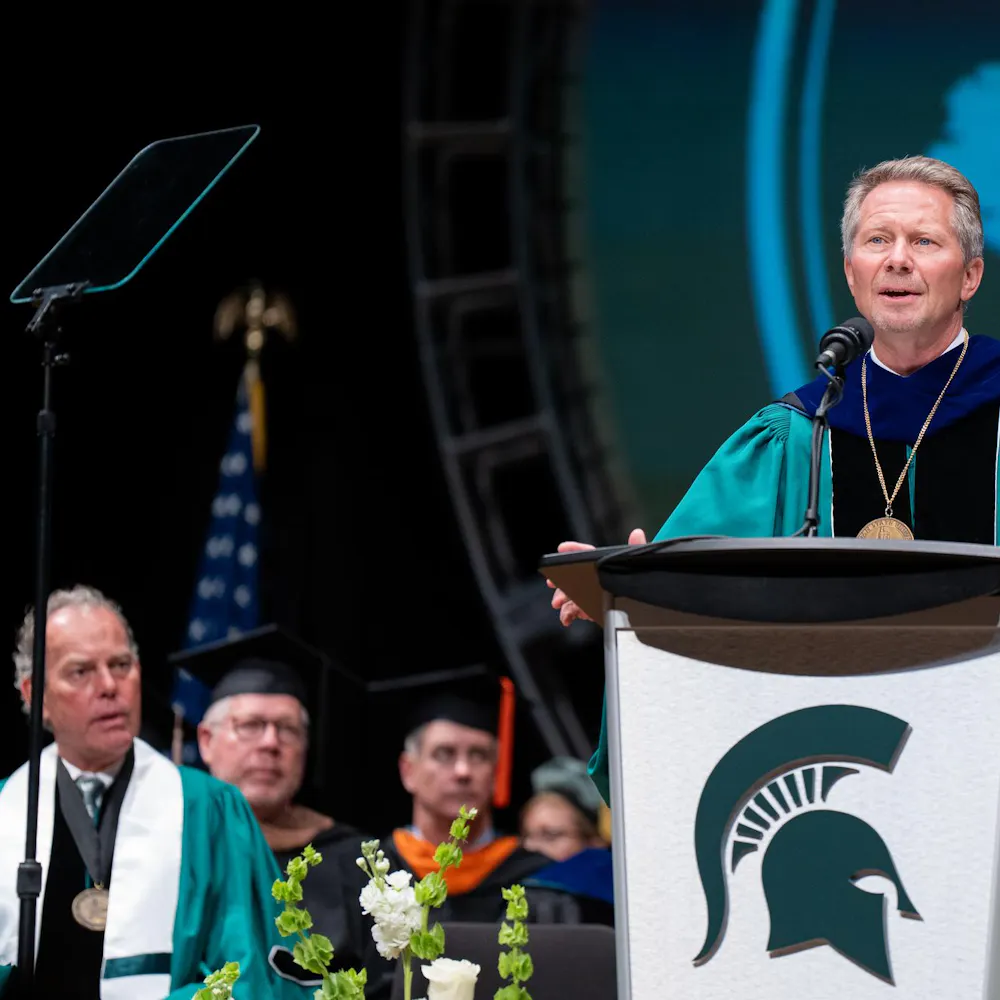
M. Peter McPherson
MSU president
The highest priority on McPherson’s list was making sure students’ concerns and worries were taken care of, despite a national disaster.
“I worried about what students were thinking and feeling,” he said. “At that time it wasn’t at all clear what else might occur. It was a time of great uncertainty.”
McPherson began his day like any other, and like any other, he wasn’t expecting a terrorist attack.
He found out about the attacks after the north tower of the World Trade Center was struck and shortly before a second plane crashed into the south tower.
He didn’t have to think about his next move.
“I came back to campus, and we began to work through the questions about campus,” he said. “It was both very sad about the people and frankly threatening as to what else was going to happen.”
Later in the day McPherson sent an e-mail to students to tell them classes were still going to be held.
“Almost immediately we had to get into the questions of students from Arab countries, from Islamic countries, and make sure they feel secure,” he said. “And that’s something we continue to work on.”
McPherson said, like most people, he followed the news throughout the day and watched the events unfold.
“It was an enormously sad and threatening time,” he said.
Khalida Zaki
sociology professor
“Sept. 11 left me with feelings of questioning my own identity as an American Muslim,” said Zaki, a native of Pakistan.
Zaki explained that the world became a different place in her eyes after that morning.
“I remember seeing the buildings crumble, and I was thinking to myself that what I was seeing was not real,” she said.
The experience has helped Zaki to rethink her role not only as a professor, but as a person. She began by leading discussions in her classes about the disaster and its aftermath.
Zaki furthered her work by presenting a paper on American-Muslim identity issues to the American Sociological Association. She is also working on a research project involving social, cultural and religious issues that will reach it’s completion this fall.
Zaki said she is interested in spreading the discussion and awareness of the consequences of the Sept. 11 terrorist attacks. She emphasizes her feelings of sadness and depression in relation to the attacks and the cultural misunderstandings and misconceptions that suddenly became part of every day conversations.
“America has changed forever - not just for Muslims,” she said.
Dale Swims
physiology sophomore
Swims remembers the difference between Times Square and Ground Zero when he visited New York City last March.
“People were going 110 mph, honking horns and swearing, then you went down (to Ground Zero) and it’s just nothing,” he said.
Swims, a defenseman on the MSU men’s club hockey team, went to New York for the American Collegiate Hockey Association’s national tournament six months after the terrorist attacks. Swims said he and his teammates made a point of visiting where the World Trade Center had stood just months before.
“Walking down the street (in Times Square) you’re shoulder to shoulder with people. Then you get down (to Ground Zero) and it looks like everything’s in black and white - it was two different cities,” he said.
Rick Erickson
University United Methodist minister
Since Sept. 11, 2001, the Rev. Rick Erickson has had a personal resolve. He didn’t want to be imprisoned by the fear that could come from an event like the terrorist attacks.
“I was an early advocate of resumption of a normal life,” said the United Methodist Campus minister.
Erickson, who preaches at University United Methodist, 1120 S. Harrison Ave., said he did not want the attacks to limit his sermons and discussions, but most importantly he said he did not want people to give up their freedom.
Erickson spoke with minority students who thought they were under surveillance because of their skin color. Erickson said one of his Hispanic students thought he could be targeted because he had darker skin.
“Minorities become targets of unfair investigation,” Erickson said. “Targets of the government become people that look different from the Caucasian majority.
Erickson said discrimination is not the price to pay for protection against terrorist attacks, and he is not willing to give into the fear the terrorist wanted to spread.
“While we need to remember the lives of the persons killed,” he said. “We cannot feed the fear.”
Virginia Birringer
education freshman
Talks of celebration turned to moments of sadness for Birringer on Sept. 11, 2001.
Birringer, then a senior in high school, was at her first class meeting to discuss prom and graduation issues.
“Our principal informed us that a plane had crashed into one of the (World Trade Center) towers,” she said. “I still remember him telling us that this would change our country. He sent us back to our classrooms saying how important that building and the people in it were to the United States.”
After Birringer returned to class, she and her classmates did what millions of Americans were doing - she watched television reports on the terrorist attacks.
“Watching the towers fall was like a scene from a movie. It was hard to digest. It seemed so unreal,” Birringer said.
Like many Americans, the events were a shock for Birringer, but she was able to progress through it.
“Together with the other students we talked through our emotions, and it helped,” she said. “I was also able to visit the Pentagon with my aunt to grasp the reality of it.”
Birringer believes that the events of last Sept. 11 can be overcome, but it will take everyone’s cooperation.
“We have lost a bit of freedom since the attacks, but I believe you have to give up some to get some,” Birringer said. “The only way we can have the freedom to leave our homes feeling safe is to give up the freedom to carry weapons. It is impossible to only restrict the freedom of terrorists without somewhat restricting ourselves.”
Lou Anna Simon
MSU provost
Simon was on her way to the airport to return to Michigan after attending an annual conference for provosts when she heard the news of the Sept. 11 terrorist attacks.
“I learned about it on the radio in the car going to the airport,” she said. “But I couldn’t make sense of it because the reports were sketchy.”
When she arrived at the airport, she was still unsure of what had happened - but she saw security guards with machine guns at the doors and police dogs.
“So the safety concern of flying from my perspective wasn’t a concern,” she said. “I was much more concerned through that time of the health and well-being of the MSU community.”
The other provosts, like Simon, were on their cell phones trying to keep in contact with their universities.
“You’re all there in California together trying to get home,” she said. “There’s this sense of being away from home.”
Simon left Sunday to go to this year’s conference, and said she’s wondering how the same event will be different one year later.
“It’ll be interesting to know whether attendance is down,” she said. “I anticipate everything will go well. It’s a very sort of important gathering for all of us, but I’ll be interested to hear people’s reflections.
“There’s no way that it’s not going to be on everyone’s minds.”
Dorothy Gonzales
MSU trustee
A phone call from a friend interrupted Gonzales’ morning routine as she was getting ready for work.
Gonzales said her morning went from normal to terrifying in the matter of a few minutes.
“It’s a day that’ll remain in my mind forever because I have friends and family in New York,” she said. “It was a horrifying scene when you’re watching it on television.”
Gonzales didn’t go into work that day.
“I could help but stay glued to the television set,” she said. “It’s one of those situations that has a long-lasting effect on us.”
All of Gonzales’ eight friends and family in New York were safe and accounted for - a big relief, she said.
“I think I finally went to bed at 3 or 4 o’clock in the morning,” she said. “Not being able to get through to New York was the most frustrating.”
Gonzales said she spent the day with her family, watching television and consoling one another.
“It’s one of those unfortunate incidents that will remain in your mind forever and imbedded in your soul,” she said.
Gabe Cervantes
no-preference sophomore
Cervantes tossed and turned in his Phillips dorm-room bed as his phone relentlessly rang on the morning of Sept. 11, 2001.
Cervantes’ dad had just heard about the terrorist attacks and was on the other end of the phone line, checking on his son’s safety.
“I didn’t know what he was talking about,” Cervantes said. “He was saying, ‘We’re being attacked.’ Then I turned on the TV and it went from there.”
Cervantes said what he saw was surreal.
“It was like it wasn’t happening,” he said. “It was, obviously, but it felt like it was impossible. I thought it was an accident or something.”
Cervantes said in the year since the attacks he’s become more knowledgeable in politics and international relations.
“I have more of an understanding of our relations with the Middle East now,” he said. “I didn’t really know stuff was that deep until this happened.”
Emily Mullen
no-preference freshman
Mullen wasn’t told about the Sept. 11 terrorists attacks until about five hours after it happened.
“I was at a day camp group team-building program with my National Honor Society, and they didn’t tell us about it because it would’ve ruined the activities,” she said. “Then we still had a bus ride home before I got to watch anything on the news.”
Mullen said although the attacks haven’t affected her lifestyle, the events have changed the American government.
“They’re being a lot more careful about what exactly our freedoms are,” she said. “When they say we are free, they have a lot different meanings for it now.”
Bob Pratt
East Lansing fire marshal
Pratt watched the second plane crash into the south tower of the World Trade Center from a television in the Kellogg Center along with about 500 other fire officials.
Pratt, the East Lansing fire marshal, was taking a break from a Michigan fire-inspector meeting on Sept. 11, 2001, when he saw the news.
“We were all kind of dumbstruck,” he said.
Pratt said now when he wears his East Lansing Fire Department apparel in different cities and states he is welcomed by others in his profession.
“It has brought the fire departments closer both in-house and throughout the country,” he said. “Our relationships are more important now, and we’ve all drawn a little bit closer.”
Pratt added that firefighters are not the only group who has become united since the attacks.
“The world really came together and condemned this action,” he said. “We’ve come to realize that we might have taken all of the freedoms we have for granted.”
Pratt said that ordinary citizens have made just as large of an impact on the nation’s recovery as police and firefighters.
“What I try to stay focused on are the every-day heroes,” he said. “The ones who’ve donated their blood and showed up to all of the functions and gave time to the cause.”
Beth Kwapis, psychology junior
“It was just a normal Tuesday, and throughout the entire day it just did not sink in at all,” Kwapis said. “Everything felt disjointed.”
Like many students, Kwapis didn’t learn of the terrorist attacks until her roommate woke her up and told her. Trying to understand why the attacks occurred was her biggest frustration.
“The idea of hurting another person is so revolting to me,” she said. “But I wanted retribution right there. I scared myself the way I thought about it. It’s sad that it takes something like this to wake us up to another culture. For as open-minded as we should be, everything was such a big wake-up call.”