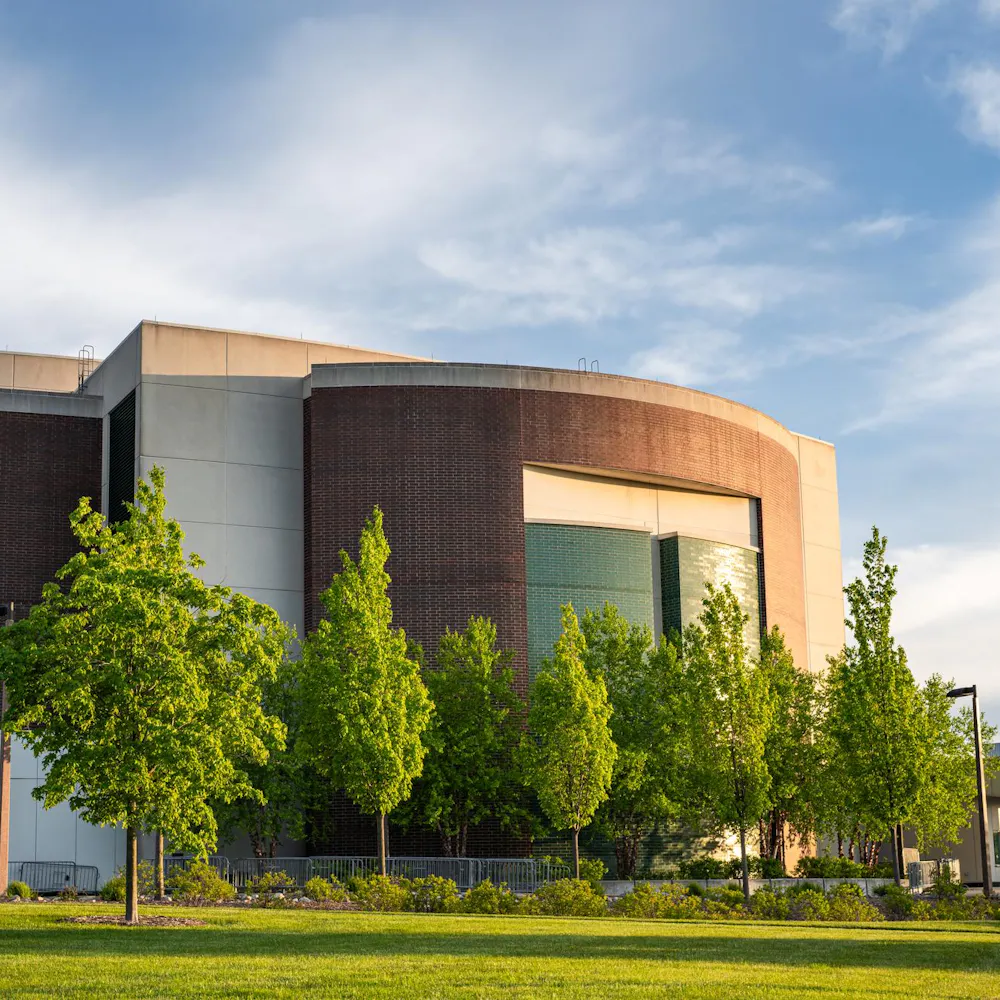
It’s 3:30 p.m. on a Wednesday when music therapy junior Jill Hemmila sits anxiously for her scheduled appointment with her patient, Justin Lyman, in the School of Music’s music therapy clinic.
Hemmila reminisces about when she began working with him in early February.
“I was a complete wreck,” she says with a sigh. “It’s always really nerve-wracking, but I was kind of anxious, too - you’re meeting someone for the first time.
“He’s a little bit nervous, I’m a little bit nervous, too. After I talked to him for 15 seconds, I knew it was going to be great.”
Born with cerebral palsy - a disability caused by brain damage that occurred during, or shortly after birth, causing muscular incoordination and speech disturbances - Justin has been a special needs person since birth, his father Frank Lyman said.
“He wasn’t expected to live when he was born, there were all those factors, but he’s been with us for 24 years,” Frank Lyman said. “(Justin) loves music, it’s been a positive experience - he enjoys coming here and enjoys the staff very much.”
Hemmila spends Wednesday’s sessions with Justin working on processing information and dexterity, since he doesn’t use the right side of his body.
The practice of music therapy serves people of all ages who have special health care, developmental or interpersonal needs such as developmental disabilities, physical impairments, emotional disturbances, autism or sensory impairments.
Treatments focus on areas including perceptual-motor skills, social-emotional needs, learning skills, communication and self-expression, stress reduction as well as music and leisure skills. Clients at MSU pay roughly $40 an hour, with group rates available.
By using a variety of percussion instruments and a piano, Hemmila uses improvisation to improve Justin’s creativity and help his ability to express emotions and feelings.
“It works better if he uses something to fill in the blank,” Hemmila said. “It’s a lot harder for him to make up a complete idea for himself.”
Hemmila said just like any other form of therapy, the activities she does with Justin are similar during each session.
“He is becoming a lot more familiar with the activities we’re doing and he’s more comfortable,” she said. “We end every session with a relaxation activity, we’ll just play music in the background and we’ll take deep breaths or imagine our favorite place.”
As the session begins, Justin arrives donning a big smile with enough time for Hemmila to rehearse a song with him for an upcoming music therapy concert on Friday. His father, who drops Justin off every week, waits outside.
Before the two rehearse the song, they sit beside each other and sing a short tune used to warm up. They play piano together - Hemmila lays the foundation and Justin hits random keys with his left index finger, which gives the song an added solo.
The song ends and they talk about what each has been up to during the past week. Justin’s smile remains present, mirroring Hemmila’s enjoyment as she plays the opening notes of Carol King’s “You’ve Got a Friend.”
Justin nods his head to the rhythm of Hemmila’s piano playing as he belts out the lyrics to the song - one of his favorites. He throws in his own flavor by singing extra improvisational lyrics.
The session ends, and Justin slowly comes out of the enclosed room and meets up with his father, who also wears a smile.
When asked how music makes him feel, Justin simply replies, “Great.”
“I think music has obviously been an important part of his life,” his father said.
“And since he can’t express himself in lots of other ways, music really is his life - it’s his passion and his joy.”
The MSU music therapy curriculum, established in 1944, is the first of its kind in the world designed specifically to train music therapists. And it helps patients such as Justin express themselves and help them overcome their daily obstacles.
A unique and growing practice
Roger Smeltekop, an associate professor of music therapy and a music therapist, said anything done musically can be used as an activity for music therapy treatment.
“Mostly, we emphasize the client being engaged and involved actively with music making if possible,” he said.
“Our clinic represents a unique facility because we’re a university and we’re training students to become music therapists.
The music therapy program has between 35 to 40 music therapy students, along with eight to 10 graduate students. At any given time, the clinic sees between 80 and 100 clients a year. The students are required to work at the clinic at some point during their undergraduate work. The program graduates between 10 and 15 students each year.
“Many people may be having treatment elsewhere, seeking speech therapists, special education or have their own psychotherapists - and so what we’re doing is hopefully coordinating with what they’re doing in other areas,” he said.
Smeltekop also said there are a lot of misconceptions about this practice.
“One is that we go into a room with a patient and put on a record or sing to them and see how they react,” he said. “Second, that we try to make people better musicians. Sometimes that does happen, but that’s not the primary objective of music therapy.
“Our goal is to make them better and more satisfied with their lives and their development.”
Doctoral student Terra Merrill, who works at the music therapy clinic, said the clients come with varied needs and it’s the job of the music therapist and the student to assess the clients’ needs, hopes and desires.
“They bring those needs all together into a cohesive plan of treatment and therapy, and they design methods that are musical activities with a physical behavior - it’s sort of an overarching process.”
Corey Elliott, a music therapy senior, said the methods students use depend on the specific needs of the client.
“We do music listening and we analyze the lyrics of songs, or we do song writing,” she said. “Some clients have physical disabilities, so we work on motor skills, or we might have them playing a drum to work on movement.
“If a client has emotional problems, we do a lot of song writing and expressing through improvisation to play out their emotions.”
Smeltekop said an example of a treatment for a moderate to severe autistic patient includes engaging the person in making his or her own music as a means of communication.
“We might do a lot of singing as a way to get words into their repertoire because, in many cases, an autistic patient will sing words before they’ll speak them,” he said.
Smeltekop said the patient might use all types of music to support any goals such as motor skills or cognitive learning goals.
“Music has that give-and-take quality by waiting and listening,” he said. “There are a number of social ways patients have the opportunity to engage themselves in the music.”
A brief history
Smeltekop said music therapy is a relatively new field.
“We’ve only been around as a formal discipline for about 50 years, and in those 50 years, the employment has really changed,” he said. “Music therapy wasn’t that prominent early on.”
The School of Music’s music therapy curriculum was introduced in 1944 by Dr. Roy Underwood who, at the time, was director of the Division of Fine Arts and head of the Music Department.
Music therapists from around the area were brought in to provide the basic core of instruction, and in 1956 the music department brought in Robert Unkefer, a registered music therapist, to begin teaching specific courses.
In 1969, the on-campus music therapy clinic, located in the basement of the School of Music practice building, was established and became the prototype facility for student music therapist training at many universities throughout the United States.
In 1977, Smeltekop came to expand the teaching practices even further. By 1980, doctoral study in music therapy was offered through the Ph.D. degree in Music Education.
Smeltekop helped develop the program’s association with the MSU Cancer Care and Prevention Group and the opening of Music Therapy Clinical Services in 1993, a program that offers professional music therapy treatment under the auspices of the MSU Community Music School.
An expanding job market
Originally, therapists rarely found substantial jobs. The few who did were employed in institutions for people with mental disabilities or places such as psychiatric hospitals, in-patient hospitals and some general hospitals.
But the craft is rapidly expanding, as many therapists are working in places such as nursing homes, corrections in prisons, special education settings and many more in hospitals.
Smeltekop anticipates the trend will continue to grow, but noted many therapists aren’t working full-time.
“In the past, the standard was, you got a job, work 40 hours a week and that’s it,” he said. “Now that’s not quite so prominent, because a lot of people are working part-time.
“They may have a couple of places they work and they contract their services as private therapists to various places.”
Merrill said the private practitioner scenario is probably the most common avenue music therapists take.
“People choose the work they want to do and they pull from many different sources,” she said. “More and more people are contracting to wellness settings, too.
“I think as society changes and the views of illness and wellness change, our profession is hopefully going to be more like that.”
Behind the times
Although the practice is rapidly expanding in the states, Merrill said music therapy is part of the mainstream in Germany and throughout Europe.
“In some ways, the U.S. is a little behind the times,” she said. “In Germany, for example, music therapists are given the same status as a physician, and I think that has a lot to do with how people view music.
“In the U.S., people are raised in a culture that views music as an entertainment and it’s a mighty leap for them to get over that idea.”
“At least in the United States, there’s been a medical model we’ve been registered into, which has the physician as the authority of medical treatment,” Smeltekop said.
“Anyone who does medically quantifiable treatments were considered understood and also considered legitimate for treatment, but with music therapy, the research has not been able to prove that as quickly as you can with a medication or a surgery.”
Smeltekop said research is helping improve the credibility of the field.
“It’s difficult, because music is an art, not a medicine,” he said. “It’s not something that can easily define and identify what part of the music is doing what to each part of us.
“Music is still an art and it has this holistic quality that you can’t break down into little tiny parts and say ‘I know what this part does,’ - when you put it all together, it’s very complex.”
MSU has conducted research that describes the effects of music therapy participation and how it improves the quality of life.
“Research generally supports that music therapy does help people,” Smeltekop said. “If we go physiologically, there is research which supports that it reduces the amount of medication needed for pain, helps induce relaxation and can help with anxiety.
“Group therapy has been shown to improve social skills from the interventions and it has been shown to be a good pneumonic for people with learning disabilities, as well as a good stimulator of memory.”
Sneaking into public schools
Music therapy senior Julie Kopf hopes to teach music therapy in the public school system. For the past two summers she worked at New Beginnings School in Fairfield and works with a group at Burcham Hills Retirement Center in Lansing. She plans on completing her required six-month clinical training internship this summer at Wildwood School in Schenectady, New York.
“I don’t see it much in public schools yet, but I know it’s growing there, so I hope it reaches public schools to work with behavioral disorders,” she said.
Kopf said in school settings, individualized education programs, which are made up of representatives from different occupational therapies, such as physical therapy and speech therapy, will get together and decide what the best course of action will be for an impaired student.
“Basically, we work with the client for a half hour or an hour and determine whether or not the client responds well, enjoys music or is motivated by music - a lot of factors play in,” said Elliott.
“If (an education program official) feels music therapy is appropriate, then they will refer clients out to a music therapy clinic,” she said.
Smeltekop said since music is pervasive in everyday life, people close to the patients may identify the individuals as being particularly responsive to music even before enrolling them in the program.
“Then they might say that music therapy would be the place to go, and then we do the assessment to see if it seems to be true, and to see what we could to do help that person,” he said.
Merrill said there are some instances in which music therapy can be found ineffective for patients.
“There are some hearing conditions which result in the inability to hear music and comprehend music and accept music as music,” she said. “The other is a condition of the auditory nerve where the sound will literally cause the client pain, so it obviously wouldn’t work with those people.
“Sometimes certain clients’ impairments just fire off the brain in such a way that any kind of sound can be complex series of sound stimulus, where it could actually increase agitation and anxiety behaviors.”
Smetekop said the clinic has terminated work with different clients for various reasons, and that the most important aspect is timing.
“If the timing is wrong for them, or they’re not interested or motivated to change, then maybe it’s just better to stop and try again when the motivation level has increased,” he said. “But it’s a crunching decision, because lack of motivation might be the reason they’d be coming to therapy.
“Since music is an auditory phenomenon, you might logically think it’s useless for deaf people, and to some extent it’s true, but even people who are deaf or with hearing impairments have music therapy.”
Endless possibilities
Elliott said the people who don’t understand music therapy or its effects are the ones who haven’t seen it happen.
“I kind of see it as the only major you can just have fun and get grades for it,” she said. “The more fun you have in your session with your clients, the better your session goes.”
Hemmila said she never knew there was a music therapy field, and originally began doing work with home health care with patients with mental disabilities, before she learned of the program here.
“I would bring music in and see how it affected them,” she said. “I just couldn’t imagine myself doing anything else right now.
“I’m just kind of looking at all of the possibilities, and there are so many. I’m just going to go where it takes me.”
Elliott initially majored in kinesiology but said Smeltekop and Merrill “wouldn’t let me leave (the music therapy program).”
“Once I saw it and got into it, there was no way I wouldn’t do it,” she said. “Part of our requirements are getting together and going over to this community dance and chorus every other Monday night.
“All we do is get together with all of our friends in the major and we sing songs, do dances and eat cookies. On one hand, we’re volunteering by doing services for clients, but it’s also a lot of fun for the therapists.”
Smeltekop said getting to participate in music while helping others is a double benefit of the program.
“One thing you learn to appreciate is that progress is very small and it goes through very subtle stages,” he said. “The progress may be slow, and you have to look really hard sometimes.”
Kopf added that patience is key in music therapy.
“You must have a tolerance for delay, and you carry the knowledge that you’ve done something valuable,” she said. “It’s difficult for some people to see someone struggle at such a simple task like saying a word. But it’s so rewarding to see someone get so excited about completing a task that’s basic to someone like us.
“It puts everything into perspective with what else I’m doing.”
Kopf said the classes she takes help her utilize her skills to help her further at being a music therapist.
“I’ve had classes where I’ve always thought, “Why do I need this stupid class?,’ but I use music theory, ear conditioning and transposing music all the time,” she said. “If we have a patient who sings a song in a key too high, I’ve learned how to bring it down a key myself, to match him.”
Spreading the word
Merrill said that, just like any other professional field, music therapy students have a responsibility to talk about and promote the practice.
“It’s not so that it necessarily comes back to us, but just so that someone is going to hear about music therapy,” she said. “We do lots of presentations and that’s part of the education here - how to make a presentation so students leave here with that skill.”
Smeltekop said the crucial thing about providing music therapy is the funding.
“Who’s paying for it often determines whether it’s gotten or not,” he said. “Many times people have to make a choice, like how an insurance company makes a choice as to what they’re going to fund for a certain person’s treatment.
“More and more, there are people who don’t understand what we can do, so they wouldn’t choose music therapy over, say, speech therapy or occupational therapy - or certainly any other mainstream medical field.”
The fourth annual “Celebrate Abilities” music therapy recital will be held at 4 p.m. Friday at the School of Music Auditorium. The event is free and open to the public. Donations will be accepted to benefit the music therapy program. The American Music Therapy Association for Students at MSU will host a potluck dinner immediately following the recital in 103 Music Practice Building, which also is free and open to the public.
Dan Julian can be reached at julianda@msu.edu.