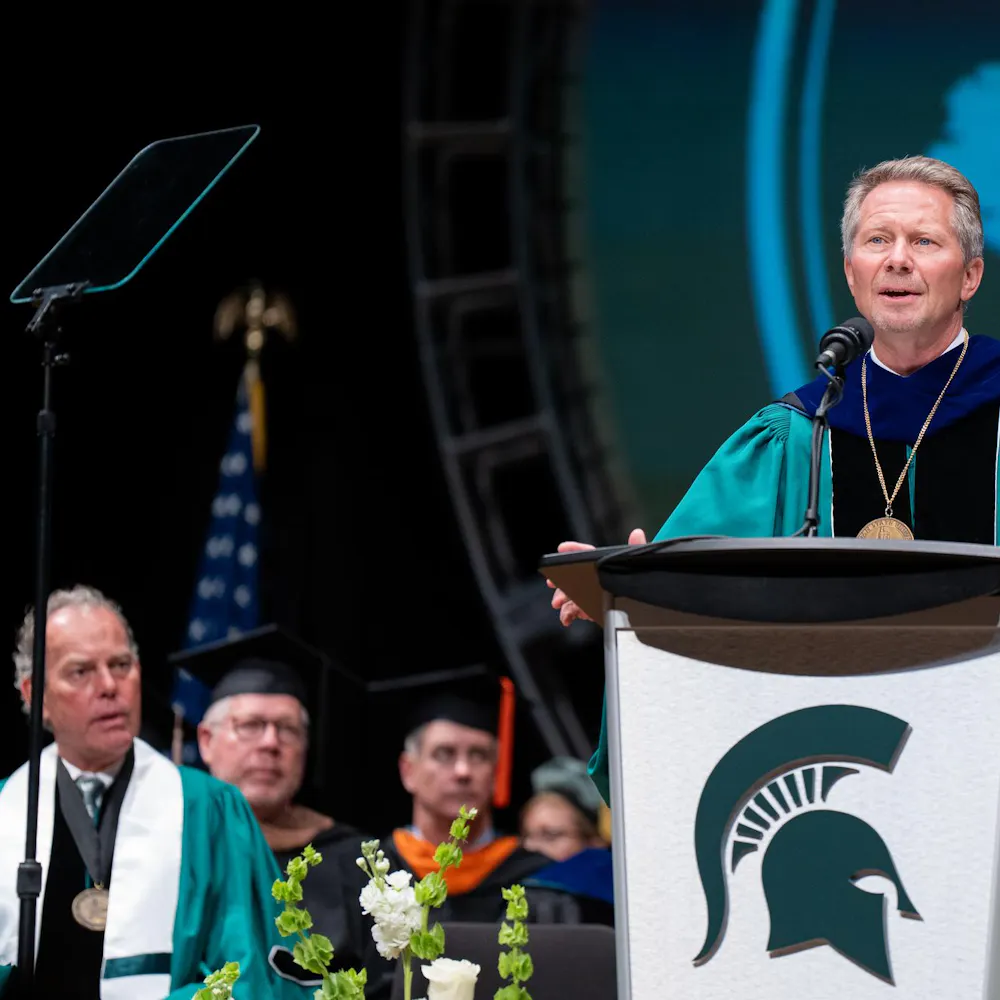
MSU President M. Peter McPherson returned to Lima, Peru two weeks ago to find a changed nation.
McPherson, who lived in Lima during the 1960s as part of the Peace Corps, organizing credit unions and getting involved in the U.S. surplus school feeding program, recently returned from a trip in which he spent observing the nation’s presidential elections.
“Lima has become a very big city with 7 million people,” McPherson said of the city which has some 5 million more people than when he was there. “It’s a very different country. There still remain huge problems like the large number of poor people, but there is no question they have improved.”
McPherson returned from Peru April 9.
Led by former President Jimmy Carter, MSU’s chief executive was selected as a member of a delegation by the National Democratic Institute and the Carter Center. The 35-member international committee was designed to ensure the people of Peru would be able to exercise their right to choose their own government.
“The country had a president over the last ten years who accomplished a great deal,” McPherson said. “But in the end he tried to control the political process in a way that was really harmful to the country.”
The nation’s former president, Alberto Fujimoro, fled to Japan in November in the midst of election fraud allegations and other scandals.
And the recent elections have U.S.-trained economist Alejandro Toledo preparing for a May run-off election with former President Alan Garcia.
An election held several months ago was unfair due to “subsequent disclosures of bribery and other forms of corruption,” McPherson said.
Enter the delegation.
While in Peru, McPherson said the committee was placed in the three main areas of the country: The coast, the Andes and a jungle to the Andes’ east
“All of these areas are very different and seem like practically different countries,” McPherson said.
McPherson and Carter, who have had many meetings in the past to discuss developing countries’ needs, stayed in Lima. McPherson said he and Carter went to various voting sites on Election Day to monitor the process. The next morning, they put together reports from throughout the country.
“From the reports, it was best determined that the election was fair and open,” McPherson said. “I must say the real credit for the election working so well, however, has to go to the people of the election who were demanding the fairness.”
McPherson’s background as an administrator of the Agency for International Development in the 1980s led to what he called a “comfortable, interesting relationship” between himself and Carter.
“It was certainly nice to be with Carter,” he said. “I think he did an extraordinary job.”
The Associated Press contributed to this report.
Rachel Wright can be reached at wrightr9@msu.edu.