For nearly eight years, MSU President M. Peter McPherson has been on one wild roller coaster ride.
The university’s 39th president has been in the front seat as MSU flew to new fund-raising heights - raising a record $121.3 million last year - and plummeted to new lows. Through two riots and sometimes tumultuous relations with students and faculty, McPherson looks barely different than when he started Oct. 1, 1993. The university he inherited that day, though, continues to change.
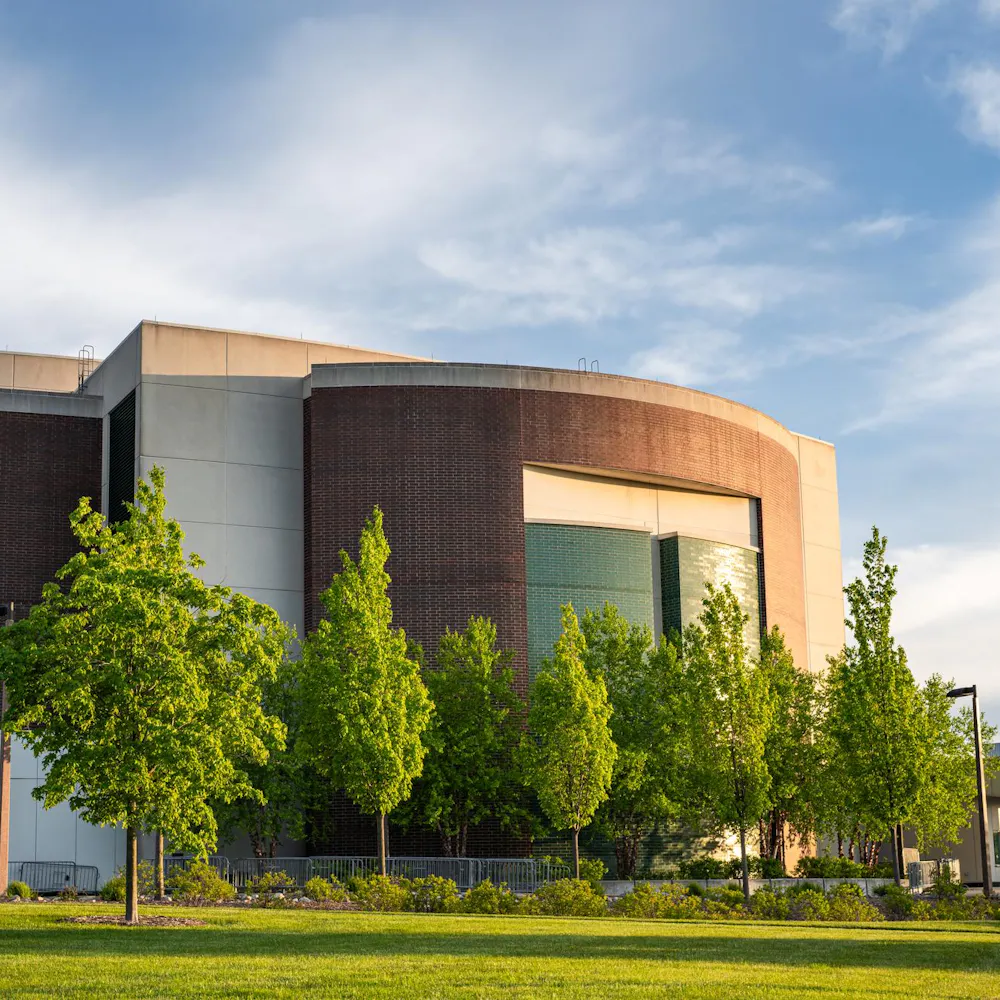
The president, currently the most senior chief executive in the Big Ten, will discuss the university’s outlook and vision at 2:30 p.m. today in his eighth annual State of the University Address in the Wharton Center’s Pasant Theatre.
An unlikely choice
Trustee Dee Cook admits the path to a McPherson presidency was not exactly a charted one.
“We interviewed him and we didn’t put him in our final group,” said Cook, who was part of the presidential search committee to replace John DiBaggio in 1993. “When the group did not come to a consensus, we went back to the drawing board. When we looked at all the applications, it was clear he had an awful lot to offer.”
What McPherson had was an extensive background in financial and economic matters, certainly not the traditional candidate with academic background, Cook admits. But whatever the reason, the board latched on to McPherson and hired him the same day his résumé was moved from the trash bin to the finalists’ heap.
“When I got here, I said I didn’t know a lot about the university,” said McPherson, who hadn’t been to campus since graduating in 1963.
The Lowell, Mich., native spent several years in Lima, Peru, organizing credit unions and getting involved in the U.S. surplus school feeding program as part of the Peace Corps. “It was a letdown when I got home and life was normal again,”he recalls.
He later moved to Washington, D.C., only returning to Michigan for family visits. But McPherson, who doesn’t have a doctorate - long-considered a key asset to become a university president - brought MSU an extensive background as a U.S. Treasury Department deputy secretary, administrator of the Agency for International Development and a more recent stint as group executive vice president of a San Francisco-based bank.
“He turned out to be an excellent selection, and we broke the mold,” Cook said. “He came from the Bank of America, and one very important thing a president must do is guide the economic future of the university.”
MSU’s economic future
Soon after he took office, McPherson instituted the university’s tuition guarantee - which pledges tuition rates won’t increase faster than inflation - and began lobbying the state for more money.
Fred Poston, vice president for finance and operations, said the president has been key in the recent pledge from the Legislature to close a funding gap between MSU, the University of Michigan and Wayne State University. MSU gets the least state aid per student of the three research universities.
“Closing the gap is a big issue, and some people relate it to the fairness and funding between individual universities - and they are wrong,” he said. “It”s the fairness and funding between individual students.”
Even McPherson’s rival on the funding gap issue, state Sen. John Schwarz, R-Battle Creek, acknowledged the president’s pledge to higher education.
Schwarz, chairman of the Senate Appropriations subcommittee on higher education, blocked several past efforts to equalize funding between the universities. He said the funding gap between Wayne State, U-M and MSU is open to interpretation.
“That aside, the one thing that McPherson and I have always agreed on is that we want to make a quality college education available to every Michigan man and woman that wants one,” Schwarz said.
Beyond landing more money per student, McPherson also played a key role in bringing other state money to the university. Research grants, in particular, have been increasing, leading to more focus on campus’ science efforts.
Since 1995, McPherson said, money for research has increased nearly 35 percent, not including a $40.4 million grant as part of the Life Sciences Corridor, an initiative to put a sharper focus on the research efforts of MSU, U-M, Wayne State and the Van Andel Institute in Grand Rapids.
And MSU chief academics supervisor, Provost Lou Anna Simon, credits McPherson’s fiscal enthusiasm with much of the university’s progress on other fronts.
“The president has a clear passion for excellence, and that passion for excellence is coupled with fiscal conservatism,” she said.
A pet project, MSU’s study abroad program, has also grown into the largest in the nation under McPherson’s watchful eye and encouragement.
The president, who hopes by 2006 that 40 percent of undergraduates at MSU have a study abroad experience before they graduate, is expected to address the effects of globalization on education in his address today.
“First of all, he has used the influence of his visibility to make the study abroad initiative a high priority of the university,” said Edward Ingraham, acting director of study abroad. “And then he has been willing to put resources behind that, allowing both faculty and student participation to increase.”
But with the good also comes the bad.
The challenges
On Oct. 21, 1998, McPherson opened the Multicultural Center in the basement of the Union.
Although minority student groups lobbied for the center, many representatives pointed out its inadequacies: It’s not large enough for events, there’s no bathroom and it’s tucked away in the basement, rather than in a highly traveled area.
While recognized as a step in the right direction, the center leaves many more strides to be taken, Black Student Alliance President Tonya Upthegrove said.
“In terms of really addressing the issues that face the minority students, at times he may be lacking,” the communication senior.
Employees, too, have felt rubbed the wrong way by the president.
Barbara Reeves, president of the Clerical-Technical Union of MSU criticizes McPherson for the treatment of university employees. CTU is the university’s largest union.
Reeves said union members are not mentioned in speeches, and their rightful salaries and benefits are restricted to support initiatives that benefit faculty and students.
“It’s no secret that I feel as though we are second-class citizens at this university,” Reeves said. “All of the staff feel there is constant mention and apparent concern for faculty and students. But the staff are the stepchildren that get left out and can’t go to the ball.”
And when an estimated 10,000 stormed East Lansing on March 27, 1999, following the men’s basketball team’s Final Four loss to Duke, MSU was faced with a large blemish on relations with its city neighbor.
Despite the challenges, East Lansing City Manager Ted Staton said relations between the city and university, although always cordial, have never been better.
The president has appeared at many community meetings and has sent out literature to area residents about the university, he said.
“We’ve had areas around which we’ve disagreed and I suspect that will always be the case,” said Staton, who has managed city operations for six years.
But despite the controversies of the past eight years, university spokesman Terry Denbow, said MSU has managed to overcome many of them.
“I don’t think there would be any massive critics of our reputation or changes in reputation negatively at all,” said Denbow, who during the good times and the bad is responsible for dealing with the media.
McPherson gives much of his credit to his eight teammates who sit on the Board of Trustees.
“There are always issues,” he said. “The questions are if you can settle these issues reasonably and can you really get things done. The way the board has worked has been key.”
And in return for his service, Poston can say MSU has been able to give something back to the 1963 graduate who rose to the presidency in a most unusual way.
“On the humorous side, we got him to quit smoking cigars when he came,” Poston recalls.
“He just chews on them now.”
Staff writer Jeremy W. Steele contributed to this report.