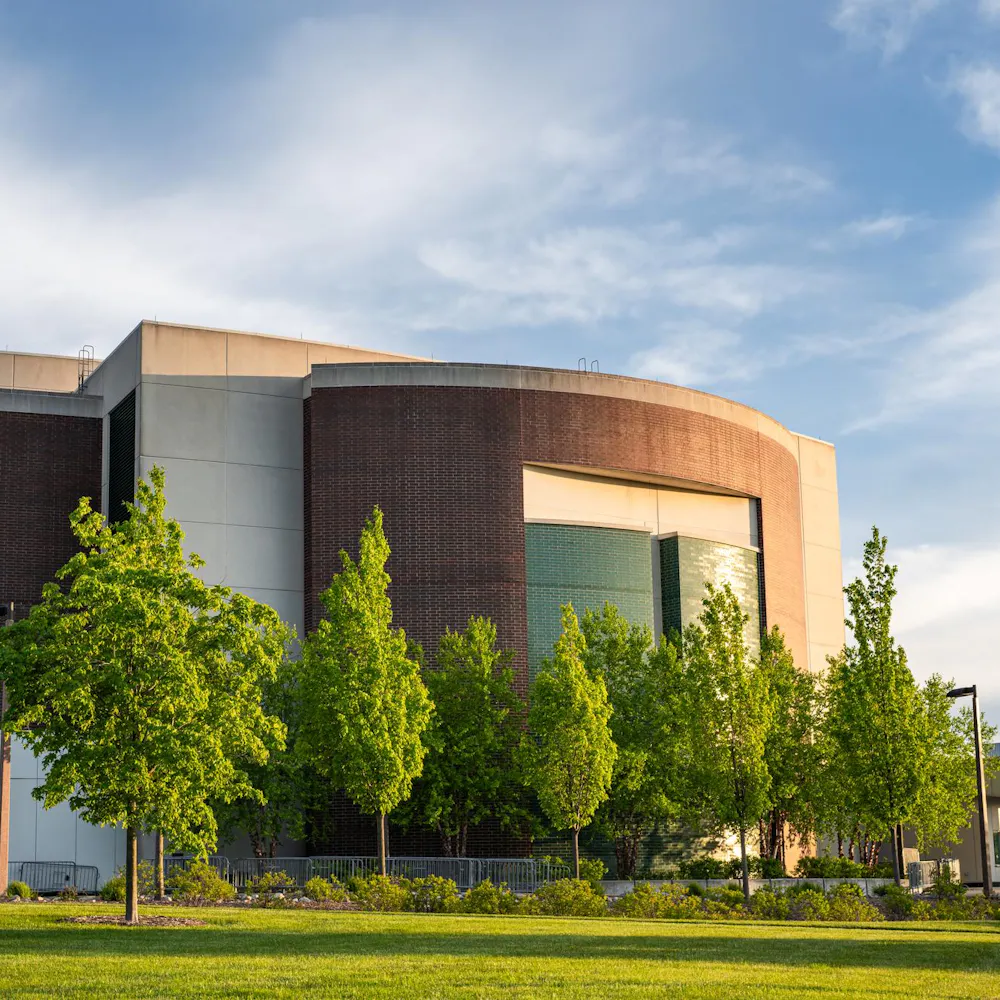
The people who work there affectionately refer to room 40 in the basement of Giltner Hall as the “cherry pit.”
There Patrick Oriel, a professor in the Department of Microbiology and Molecular Genetics, has been working on a way to create a new product - tart cherry-based alcoholic cider.
The project is sponsored by the state of Michigan under Project GREEEN, or Generating Research and Extension to meet Economic and Environmental Needs. The premise behind the project is to find new uses for Michigan’s agricultural goods.
Robin Millsap, university spokesperson for the project, said the program includes a number of experiments underway on campus.
“Project GREEEN is the state’s planned agricultural initiative,” Millsap said. “What happened was the Plant Commodity Organization asked MSU to help in becoming more proactive in helping plant agricultural producers and processors stay economically viable.”
Michigan leads the country in tart cherry production with 200 to 250 million pounds per year, about 70 percent of the nation’s average.
Millsap said because there is such a diversity of crops in Michigan, the university wanted to help find different ways to help use these products and keep their producers in business.
“Our project consists of developing Michigan tart cherries, which are in abundance mainly in northern Michigan, into a new kind of alcoholic or ‘hard’ cider,” Oriel said. “Hard cider is made from a particular type of apples which have high amounts of a certain chemical.
“Right now the U.S. is going through a real hard cider revival, it’s the fastest growing beverage in the country right now. What we noticed was the chemistry of tart cherries was very similar to that of the apples used to make hard cider. But the question was: Could we actually make hard cider out of cherries?”
Oriel and his research assistant, Peggy Wolf, have been grappling with the microbiology and chemistry of this project for nearly two years.
“To do this is different from making beer or wine where you just need yeast,” Oriel said. “Cider needs both yeast and bacteria, and that’s where the microbiology comes in.”
Certain chemicals needed to be added, tested and even removed from the compound before the experiment could progress beyond its infancy, Oriel said.
“What we’ve done is isolate a bacteria called oenococcus,” Oriel said. “Basically this bacteria reacts with another already in the cherries and makes it taste less tart and therefore much better.
“It’s like running a little farm, it’s kind of fun.”
Oriel said his assistant has been doing a great job in getting the bacteria controlled.
“I really enjoy the science of it,” Wolf said. “To a non-scientist it may sound silly, but I can’t wait to see the data. I always want the machine to hurry up so I can see what happened.”
Wolf graduated from MSU with a degree in biochemistry in 1974.
“Here I am, I ended up picking a job squeezing cherries,” she said. “But what we are trying to do is find an organism born and bred to do this to cherries, instead of borrowing ones that are commonly used with grapes (to make wine), and we did that.”
At this point, the process of making the cider has been developed. All that remains is to add in carbonation and scale the formula to make larger amounts of the cider at a time, Oriel said.
“Right now I’m the chief taste tester, and it tastes pretty good to me,” he said. “It certainly tastes better now than it did in the beginning.”
They are hoping to finish the project within the next six months.
“To complete our original objective of creating new uses for Michigan agricultural products my next challenge will be finding a company to produce and commercialize the cider,” Oriel said.
“To our knowledge we are the only ones crazy enough to try and create a cherry cider.”
Cutler Fetherston can be reached at fetherst@msu.edu.