36 All-Americans. 13 Big Ten Champions. Two NCAA Champions.
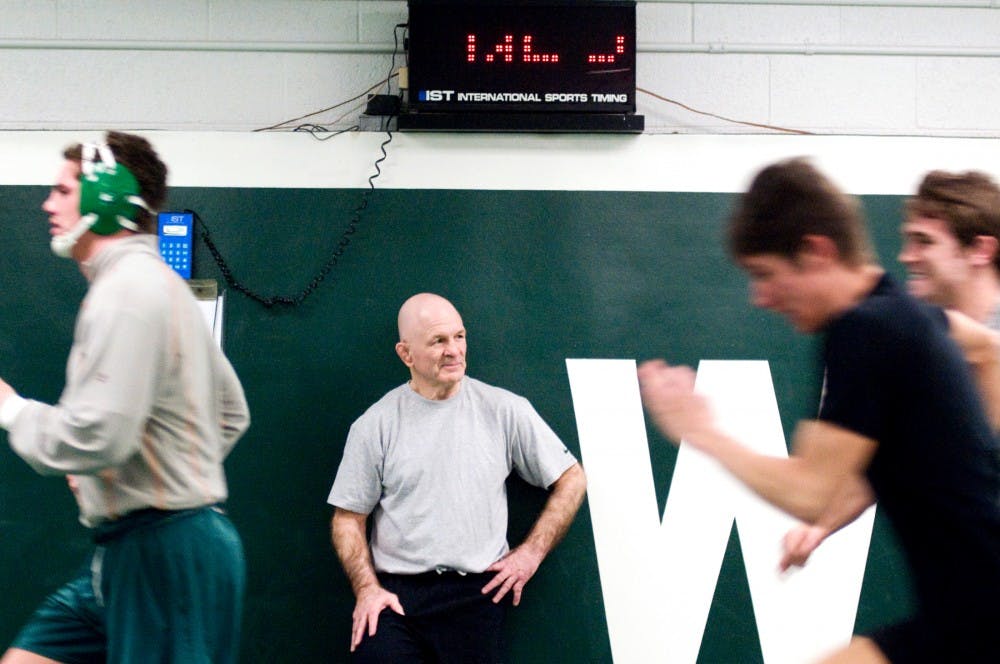
During his 20 years as the MSU wrestling head coach, Tom Minkel certainly has left his mark on the program — including his 151 dual wins as a Spartan, making him the third winningest coach in program history. He has a chance to add to those numbers this weekend with five wrestlers at the NCAA Championships in Philadelphia.
Beginning his career at MSU in 1991 — transitioning from being Central Michigan University’s head coach for two years and assistant coach for 12 — Minkel has taken his ample wrestling and coaching experience and rebuilt MSU wrestling to become a nationally-recognized and respected program amidst the always-tough Big Ten competition.
The strong relationships Minkel builds with his athletes, coaching staff and MSU peers also has earned him respect within the athletic community and sets him apart from other wrestling coaches.
“He cares about student-athletes like no coach I’ve ever seen,” MSU Athletics Director Mark Hollis said. “I think if you look at what (Minkel) does with youth wrestling and you look at what he does with the resources available at Michigan State, he’s done a phenomenal job.”
Getting started
Before Minkel became one of the most successful and respected coaches in wrestling, he was a three-time All-American at Central Michigan, and, with a 35-0-1 record in dual meets, is the only wrestler in school history to remain undefeated.
When most men end their competing careers after college, Minkel continued to wrestle until he was 34. He established himself as a world-class wrestler, competing for seven U.S. teams internationally.
At 149 pounds, Minkel’s resume expanded when he became a three-time U.S. National Greco-Roman Champion and a member of the 1980 Olympic team competing in Moscow. With so much experience, he remains grounded and applies knowledge toward the success of Spartan wrestling.
“I wrestled in a lot of different countries, and I wrestled for a lot of different coaches,” he said. “Not only U.S. coaches, but in training camps in places like the Soviet Union, I got to see a lot of different styles of coaching and a lot of different methods and a lot of different technical ways of preparing a team.”
Developing his style
In addition to coaching at his alma mater, Minkel gained a wealth of experience heading three U.S. World Teams, two U.S. National Teams and one U.S. Pan-American Team.
However, the peak of his international coaching career came when he was named the head coach of the U.S. Olympic Team for the 1992 games in Barcelona, Spain. While with the Olympic team, Minkel helped the American wrestlers develop, which included traveling and competing across the world in preparation for the games.
“You learn a lot from watching other countries compete,” he said. “All the Soviet countries are very good in wrestling, and you learn a lot from a technical standpoint from their training and their skills.”
Minkel led the U.S. team to a bronze medal in the Greco-Roman competition, which is the highest finish ever by an American team.
“Often times, the Olympics is your last competition … (and) you want to have the best performance at the Olympic games,” he said. “Helping and guiding athletes to get to that stage in their career is a lot of fun and very challenging.”
Minkel said the atmosphere of the games was amazing when he was wrestling and coaching, and he can’t put a price on everything he took away from Moscow and Barcelona.
“It was really challenging but very rewarding,” he said. “The level of competition is just extraordinary. Then, of course, the stage that you’re on at the Olympics — the entire world is watching and participating.”
Leading the way in East Lansing
Because of his experience, Minkel has been able to apply his in-depth understanding of the sport to the Spartans, earning him respect from his athletes and coaching staff.
“He’s very knowledgeable because he’s coached the Olympic and World Teams and so forth, and he transfers that knowledge into a good practice plan that gets these guys ready to compete,” assistant coach Roger Chandler said.
“He breaks down technique really well, so the guys can learn it.”
To succeed in this sport, Minkel said he realized early on that everything comes back down to the basic fundamentals, a concept that anchors his coaching methods for the Spartans. He focuses on the origins of wrestling, and, with fundamentals, has the Spartans branch off of that into the technical skills.
Support student media!
Please consider donating to The State News and help fund the future of journalism.
“He always tells us, ‘You can learn a move, but do you actually understand the base of wrestling?’ … because if you don’t understand the basics, then the moves are just moves, and you can’t really incorporate them into your wrestling,” junior 174-pounder Curran Jacobs said.
“His wisdom and experience in wrestling take us a long way in understanding the technique and the discipline.”
The road to a National Championship
In his 20 years at MSU, Minkel has coached two Spartans to national championships: Kelvin Jackson at 118 pounds in 1995 and Franklin Gomez at 133 pounds in 2009.
The championships shed light on the potential of what Hollis called the “Rocky” of wrestling programs because of how far Minkel has brought it over the years. Minkel said he’s had so many extraordinary athletes and takes pride in what they accomplish.
“The thing I enjoy most about the job is the impact you have on young men at an age when they often need guidance, and sometimes it’s hard,” Minkel said. “But the impact you have on their lives through the sport of wrestling is enormously rewarding.”
“When it’s all said and done, you’ve helped them become better people — more disciplined, more secure, more competent.”
Discussion
Share and discuss “Minkel leaving a mark on MSU wrestling” on social media.